Solid-waste director reports heavy spring activity; commission asks staff to analyze tipping-fee alternative
May 09, 2026 | Reno County, Kansas
This article was created by AI summarizing key points discussed. AI makes mistakes, so for full details and context, please refer to the video of the full meeting. Please report any errors so we can fix them. Report an error »
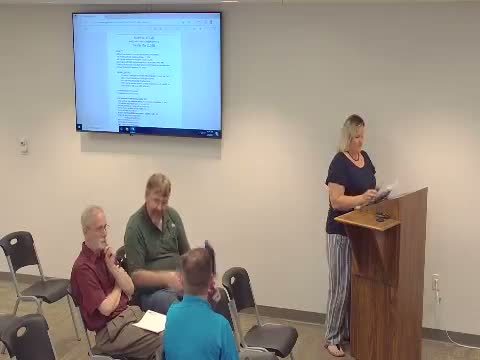
Reno County's solid-waste manager presented an annual update May 10, reporting heavy spring activity, ongoing site work and a recent disaster response for the Cottonwood Complex Fire.
Megan, who manages solid-waste operations, said Cell 8 (a 10.2-acre cell) will go to bid this summer for fall construction and that in-house dirt work has saved the county significant excavation costs. She noted two scales now provide more precise in/out weights, which affects monthly KDHE tonnage fees. For the Cottonwood fire debris, KDHE waived a usual $1-per-ton fee for disaster loads in March and April. The landfill recorded 721.65 tons of municipal solid waste in March and 633.56 tons in April; brush tonnages were also reported.
Megan summarized recycling and reuse work: the county collected over 66,422 pounds of household hazardous waste in 2021, recycled thousands of gallons of used oil and recovered nearly 943 tons of metal. The county also works with the Hutch Correctional Facility on mattress recycling (about 77.88 tons).
A lengthy discussion followed on whether the county should shift funding away from a tax-associated user fee toward a door-gate tipping-fee model or other fee adjustments. Some commissioners worried a tipping fee could increase illegal dumping or unfairly burden rural residents; others asked staff to model residential tipping-fee scenarios and the effect on commercial haulers. The commission directed staff to prepare pro forma analyses and bring a study-session report, with a preliminary review by September and a final analysis by year-end.
Next steps: staff will produce revenue and usage comparisons (residential vs. commercial), run pro forma models for tipping-fee options, and return with recommendations for a study session and budget planning.
Megan, who manages solid-waste operations, said Cell 8 (a 10.2-acre cell) will go to bid this summer for fall construction and that in-house dirt work has saved the county significant excavation costs. She noted two scales now provide more precise in/out weights, which affects monthly KDHE tonnage fees. For the Cottonwood fire debris, KDHE waived a usual $1-per-ton fee for disaster loads in March and April. The landfill recorded 721.65 tons of municipal solid waste in March and 633.56 tons in April; brush tonnages were also reported.
Megan summarized recycling and reuse work: the county collected over 66,422 pounds of household hazardous waste in 2021, recycled thousands of gallons of used oil and recovered nearly 943 tons of metal. The county also works with the Hutch Correctional Facility on mattress recycling (about 77.88 tons).
A lengthy discussion followed on whether the county should shift funding away from a tax-associated user fee toward a door-gate tipping-fee model or other fee adjustments. Some commissioners worried a tipping fee could increase illegal dumping or unfairly burden rural residents; others asked staff to model residential tipping-fee scenarios and the effect on commercial haulers. The commission directed staff to prepare pro forma analyses and bring a study-session report, with a preliminary review by September and a final analysis by year-end.
Next steps: staff will produce revenue and usage comparisons (residential vs. commercial), run pro forma models for tipping-fee options, and return with recommendations for a study session and budget planning.
Don't Miss a Word: See the Full Meeting!
Go beyond summaries. Unlock every video, transcript, and key insight with a Founder Membership.
✓
Get instant access to full meeting videos
✓
Search and clip any phrase from complete transcripts
✓
Receive AI-powered summaries & custom alerts
✓
Enjoy lifetime, unrestricted access to government data
30-day money-back guarantee
