Fort Myers Beach narrows strategic-plan priorities after bridge-loan briefing
May 08, 2026 | Fort Myers Beach, Lee County, Florida
This article was created by AI summarizing key points discussed. AI makes mistakes, so for full details and context, please refer to the video of the full meeting. Please report any errors so we can fix them. Report an error »
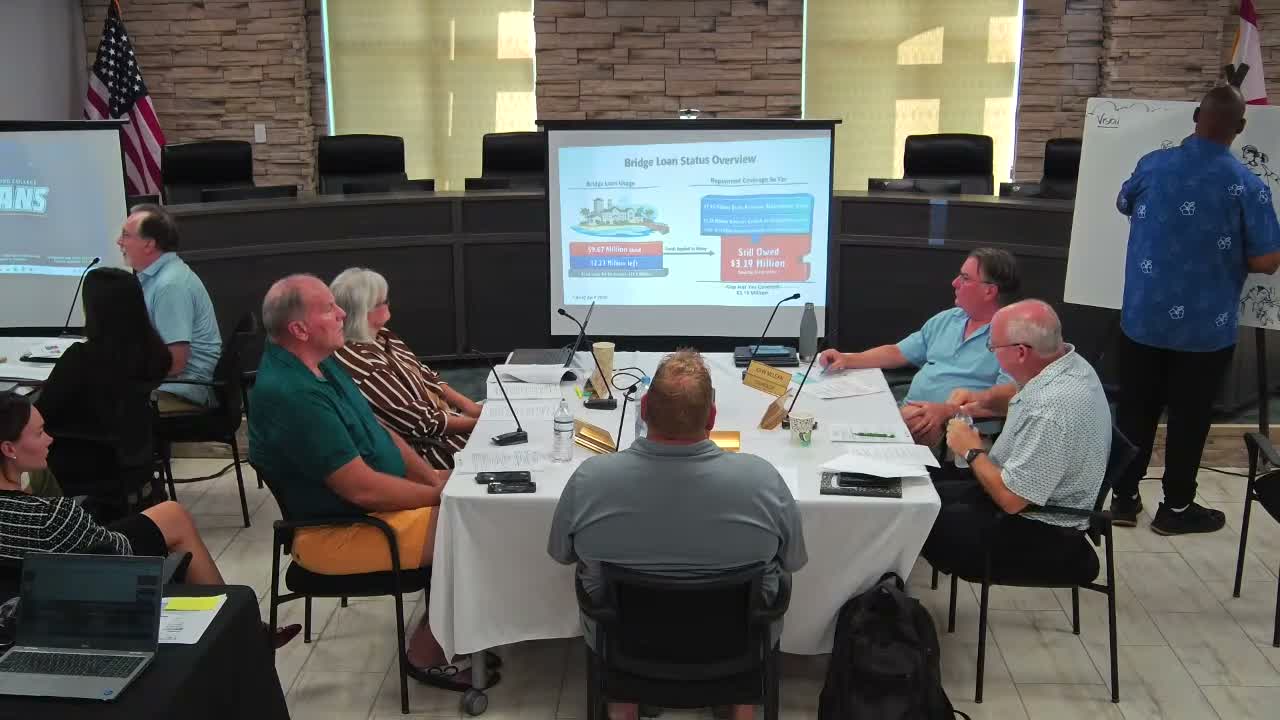
Councilors in Fort Myers Beach spent a May strategic-planning workshop narrowing a draft strategic plan down to a short list of priority goals and hearing how a multi-million-dollar bridge loan constrains near-term capital work.
"We only have 1 agenda item, and that's the strategic plan," the meeting chair said as the session opened. Consultants from the Florida Institute of Government at the University of South Florida and partners from SPC Collaborative Labs guided councilors through the plan's vision, five strategic themes and a rating exercise intended to identify three to five top priorities for the town.
Consultant Angela Crist presented the plan's recommended vision and mission language, calling the town "an eclectic coastal community where you can safely live, prosper, and enjoy island life." She outlined five themes— infrastructure; leadership; communications; community and economic development; and environmental sustainability—backed by 18 goals and 44 objectives.
Finance director Joe Wanzick told the council the town has borrowed $11,900,000 on a bridge loan and has used about $9,700,000 of that, leaving roughly $2,200,000 still available. He said the town is holding $7,600,000 in state revenue-replacement grant funds and about $1,200,000 of accumulated interest in a fund earmarked for loan repayment, and estimated the town still needs about $3,200,000 to fully repay the loan. "Until we repay the bridge loan, we are subject to the restrictions of the bridge loan," Wanzick said, explaining the municipal limits on using non-ad-valorem general-fund revenues for new programs or capital projects.
Deputy town manager Tracy Kohler demonstrated the Achieve It performance dashboard the town will use to report implementation progress. "Right now, it looks rather underwhelming because we don't have any progress to put into the pie graph," she said, explaining the tool will show not started/started/on-track/off-track status for each objective and be visible to the public once implementation begins.
Facilitators then led councilors through a ratings exercise using a three-criteria rubric—community impact, financial sustainability and doability—entered on phones or tablets. In the infrastructure round, the software surfaced "well-lit and safe town-owned streets and sidewalks" and "robust, adaptable infrastructure systems" as the top two infrastructure goals; councilors debated the result because the lighting project is widely advanced and doability weighting tended to favor near-complete tasks. Community Services Director Jeff Haughey said lighting gaps remain in some parks and downtown areas and emphasized the broader safety objectives tied to the lighting goal.
Across the five themes, councilors generally advanced the following priorities into the final poll: A1 (robust infrastructure systems), D1 (economic growth through business development and year-round tourism), C1 (transparent, responsive, inclusive communications) and E2 (storm-surge mitigation/emergency-management planning). Councilors discussed whether shoreline protection and storm mitigation should be treated primarily as distinct environmental goals or as part of emergency-management planning; staff noted many of those actions appear as objectives under multiple goals.
Consultants and staff outlined next steps: the team will present a draft final report for internal review on June 1 and deliver the report to the council on June 15; implementation (phase 3) and action-item definition are set to begin in July, and Achieve It will be used to track metrics and report progress to the public.
The council adjourned at 11:11 a.m. without taking formal ordinance or resolution votes during the session. The draft final strategic plan and the Achieve It dashboard will be the next public opportunities to see the plan's final language and the town's implementation commitments.
"We only have 1 agenda item, and that's the strategic plan," the meeting chair said as the session opened. Consultants from the Florida Institute of Government at the University of South Florida and partners from SPC Collaborative Labs guided councilors through the plan's vision, five strategic themes and a rating exercise intended to identify three to five top priorities for the town.
Consultant Angela Crist presented the plan's recommended vision and mission language, calling the town "an eclectic coastal community where you can safely live, prosper, and enjoy island life." She outlined five themes— infrastructure; leadership; communications; community and economic development; and environmental sustainability—backed by 18 goals and 44 objectives.
Finance director Joe Wanzick told the council the town has borrowed $11,900,000 on a bridge loan and has used about $9,700,000 of that, leaving roughly $2,200,000 still available. He said the town is holding $7,600,000 in state revenue-replacement grant funds and about $1,200,000 of accumulated interest in a fund earmarked for loan repayment, and estimated the town still needs about $3,200,000 to fully repay the loan. "Until we repay the bridge loan, we are subject to the restrictions of the bridge loan," Wanzick said, explaining the municipal limits on using non-ad-valorem general-fund revenues for new programs or capital projects.
Deputy town manager Tracy Kohler demonstrated the Achieve It performance dashboard the town will use to report implementation progress. "Right now, it looks rather underwhelming because we don't have any progress to put into the pie graph," she said, explaining the tool will show not started/started/on-track/off-track status for each objective and be visible to the public once implementation begins.
Facilitators then led councilors through a ratings exercise using a three-criteria rubric—community impact, financial sustainability and doability—entered on phones or tablets. In the infrastructure round, the software surfaced "well-lit and safe town-owned streets and sidewalks" and "robust, adaptable infrastructure systems" as the top two infrastructure goals; councilors debated the result because the lighting project is widely advanced and doability weighting tended to favor near-complete tasks. Community Services Director Jeff Haughey said lighting gaps remain in some parks and downtown areas and emphasized the broader safety objectives tied to the lighting goal.
Across the five themes, councilors generally advanced the following priorities into the final poll: A1 (robust infrastructure systems), D1 (economic growth through business development and year-round tourism), C1 (transparent, responsive, inclusive communications) and E2 (storm-surge mitigation/emergency-management planning). Councilors discussed whether shoreline protection and storm mitigation should be treated primarily as distinct environmental goals or as part of emergency-management planning; staff noted many of those actions appear as objectives under multiple goals.
Consultants and staff outlined next steps: the team will present a draft final report for internal review on June 1 and deliver the report to the council on June 15; implementation (phase 3) and action-item definition are set to begin in July, and Achieve It will be used to track metrics and report progress to the public.
The council adjourned at 11:11 a.m. without taking formal ordinance or resolution votes during the session. The draft final strategic plan and the Achieve It dashboard will be the next public opportunities to see the plan's final language and the town's implementation commitments.
Don't Miss a Word: See the Full Meeting!
Go beyond summaries. Unlock every video, transcript, and key insight with a Founder Membership.
✓
Get instant access to full meeting videos
✓
Search and clip any phrase from complete transcripts
✓
Receive AI-powered summaries & custom alerts
✓
Enjoy lifetime, unrestricted access to government data
30-day money-back guarantee
