Cache County councilors debate airport authority’s governance, budget and asset transfer in draft revisions
May 08, 2026 | Cache County School District, School Boards, Utah
This article was created by AI summarizing key points discussed. AI makes mistakes, so for full details and context, please refer to the video of the full meeting. Please report any errors so we can fix them. Report an error »
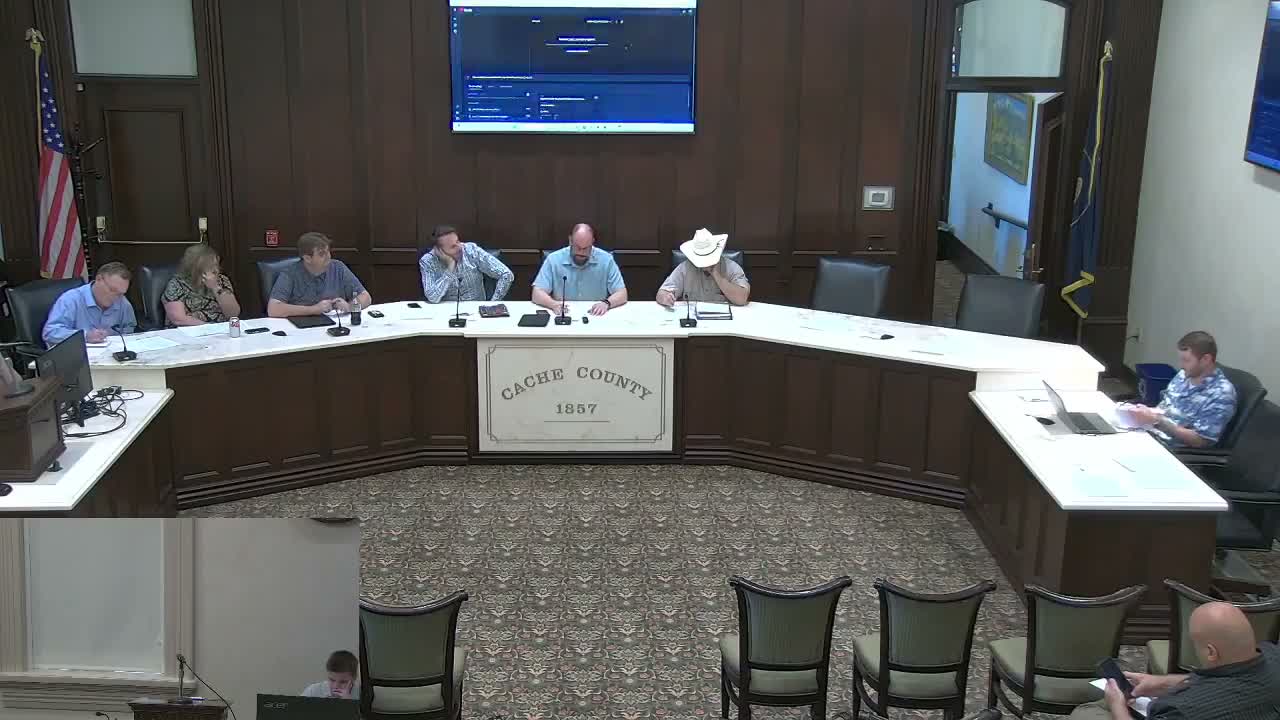
At a Cache County Council workshop, members spent most of the meeting parsing revisions to a proposed interlocal agreement to form the Logan-Cache Airport Authority, focusing on how long the authority would remain in place, who appoints and sits on its boards, when the county must approve debt and budgets, and how assets and employees would transfer.
The discussion opened with a request that staff walk the committee through a framework drafted from prior conversations. A senior committee member (Committee member S3) said the draft improperly allowed Logan City a mechanism to trigger termination, arguing the county should avoid language that gives the city “those kind of rights.” S3 proposed shortening the minimum term language so the agreement “remains in for a minimum of 10 years” and striking the remainder that could allow unilateral termination.
The county’s legislative staff (Staff member S2) described much of the contested language as consistent with the existing interlocal agreement and noted several provisions track state law. On one contested point about liabilities, S2 said, “it’s an interlocal entity, so its debts are separate from the county’s debts.” That prompted members to discuss whether explicitly repeating statutory positions was necessary or whether the agreement should simply refer to what is required by Utah law.
Board appointments and composition drew sustained debate. Multiple council voices agreed they did not want to lock appointments to particular offices or geographic labels (for example, “one from the North, one from the South”), and S3 urged allowing the County Council flexibility to select the elected officials best qualified to serve rather than prescribing named offices. The group discussed inclusion of other elected county officers (auditor, clerk) and whether terms on the authority should match the officers’ terms in office.
Members also debated how the sponsor board and the airport authority board should interact. S2 proposed the sponsor board receive the airport authority’s budget request and exercise “advise and consent” on the authority’s adopted budget rather than micromanaging day-to-day spending. Several members said historically Logan City and Cache County each contributed about $100,000 (cited in discussion as the roughly $200,000 a year figure) and that any taxpayer money provided should be tied to specified uses and conditions.
Control over debt and long-term obligations was a major sticking point. Committee member S3 pushed for clear limits so the county would review and approve long-term debt, proposing a 24-month threshold as a starting point for definition; other members suggested longer windows or different characterizations of short-, intermediate- and long-term obligations. The council emphasized balancing the airport authority’s need to operate independently with the county’s interest in not being automatically bound to multi-year financial commitments without oversight.
Independence, staffing and finance structure were also discussed. Staff member S2 confirmed employees who move to the authority would become authority employees rather than county employees and that the authority’s finances would be run through an enterprise fund; S2 said any county resources used by the authority would need reimbursement. The council noted the authority should be able to hire outside legal counsel and obtain insurance and benefits separately from the county.
On assets, members asked for a clear mechanism for transferring vehicles, equipment and some land, recommending a bill of sale or memorandum to track title changes and to state minimal value where appropriate so transfers are auditable.
Councilors asked staff to generalize some of the agreement’s specifics and leave detailed operational rules to the authority’s future bylaws. Staff was directed to prepare a revised draft incorporating the council’s directions — removing restrictive geographic appointment language, clarifying budget and debt thresholds, specifying the county’s discretion on appropriations, and adding clear language on assets and staffing — and bring it back at a scheduled workshop. The meeting adjourned after members agreed to set a follow-up session to review the revised text.
The council set a near-term workshop to continue deliberations and directed staff to share a redraft before the next meeting so the committee can finalize a version for transmission to Logan City.
The discussion opened with a request that staff walk the committee through a framework drafted from prior conversations. A senior committee member (Committee member S3) said the draft improperly allowed Logan City a mechanism to trigger termination, arguing the county should avoid language that gives the city “those kind of rights.” S3 proposed shortening the minimum term language so the agreement “remains in for a minimum of 10 years” and striking the remainder that could allow unilateral termination.
The county’s legislative staff (Staff member S2) described much of the contested language as consistent with the existing interlocal agreement and noted several provisions track state law. On one contested point about liabilities, S2 said, “it’s an interlocal entity, so its debts are separate from the county’s debts.” That prompted members to discuss whether explicitly repeating statutory positions was necessary or whether the agreement should simply refer to what is required by Utah law.
Board appointments and composition drew sustained debate. Multiple council voices agreed they did not want to lock appointments to particular offices or geographic labels (for example, “one from the North, one from the South”), and S3 urged allowing the County Council flexibility to select the elected officials best qualified to serve rather than prescribing named offices. The group discussed inclusion of other elected county officers (auditor, clerk) and whether terms on the authority should match the officers’ terms in office.
Members also debated how the sponsor board and the airport authority board should interact. S2 proposed the sponsor board receive the airport authority’s budget request and exercise “advise and consent” on the authority’s adopted budget rather than micromanaging day-to-day spending. Several members said historically Logan City and Cache County each contributed about $100,000 (cited in discussion as the roughly $200,000 a year figure) and that any taxpayer money provided should be tied to specified uses and conditions.
Control over debt and long-term obligations was a major sticking point. Committee member S3 pushed for clear limits so the county would review and approve long-term debt, proposing a 24-month threshold as a starting point for definition; other members suggested longer windows or different characterizations of short-, intermediate- and long-term obligations. The council emphasized balancing the airport authority’s need to operate independently with the county’s interest in not being automatically bound to multi-year financial commitments without oversight.
Independence, staffing and finance structure were also discussed. Staff member S2 confirmed employees who move to the authority would become authority employees rather than county employees and that the authority’s finances would be run through an enterprise fund; S2 said any county resources used by the authority would need reimbursement. The council noted the authority should be able to hire outside legal counsel and obtain insurance and benefits separately from the county.
On assets, members asked for a clear mechanism for transferring vehicles, equipment and some land, recommending a bill of sale or memorandum to track title changes and to state minimal value where appropriate so transfers are auditable.
Councilors asked staff to generalize some of the agreement’s specifics and leave detailed operational rules to the authority’s future bylaws. Staff was directed to prepare a revised draft incorporating the council’s directions — removing restrictive geographic appointment language, clarifying budget and debt thresholds, specifying the county’s discretion on appropriations, and adding clear language on assets and staffing — and bring it back at a scheduled workshop. The meeting adjourned after members agreed to set a follow-up session to review the revised text.
The council set a near-term workshop to continue deliberations and directed staff to share a redraft before the next meeting so the committee can finalize a version for transmission to Logan City.
Don't Miss a Word: See the Full Meeting!
Go beyond summaries. Unlock every video, transcript, and key insight with a Founder Membership.
✓
Get instant access to full meeting videos
✓
Search and clip any phrase from complete transcripts
✓
Receive AI-powered summaries & custom alerts
✓
Enjoy lifetime, unrestricted access to government data
30-day money-back guarantee
