Keizer diversity committee removes proposed letter after debate over scope and process
May 08, 2026 | Keizer, Marion County, Oregon
This article was created by AI summarizing key points discussed. AI makes mistakes, so for full details and context, please refer to the video of the full meeting. Please report any errors so we can fix them. Report an error »
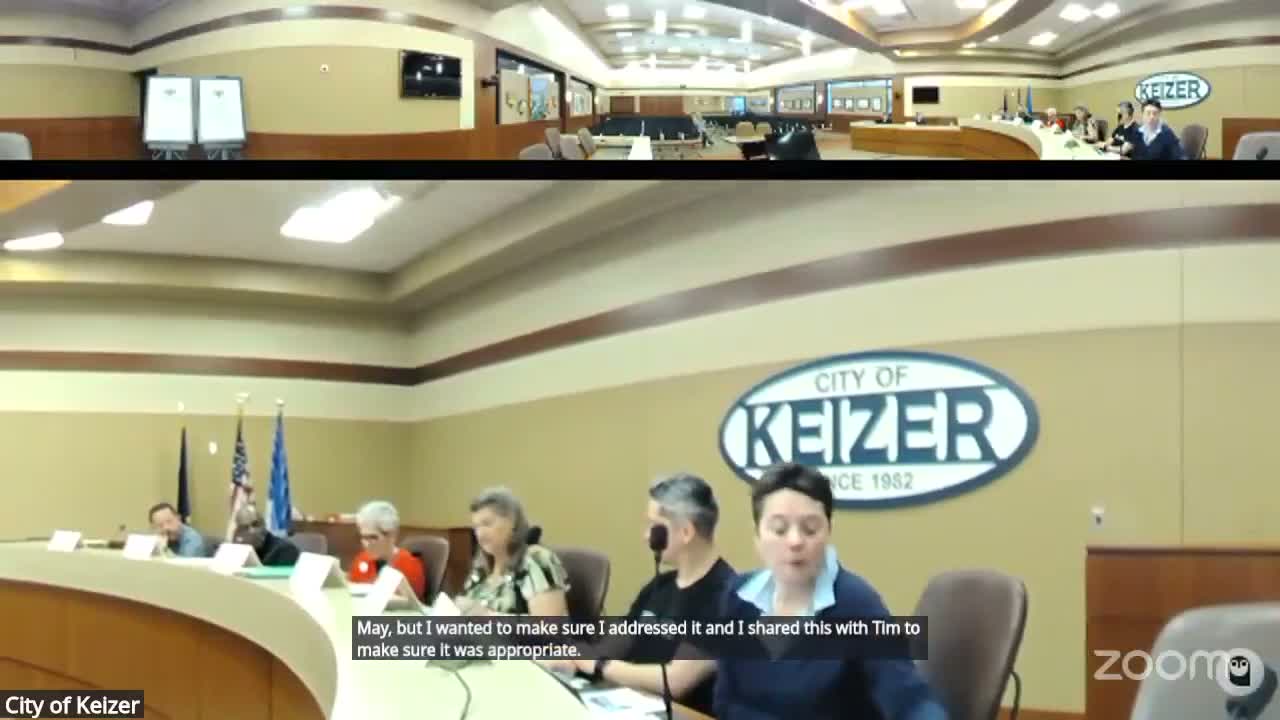
The Keizer Community Diversity Engagement Committee voted to remove a draft letter that its chair prepared to respond to a public comment calling the panel “mostly white.” The motion to take the letter off the committee’s to‑do list passed by voice vote after members raised procedural and jurisdictional concerns.
The chair (speaker S1) said she had drafted the letter because she was “floored with some of the comments made” at an off‑site meeting and wanted to correct the record, reading from a text that began, “Dear Keizer Community Diversity Engagement Committee and Keizer community… We value community feedback and engagement.” The chair said the letter was intended to affirm the committee’s diversity and to ask that “public discourse remain rooted in factual representation.”
Several committee members said they had not seen the letter before the meeting and objected to a single member circulating a communication “on behalf of the committee” without committee review. “I think you need to have input and approval from this committee to even do anything with that,” one member (S3) said, noting that the committee is a seven‑person advisory group and needs collective agreement before acting for the body.
Others urged caution about escalating a single comment into a public dispute. One member (S2) suggested alternative, lower‑risk steps such as posting a committee photo and brief bios on the city website so residents could more easily see the committee’s makeup. S5, who moved the formal action, said the draft letter did not fall within the committee’s scope under its guiding document (Appendix A).
“I'd like to make a motion to take the letter off our agenda and that we no longer have any action regarding the [bullying/letter] because it does not fit in Appendix A into our purview,” Robin (S5) said. A colleague (S4) seconded the motion. Chair S1 asked for a voice vote and then declared, “Motion carries.” The committee did not record a roll‑call tally.
The committee discussed alternative steps that would fall clearly within its authority, including recommending that the city council express support for the district’s anti‑bullying efforts or consider recognizing National Bullying Prevention Month in October. Members agreed to revisit related topics at future meetings and to ask staff to include the draft letter in the next packet for formal review if they wanted to return to it.
The motion to remove the letter was a procedural decision, not a finding about the accuracy of the original public comment. The committee’s action closes the immediate item but leaves open options for members who want to pursue awareness or educational measures that the body can formally recommend to council.
The chair (speaker S1) said she had drafted the letter because she was “floored with some of the comments made” at an off‑site meeting and wanted to correct the record, reading from a text that began, “Dear Keizer Community Diversity Engagement Committee and Keizer community… We value community feedback and engagement.” The chair said the letter was intended to affirm the committee’s diversity and to ask that “public discourse remain rooted in factual representation.”
Several committee members said they had not seen the letter before the meeting and objected to a single member circulating a communication “on behalf of the committee” without committee review. “I think you need to have input and approval from this committee to even do anything with that,” one member (S3) said, noting that the committee is a seven‑person advisory group and needs collective agreement before acting for the body.
Others urged caution about escalating a single comment into a public dispute. One member (S2) suggested alternative, lower‑risk steps such as posting a committee photo and brief bios on the city website so residents could more easily see the committee’s makeup. S5, who moved the formal action, said the draft letter did not fall within the committee’s scope under its guiding document (Appendix A).
“I'd like to make a motion to take the letter off our agenda and that we no longer have any action regarding the [bullying/letter] because it does not fit in Appendix A into our purview,” Robin (S5) said. A colleague (S4) seconded the motion. Chair S1 asked for a voice vote and then declared, “Motion carries.” The committee did not record a roll‑call tally.
The committee discussed alternative steps that would fall clearly within its authority, including recommending that the city council express support for the district’s anti‑bullying efforts or consider recognizing National Bullying Prevention Month in October. Members agreed to revisit related topics at future meetings and to ask staff to include the draft letter in the next packet for formal review if they wanted to return to it.
The motion to remove the letter was a procedural decision, not a finding about the accuracy of the original public comment. The committee’s action closes the immediate item but leaves open options for members who want to pursue awareness or educational measures that the body can formally recommend to council.
Don't Miss a Word: See the Full Meeting!
Go beyond summaries. Unlock every video, transcript, and key insight with a Founder Membership.
✓
Get instant access to full meeting videos
✓
Search and clip any phrase from complete transcripts
✓
Receive AI-powered summaries & custom alerts
✓
Enjoy lifetime, unrestricted access to government data
30-day money-back guarantee
