Senate panel debates broad fraud penalties, prioritization rules and a $500,000 funding shift in homelessness bill
May 08, 2026 | Health & Welfare, SENATE, Committees, Legislative , Vermont
This article was created by AI summarizing key points discussed. AI makes mistakes, so for full details and context, please refer to the video of the full meeting. Please report any errors so we can fix them. Report an error »
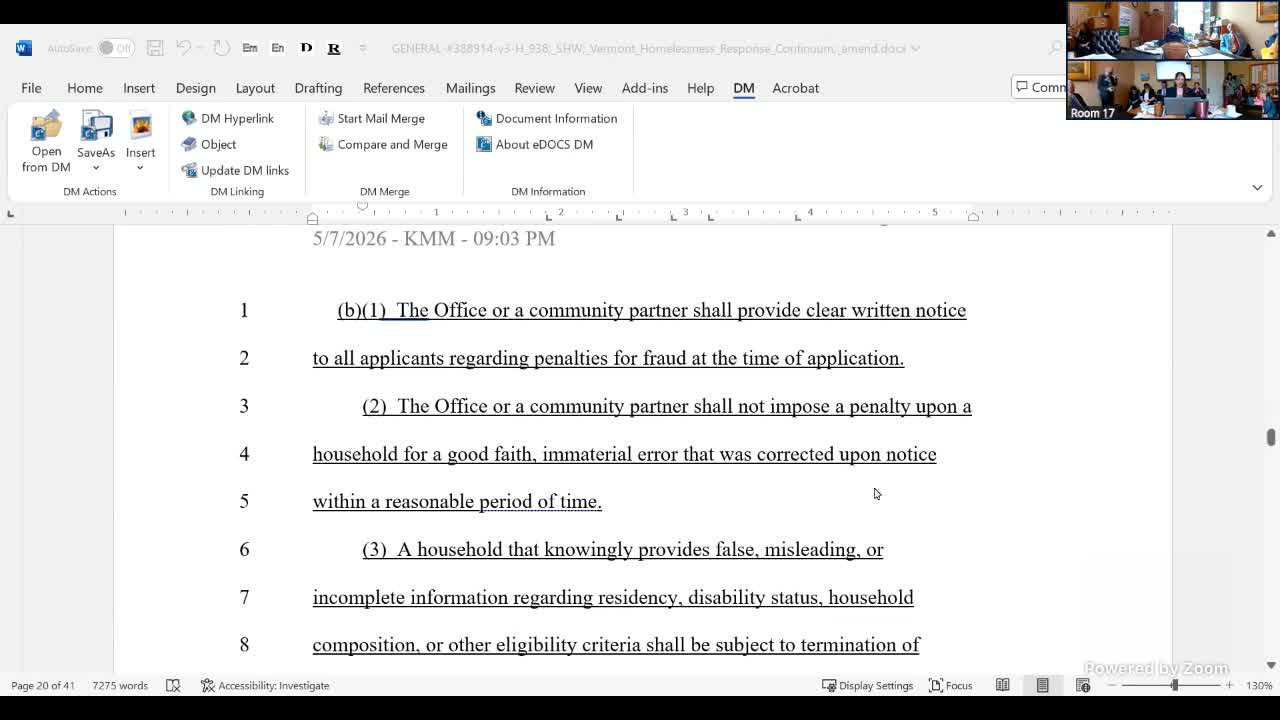
The Senate Health & Welfare committee spent extensive time on H.938, focusing on expanded fraud and termination language, prioritization for households with disabilities and funding trade-offs that would shift $500,000 from hotel/motel emergency housing to a community resource center.
Committee staff read new Subdivision B, which requires community partners to notify applicants about penalties for fraud, exempts households for good-faith corrected errors, allows referral for prosecution pending a Human Services Board hearing, and permits immediate termination of members for criminal activity not related to disability or victimization. "We think that the fraud section is way too extensive," said Brenda Siegel of Homelessness Vermont, who said a client withdrew from a hearing after being wrongly accused and warned that broad language can "scare" people away from seeking help.
Brandon, representing the Agency of Human Services, told the chair the agency is open to addressing some specifics through rulemaking and to follow up with the committee on the current fraud process. The chair and other members emphasized the need to protect applicants from intimidation while preserving tools to remove truly dangerous actors from congregate settings.
The committee also discussed prioritization and verification rules (section 22.11). Staff explained that presence of a disability would be verified by the office or a community partner, and members pressed for clarity on proof standards for lifelong disabilities and compliance with the Americans with Disabilities Act.
On benefits timing, Office of Economic Opportunity staff urged the committee to clarify that the hotel/motel 70‑day cap should be computed on a rolling 12‑month lookback—"calculated from date of application to the same day of the month 12 months prior"—so access is equitable regardless of when an individual becomes homeless. Members agreed that a clarifying clause or rulemaking language could address confusion about whether the cap resets on a fixed date.
Budget deliberations included a spreadsheet change that reduces hotel/motel emergency housing by $500,000 and creates a new base general-fund line for a Community Resource Center (CVOEO). Staff explained the CRC would include daytime resource services and link to an existing nighttime triage center; committee members and advocates warned that removing 17 motel rooms could mean as many as 68 fewer beds for families and urged considering spreading cuts across multiple lines rather than taking one large reduction in hotel/motel funds.
AHS staff cautioned that the governor’s recommended budget counted on investing in shelters coming online and that cuts could delay specialized shelter openings or reduce support for current providers. Committee members noted constraints on moving federal funds and discussed whether to use one-time money or base funds for CRC support. Several members suggested interim and final reporting timelines to inform fiscal choices.
The committee did not finalize all budget trade-offs in public session and agreed to continue negotiations offline; unresolved issues include exact funding sources for the CRC, the final treatment of hotel/motel funding, and whether more of the fraud/termination details should be moved to rulemaking. The meeting concluded with procedural steps to send drafts to the House and to follow up on outstanding implementation questions.
Committee staff read new Subdivision B, which requires community partners to notify applicants about penalties for fraud, exempts households for good-faith corrected errors, allows referral for prosecution pending a Human Services Board hearing, and permits immediate termination of members for criminal activity not related to disability or victimization. "We think that the fraud section is way too extensive," said Brenda Siegel of Homelessness Vermont, who said a client withdrew from a hearing after being wrongly accused and warned that broad language can "scare" people away from seeking help.
Brandon, representing the Agency of Human Services, told the chair the agency is open to addressing some specifics through rulemaking and to follow up with the committee on the current fraud process. The chair and other members emphasized the need to protect applicants from intimidation while preserving tools to remove truly dangerous actors from congregate settings.
The committee also discussed prioritization and verification rules (section 22.11). Staff explained that presence of a disability would be verified by the office or a community partner, and members pressed for clarity on proof standards for lifelong disabilities and compliance with the Americans with Disabilities Act.
On benefits timing, Office of Economic Opportunity staff urged the committee to clarify that the hotel/motel 70‑day cap should be computed on a rolling 12‑month lookback—"calculated from date of application to the same day of the month 12 months prior"—so access is equitable regardless of when an individual becomes homeless. Members agreed that a clarifying clause or rulemaking language could address confusion about whether the cap resets on a fixed date.
Budget deliberations included a spreadsheet change that reduces hotel/motel emergency housing by $500,000 and creates a new base general-fund line for a Community Resource Center (CVOEO). Staff explained the CRC would include daytime resource services and link to an existing nighttime triage center; committee members and advocates warned that removing 17 motel rooms could mean as many as 68 fewer beds for families and urged considering spreading cuts across multiple lines rather than taking one large reduction in hotel/motel funds.
AHS staff cautioned that the governor’s recommended budget counted on investing in shelters coming online and that cuts could delay specialized shelter openings or reduce support for current providers. Committee members noted constraints on moving federal funds and discussed whether to use one-time money or base funds for CRC support. Several members suggested interim and final reporting timelines to inform fiscal choices.
The committee did not finalize all budget trade-offs in public session and agreed to continue negotiations offline; unresolved issues include exact funding sources for the CRC, the final treatment of hotel/motel funding, and whether more of the fraud/termination details should be moved to rulemaking. The meeting concluded with procedural steps to send drafts to the House and to follow up on outstanding implementation questions.
View the Full Meeting & All Its Details
This article offers just a summary. Unlock complete video, transcripts, and insights as a Founder Member.
✓
Watch full, unedited meeting videos
✓
Search every word spoken in unlimited transcripts
✓
AI summaries & real-time alerts (all government levels)
✓
Permanent access to expanding government content
30-day money-back guarantee
