Palo Alto ARB hears study session for 72‑unit 100% affordable project at 450 Lytton
May 08, 2026 | Palo Alto, Santa Clara County, California
This article was created by AI summarizing key points discussed. AI makes mistakes, so for full details and context, please refer to the video of the full meeting. Please report any errors so we can fix them. Report an error »
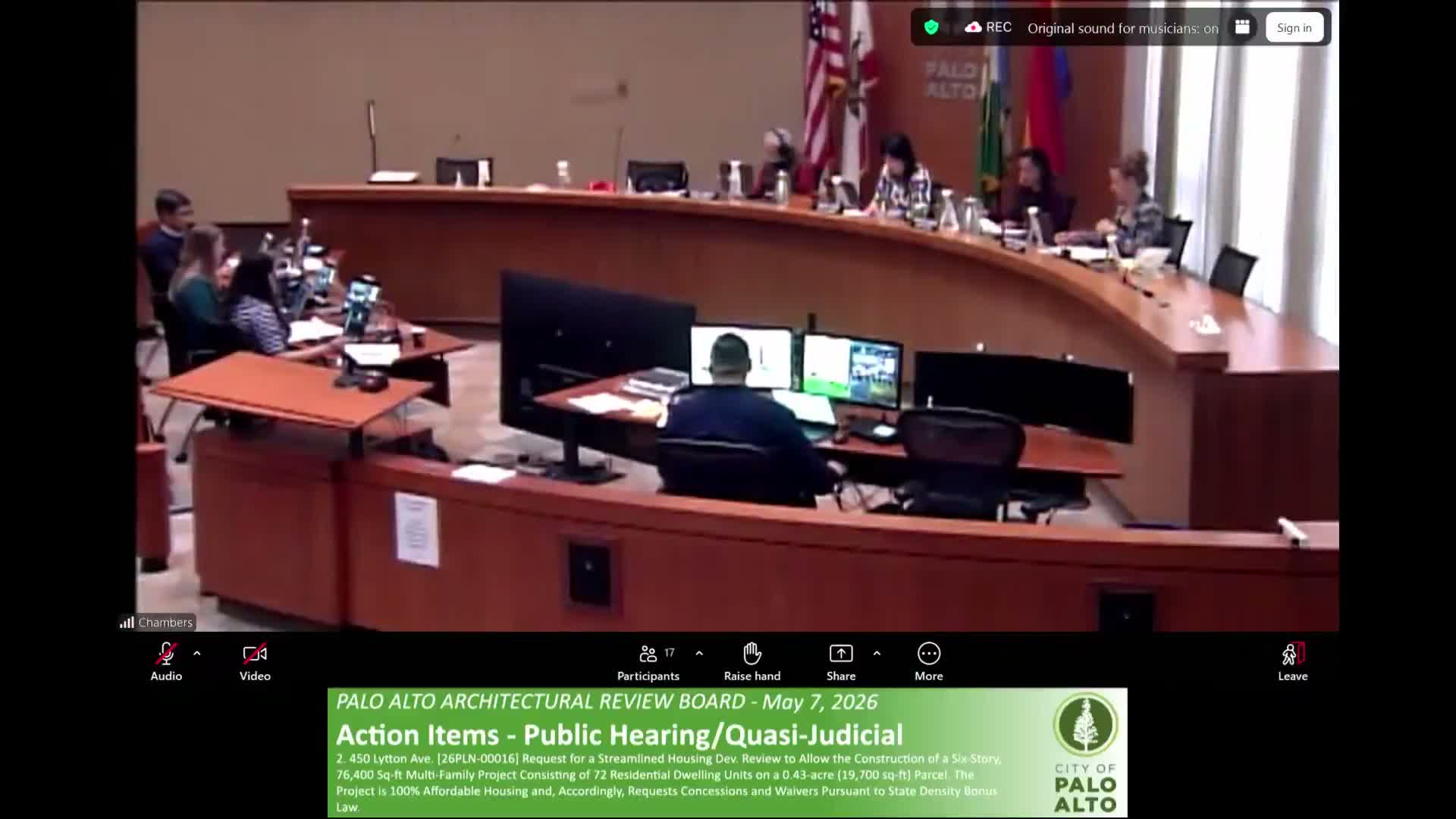
The Palo Alto Architectural Review Board on May 7 reviewed a study session for a proposed six‑story, 72‑unit affordable housing development at 450 Lytton Avenue (Block T), a city‑owned surface parking lot. Planning staff said the project proposes 71 rental units plus one manager unit, all restricted to households earning no more than 60% of area median income, and is pursuing concessions under the state density bonus law.
City planner Nishida Kambikupa told the board the site is 0.43 acres, currently provides 52 parking spaces and is adjacent to a Category 3 historic structure at 430 Kipling Street. Staff said the city is evaluating whether the application qualifies for processing under AB‑130 (an infill CEQA exemption) and noted timelines under that statute. The city also confirmed the project would reuse off‑site parking in a planned Lot D (Waverly and Hamilton) garage rather than retain the on‑site spaces.
The applicant, Carlos Castellanos of Alta Housing, described the design decisions and financing constraints that led to a six‑story massing and a unit mix heavy on 1‑, 2‑ and 3‑bedroom family units. ‘‘We felt that the six‑story development really maximizes the financing opportunities that we have,’’ Castellanos said, and noted a typical ground lease for city‑owned land would be long term. Architect Adrian(ne) Steichen outlined courtyard orientation, a Level‑2 podium open space, 34 on‑site parking spaces (EV‑ready), and 72 bicycle spaces.
Public commenters and board members pressed staff and the applicant on several points. Herb Borock argued the Lytton project and the proposed replacement garage should be considered together for CEQA rather than separately, saying the combined change in parking inventories could require a consolidated environmental analysis. Christopher Bee criticized the lack of storefront setbacks and asked whether the building would “push up to the edge of the street,” urging a more usable streetscape. Board members focused on daylighting and unit livability where the building sits close to interior property lines; the design team said most affected units face the internal courtyard and that setbacks range about 9–11 feet to the property lines to preserve light and air.
Technical questions included whether windows on interior lot lines would be operable and whether fire egress rules require window egress in a Type III building. The architect said operable windows are planned where separation exceeds five feet and that, for Type III construction, windows are not required for egress. The board also asked about loading and move‑in accommodation; the applicant said typical practice would be to obtain a short‑term curb encroachment permit for moving trucks.
Members suggested refinements rather than rejecting the project at study session: consider more articulated window surrounds instead of thin metal fins, reconsider locating a resident community room on the podium versus the ground floor to better animate the street, and reexamine options for parking stackers or partial stacking only if costs permit. Staff will incorporate feedback before the project returns for subsequent review and the city anticipates a Council hearing by August 2026.
The ARB did not take an action on this item at the May 7 meeting; it was presented for study session feedback only.
City planner Nishida Kambikupa told the board the site is 0.43 acres, currently provides 52 parking spaces and is adjacent to a Category 3 historic structure at 430 Kipling Street. Staff said the city is evaluating whether the application qualifies for processing under AB‑130 (an infill CEQA exemption) and noted timelines under that statute. The city also confirmed the project would reuse off‑site parking in a planned Lot D (Waverly and Hamilton) garage rather than retain the on‑site spaces.
The applicant, Carlos Castellanos of Alta Housing, described the design decisions and financing constraints that led to a six‑story massing and a unit mix heavy on 1‑, 2‑ and 3‑bedroom family units. ‘‘We felt that the six‑story development really maximizes the financing opportunities that we have,’’ Castellanos said, and noted a typical ground lease for city‑owned land would be long term. Architect Adrian(ne) Steichen outlined courtyard orientation, a Level‑2 podium open space, 34 on‑site parking spaces (EV‑ready), and 72 bicycle spaces.
Public commenters and board members pressed staff and the applicant on several points. Herb Borock argued the Lytton project and the proposed replacement garage should be considered together for CEQA rather than separately, saying the combined change in parking inventories could require a consolidated environmental analysis. Christopher Bee criticized the lack of storefront setbacks and asked whether the building would “push up to the edge of the street,” urging a more usable streetscape. Board members focused on daylighting and unit livability where the building sits close to interior property lines; the design team said most affected units face the internal courtyard and that setbacks range about 9–11 feet to the property lines to preserve light and air.
Technical questions included whether windows on interior lot lines would be operable and whether fire egress rules require window egress in a Type III building. The architect said operable windows are planned where separation exceeds five feet and that, for Type III construction, windows are not required for egress. The board also asked about loading and move‑in accommodation; the applicant said typical practice would be to obtain a short‑term curb encroachment permit for moving trucks.
Members suggested refinements rather than rejecting the project at study session: consider more articulated window surrounds instead of thin metal fins, reconsider locating a resident community room on the podium versus the ground floor to better animate the street, and reexamine options for parking stackers or partial stacking only if costs permit. Staff will incorporate feedback before the project returns for subsequent review and the city anticipates a Council hearing by August 2026.
The ARB did not take an action on this item at the May 7 meeting; it was presented for study session feedback only.
View the Full Meeting & All Its Details
This article offers just a summary. Unlock complete video, transcripts, and insights as a Founder Member.
✓
Watch full, unedited meeting videos
✓
Search every word spoken in unlimited transcripts
✓
AI summaries & real-time alerts (all government levels)
✓
Permanent access to expanding government content
30-day money-back guarantee
