City manager briefs Youth Commission on budget; personnel drives about 70% of costs
May 08, 2026 | Redondo Beach City, Los Angeles County, California
This article was created by AI summarizing key points discussed. AI makes mistakes, so for full details and context, please refer to the video of the full meeting. Please report any errors so we can fix them. Report an error »
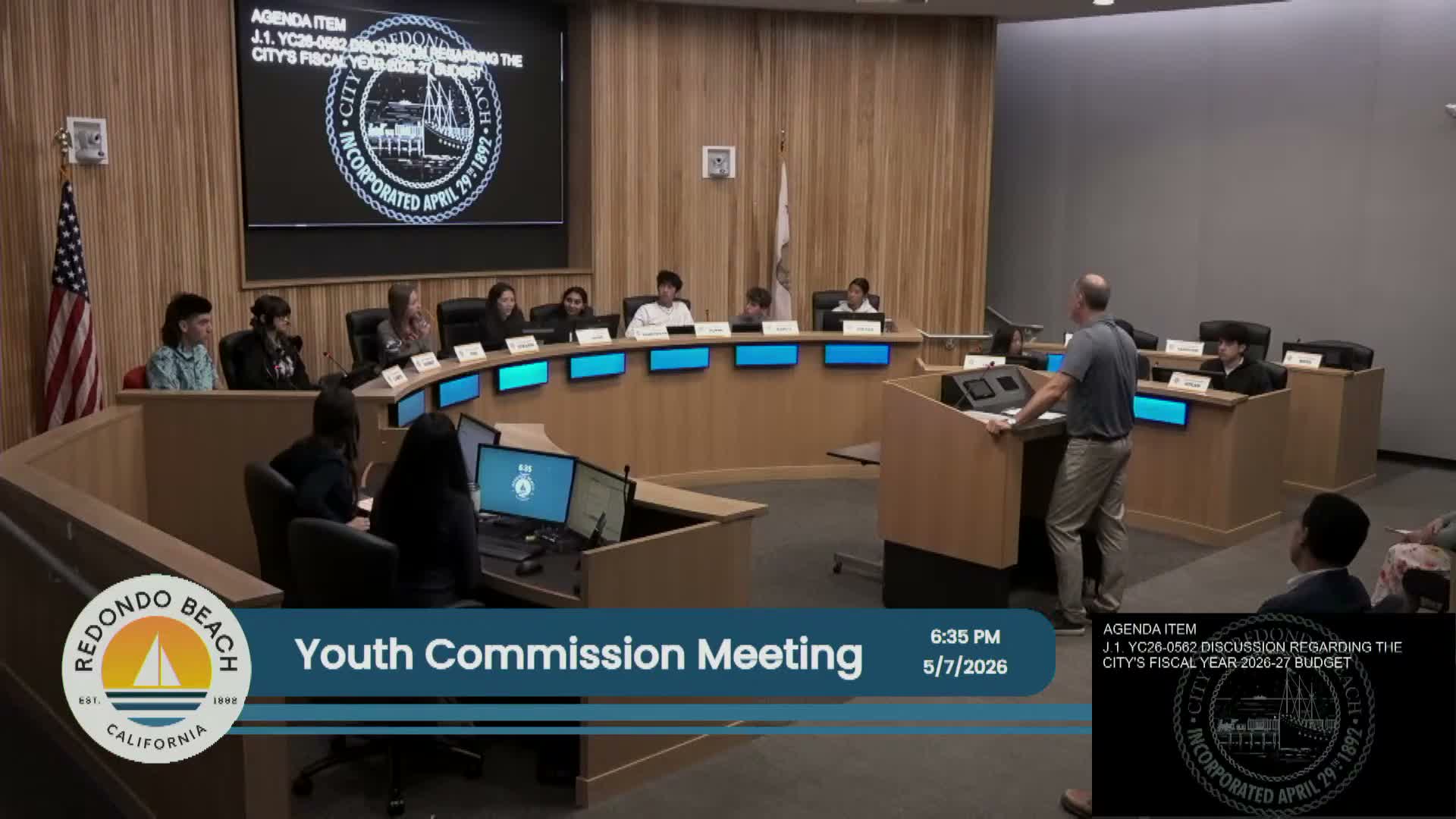
City Manager Mike Wazanski briefed the Redondo Beach Youth Commission on the city’s budget process and revenue picture, saying the charter requires the proposed budget be delivered to City Council by May 16 and adopted in June for the fiscal year beginning July 1.
Wazanski said labor and personnel expenses are the biggest driver of the budget, “about 70%” of overall costs, and that the city currently staffs roughly 435 full‑time positions and several hundred part‑time workers. He described the capital improvement program (CIP) as a separate five‑year plan that last year included roughly 108 projects and about $110 million in available funding to repair roads, buildings and sewers. He noted the city used CIP funds to support a recent teen center renovation of “a little over $100,000.”
During questions, commissioners asked how commission recommendations and a March strategic‑plan letter were being integrated. Wazanski said strategic planning and budgeting are reconciled but are distinct documents; some commission items (for example, an ebike safety objective) were incorporated into the strategic plan and will inform the city’s work plan.
On revenues, Wazanski provided order‑of‑magnitude figures: property tax accounts for roughly $40 million of the general fund, transient occupancy (hotel) tax about $10 million, sales tax about $10 million and utility user tax just under $10 million. Leasing and special‑event fees yield smaller sums: he estimated leasing of waterfront properties and concession revenue at “a couple million” and special events in aggregate at several hundred thousand dollars. For the Beach Life festival specifically, he said last year’s fee totaled about $135,000 and that, after final accounting, this year’s license fee will likely settle between $175,000 and $200,000; the city also is reimbursed for event‑related staff costs.
Commissioners pressed tradeoffs between keeping waterfront space wholly public and leasing areas for revenue. Wazanski said the city balances public access and revenue generation because waterfront maintenance and operations are expensive; without revenue from concessions and partnerships the city would have to cut other services to maintain the structures and amenities.
The commission provided input on priorities — including continued support for teen programs and ebike education — that staff said will be considered as the proposed budget is finalized and sent to council.
Wazanski said labor and personnel expenses are the biggest driver of the budget, “about 70%” of overall costs, and that the city currently staffs roughly 435 full‑time positions and several hundred part‑time workers. He described the capital improvement program (CIP) as a separate five‑year plan that last year included roughly 108 projects and about $110 million in available funding to repair roads, buildings and sewers. He noted the city used CIP funds to support a recent teen center renovation of “a little over $100,000.”
During questions, commissioners asked how commission recommendations and a March strategic‑plan letter were being integrated. Wazanski said strategic planning and budgeting are reconciled but are distinct documents; some commission items (for example, an ebike safety objective) were incorporated into the strategic plan and will inform the city’s work plan.
On revenues, Wazanski provided order‑of‑magnitude figures: property tax accounts for roughly $40 million of the general fund, transient occupancy (hotel) tax about $10 million, sales tax about $10 million and utility user tax just under $10 million. Leasing and special‑event fees yield smaller sums: he estimated leasing of waterfront properties and concession revenue at “a couple million” and special events in aggregate at several hundred thousand dollars. For the Beach Life festival specifically, he said last year’s fee totaled about $135,000 and that, after final accounting, this year’s license fee will likely settle between $175,000 and $200,000; the city also is reimbursed for event‑related staff costs.
Commissioners pressed tradeoffs between keeping waterfront space wholly public and leasing areas for revenue. Wazanski said the city balances public access and revenue generation because waterfront maintenance and operations are expensive; without revenue from concessions and partnerships the city would have to cut other services to maintain the structures and amenities.
The commission provided input on priorities — including continued support for teen programs and ebike education — that staff said will be considered as the proposed budget is finalized and sent to council.
Don't Miss a Word: See the Full Meeting!
Go beyond summaries. Unlock every video, transcript, and key insight with a Founder Membership.
✓
Get instant access to full meeting videos
✓
Search and clip any phrase from complete transcripts
✓
Receive AI-powered summaries & custom alerts
✓
Enjoy lifetime, unrestricted access to government data
30-day money-back guarantee
