Commissioners set fence viewing in dispute involving Ducks Unlimited property
May 08, 2026 | Reno County, Kansas
This article was created by AI summarizing key points discussed. AI makes mistakes, so for full details and context, please refer to the video of the full meeting. Please report any errors so we can fix them. Report an error »
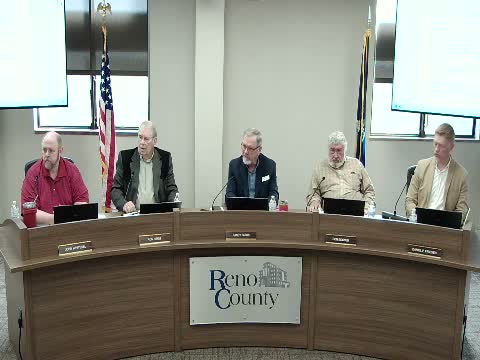
Reno County commissioners voted to appoint fence viewers and move forward with a statutory viewing to resolve a boundary and cost-sharing dispute between a private landowner and Ducks Unlimited.
The issue arose after a landowner requested a formal partition-fence determination. A commissioner summarized Kansas law as broadly pro-fence, saying the board’s role is limited to inspecting the existing boundary and determining whether a current fence is a legal partition fence and how costs should be split. The board discussed a statutory cost split commonly described as 50/50 and read a cited Attorney General opinion (referenced as AG 8728) explaining that partition fences serve both to restrain animals and to delineate boundaries.
Tim Horst, identifying himself as land manager for Ducks Unlimited for Nebraska and Kansas, told commissioners the Ducks Unlimited property is enrolled in the Conservation Reserve Program (CRP), is not grazed and is intended for public-access wildlife programs. Horst said the existing fence is not functioning for livestock, that the property contains a tree line and signage marking the boundary, and that building a new fence would require expense beyond the fence materials (removing old fence, a legal survey). He told the board Ducks Unlimited prefers not to share a fence with the requesting landowner and said, "If we do build a fence, our preference might be to build it fully on us, fully on our dime." He added the organization would comply with whatever the board decides.
Commissioners debated outreach to Ducks Unlimited and whether another contact attempt would be productive before the viewing. One commissioner said scheduling the viewing can prompt the parties to reach an agreement on their own. The board nominated and approved fence viewers (nominations and the final slate were made on the record) and discussed a tentative date and time for the viewing; the chair and staff agreed to confirm scheduling with both parties. The chair asked staff to notify the parties and make the date official.
What happens next: the board will finalize a date and conduct the on-site viewing required by statute; once the commissioners complete the viewing, their written determination on whether the existing fence is legal and how costs are allocated will be binding unless altered through further legal process.
Quotes
"If we do build a fence, our preference might be to build it fully on us, fully on our dime," said Tim Horst, land manager for Ducks Unlimited for Nebraska and Kansas.
"The statute requires us to set a viewing," a commissioner said, noting the board's limited role is to observe and make a determination.
Details
- Legal reference cited on the record: Attorney General opinion referenced as AG 8728 regarding partition fences and boundary delineation. The board noted the law can be interpreted broadly to require building and maintaining legal fences even where land use differs between neighbors.
- The board indicated a typical cost allocation for partition fences is approximately 50/50, subject to their finding.
- The board agreed to notify both parties and to confirm logistics (one commissioner suggested a tentative date to discuss internally, pending availability).
Next step: chair and county staff will follow up to set the viewing date and notify the involved landowners.
The issue arose after a landowner requested a formal partition-fence determination. A commissioner summarized Kansas law as broadly pro-fence, saying the board’s role is limited to inspecting the existing boundary and determining whether a current fence is a legal partition fence and how costs should be split. The board discussed a statutory cost split commonly described as 50/50 and read a cited Attorney General opinion (referenced as AG 8728) explaining that partition fences serve both to restrain animals and to delineate boundaries.
Tim Horst, identifying himself as land manager for Ducks Unlimited for Nebraska and Kansas, told commissioners the Ducks Unlimited property is enrolled in the Conservation Reserve Program (CRP), is not grazed and is intended for public-access wildlife programs. Horst said the existing fence is not functioning for livestock, that the property contains a tree line and signage marking the boundary, and that building a new fence would require expense beyond the fence materials (removing old fence, a legal survey). He told the board Ducks Unlimited prefers not to share a fence with the requesting landowner and said, "If we do build a fence, our preference might be to build it fully on us, fully on our dime." He added the organization would comply with whatever the board decides.
Commissioners debated outreach to Ducks Unlimited and whether another contact attempt would be productive before the viewing. One commissioner said scheduling the viewing can prompt the parties to reach an agreement on their own. The board nominated and approved fence viewers (nominations and the final slate were made on the record) and discussed a tentative date and time for the viewing; the chair and staff agreed to confirm scheduling with both parties. The chair asked staff to notify the parties and make the date official.
What happens next: the board will finalize a date and conduct the on-site viewing required by statute; once the commissioners complete the viewing, their written determination on whether the existing fence is legal and how costs are allocated will be binding unless altered through further legal process.
Quotes
"If we do build a fence, our preference might be to build it fully on us, fully on our dime," said Tim Horst, land manager for Ducks Unlimited for Nebraska and Kansas.
"The statute requires us to set a viewing," a commissioner said, noting the board's limited role is to observe and make a determination.
Details
- Legal reference cited on the record: Attorney General opinion referenced as AG 8728 regarding partition fences and boundary delineation. The board noted the law can be interpreted broadly to require building and maintaining legal fences even where land use differs between neighbors.
- The board indicated a typical cost allocation for partition fences is approximately 50/50, subject to their finding.
- The board agreed to notify both parties and to confirm logistics (one commissioner suggested a tentative date to discuss internally, pending availability).
Next step: chair and county staff will follow up to set the viewing date and notify the involved landowners.
View the Full Meeting & All Its Details
This article offers just a summary. Unlock complete video, transcripts, and insights as a Founder Member.
✓
Watch full, unedited meeting videos
✓
Search every word spoken in unlimited transcripts
✓
AI summaries & real-time alerts (all government levels)
✓
Permanent access to expanding government content
30-day money-back guarantee
