Farmington commission accepts intervener petition on Noble Energy proposal; hearing continued after experts raise vernal-pool, runoff concerns
May 08, 2026 | Town of Farmington, Hartford County, Connecticut
This article was created by AI summarizing key points discussed. AI makes mistakes, so for full details and context, please refer to the video of the full meeting. Please report any errors so we can fix them. Report an error »
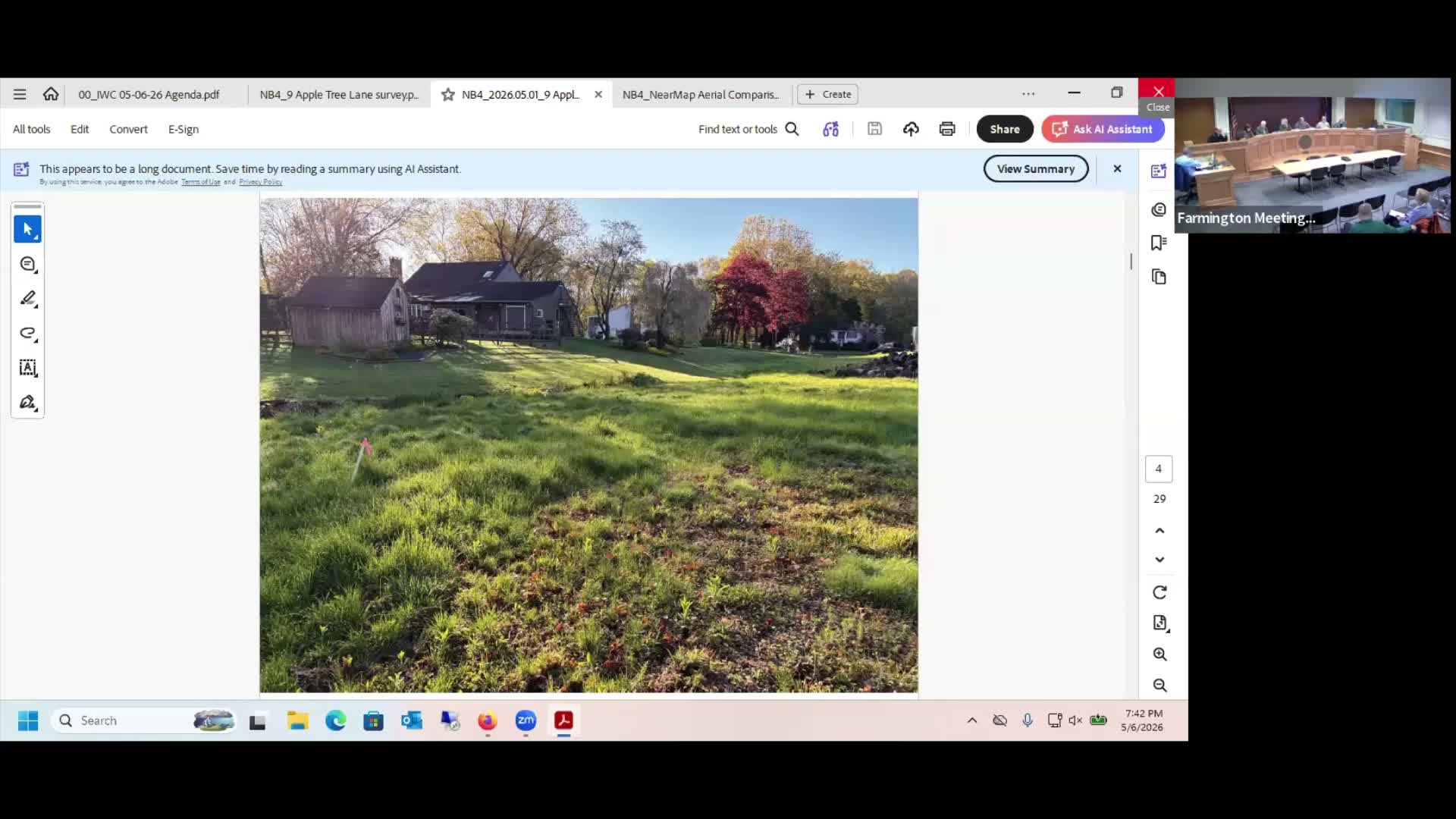
The Town of Farmington Inland Wetlands Commission voted to accept an intervener petition and to continue the public hearing on a proposed commercial development by Noble Energy Real Estate Holdings to May 20.
The petition was presented by intervenor Stephanie Roman, a nearby property owner, who said the plan would convert residentially-zoned land to commercial use, add impervious surfaces for an 18,000-square-foot warehouse, an 8,400-square-foot travel center with diesel fueling and more than 100 parking spaces, and thereby threaten more than 50 acres of high-functioning wetlands and two vernal pools. Roman cited a 2024 Connecticut Department of Energy and Environmental Protection (DEEP) report and alleged the project’s proposed stormwater systems and separators would be insufficient to treat dissolved pollutants such as hydrocarbons and polycyclic aromatic hydrocarbons (PAHs).
"This plan would substantially increase impervious surface cover in this area, which will cause long-term harm to the wetlands," Roman said, adding she will present expert reports and assessments at the continued hearing.
Applicant counsel Robert Reeve said Noble reduced the project from earlier filings: a warehouse was cut from roughly 28,000 to 18,000 square feet, the travel center was reduced, a previously proposed restaurant was removed, and impervious area was decreased by about half an acre. Reeve said the applicant proposes a conservation easement covering roughly 75 of the site’s 86 acres — roughly 86% of the parcel — and that the active development area would total about 7.5 acres. He told the commission the team will provide additional technical responses by the next session.
Taylor Capel, a licensed civil engineer with Soli Engineering, described site changes that shift access roads and avoid direct wetland impacts, outlined proposed snow-storage zones and identified areas for stormwater treatment enhancements (including consideration of biofiltration to address dissolved pollutants), and said fill required for grading would be roughly what previous plans showed (just over 5,000 cubic yards). The applicant’s team deferred some hydrology quantification until follow-up work.
Noble owner and operator Michael Frisbie outlined company protocols for fuel facilities: licensed A/B/C operators, Veeder-Root electronic leak detection and alarms, monthly inspections, annual testing, spill-containment design features and on-site emergency stops. He described routine procedures for small spills, staff training and remote monitoring used at Noble stations.
Technical witnesses for the applicant included Jackson Smith, a certified associate ecologist, and Bill Kenny, a professional wetland scientist. Smith reported two vernal pools on-site: a northern, shallow pool where the team observed more than 50 spotted salamander egg masses, and a deeper central pool with wood frog egg masses. Smith said the project would leave the 100-foot vernal-pool envelope (VPE) for Vernal Pool 1 undeveloped but would increase development in that pool’s broader critical terrestrial habitat (CTH) from about 33% to roughly 46% — under the 50% threshold Smith cited for maintaining a tier-1 functioning vernal pool in practice, though several commissioners pressed for clearer quantification of watershed recharge and infiltration implications.
Intervener experts and several residents raised multiple concerns during public comment. Sigrin (spelled in the record as "Sigrin Gadwa"), the intervener’s ecological consultant, said she identified a rare emergent plant (lizard’s tail) and emphasized subsurface groundwater flow from upland slopes that sustains vernal-pool hydrology. She and others warned that converting upland recharge areas to impervious surfaces and routing runoff through engineered systems could lower groundwater inputs to pools and reduce habitat needed for amphibian breeding and juvenile development. Several residents urged commissioners to reject the project to protect Batterson Park Pond and ongoing restoration and recreation plans supported by state funding.
Commissioners pressed both sides for specifics. Questions centered on how the design would treat dissolved pollutants, whether infiltration would be used, the capacity and placement of snow storage, the proximity of the proposed driveway and paved areas to wetlands (staff noted a dimension of roughly 42 feet in one area to the property line), and the status of previously required restoration plantings (Bruce, town staff, said prior plantings associated with enforcement actions had likely failed after a fire and drought and must be reinstalled and monitored as a condition of approval). Jackson Smith and Taylor Capel said they would quantify watershed impacts and provide more detailed calculations and responses at the next hearing.
After hearing testimony and public comment, the Inland Wetlands Commission voted to accept the intervener petition for the record and to continue the hearing to May 20 to allow both the intervener and applicant to submit additional expert reports and responses. The commission and conservation commission also coordinated: the conservation commission accepted the intervener petition, recommended refining the proposed conservation-easement boundaries to address on-site encroachments, asked for strong best-management-practice conditions if the project moves forward, and urged increased vernal-pool protections where feasible; the conservation commission forwarded those recommendations to the Inland Wetlands Commission.
What’s next: The applicant must provide the additional technical responses and updated plans before May 20 so commissioners and both parties can review them in advance. The hearing will resume on May 20 with expert rebuttals and follow-up cross-examination expected.
Claims and responses in brief: Intervener — the plan will impair wetlands and vernal pools through increased impervious cover and inadequate pollutant treatment; Applicant — the plan’s footprint has been substantially reduced, includes proposed mitigation and a large conservation easement, and Noble follows industry safety and monitoring practices. Both sides will provide additional technical material before the next hearing.
The petition was presented by intervenor Stephanie Roman, a nearby property owner, who said the plan would convert residentially-zoned land to commercial use, add impervious surfaces for an 18,000-square-foot warehouse, an 8,400-square-foot travel center with diesel fueling and more than 100 parking spaces, and thereby threaten more than 50 acres of high-functioning wetlands and two vernal pools. Roman cited a 2024 Connecticut Department of Energy and Environmental Protection (DEEP) report and alleged the project’s proposed stormwater systems and separators would be insufficient to treat dissolved pollutants such as hydrocarbons and polycyclic aromatic hydrocarbons (PAHs).
"This plan would substantially increase impervious surface cover in this area, which will cause long-term harm to the wetlands," Roman said, adding she will present expert reports and assessments at the continued hearing.
Applicant counsel Robert Reeve said Noble reduced the project from earlier filings: a warehouse was cut from roughly 28,000 to 18,000 square feet, the travel center was reduced, a previously proposed restaurant was removed, and impervious area was decreased by about half an acre. Reeve said the applicant proposes a conservation easement covering roughly 75 of the site’s 86 acres — roughly 86% of the parcel — and that the active development area would total about 7.5 acres. He told the commission the team will provide additional technical responses by the next session.
Taylor Capel, a licensed civil engineer with Soli Engineering, described site changes that shift access roads and avoid direct wetland impacts, outlined proposed snow-storage zones and identified areas for stormwater treatment enhancements (including consideration of biofiltration to address dissolved pollutants), and said fill required for grading would be roughly what previous plans showed (just over 5,000 cubic yards). The applicant’s team deferred some hydrology quantification until follow-up work.
Noble owner and operator Michael Frisbie outlined company protocols for fuel facilities: licensed A/B/C operators, Veeder-Root electronic leak detection and alarms, monthly inspections, annual testing, spill-containment design features and on-site emergency stops. He described routine procedures for small spills, staff training and remote monitoring used at Noble stations.
Technical witnesses for the applicant included Jackson Smith, a certified associate ecologist, and Bill Kenny, a professional wetland scientist. Smith reported two vernal pools on-site: a northern, shallow pool where the team observed more than 50 spotted salamander egg masses, and a deeper central pool with wood frog egg masses. Smith said the project would leave the 100-foot vernal-pool envelope (VPE) for Vernal Pool 1 undeveloped but would increase development in that pool’s broader critical terrestrial habitat (CTH) from about 33% to roughly 46% — under the 50% threshold Smith cited for maintaining a tier-1 functioning vernal pool in practice, though several commissioners pressed for clearer quantification of watershed recharge and infiltration implications.
Intervener experts and several residents raised multiple concerns during public comment. Sigrin (spelled in the record as "Sigrin Gadwa"), the intervener’s ecological consultant, said she identified a rare emergent plant (lizard’s tail) and emphasized subsurface groundwater flow from upland slopes that sustains vernal-pool hydrology. She and others warned that converting upland recharge areas to impervious surfaces and routing runoff through engineered systems could lower groundwater inputs to pools and reduce habitat needed for amphibian breeding and juvenile development. Several residents urged commissioners to reject the project to protect Batterson Park Pond and ongoing restoration and recreation plans supported by state funding.
Commissioners pressed both sides for specifics. Questions centered on how the design would treat dissolved pollutants, whether infiltration would be used, the capacity and placement of snow storage, the proximity of the proposed driveway and paved areas to wetlands (staff noted a dimension of roughly 42 feet in one area to the property line), and the status of previously required restoration plantings (Bruce, town staff, said prior plantings associated with enforcement actions had likely failed after a fire and drought and must be reinstalled and monitored as a condition of approval). Jackson Smith and Taylor Capel said they would quantify watershed impacts and provide more detailed calculations and responses at the next hearing.
After hearing testimony and public comment, the Inland Wetlands Commission voted to accept the intervener petition for the record and to continue the hearing to May 20 to allow both the intervener and applicant to submit additional expert reports and responses. The commission and conservation commission also coordinated: the conservation commission accepted the intervener petition, recommended refining the proposed conservation-easement boundaries to address on-site encroachments, asked for strong best-management-practice conditions if the project moves forward, and urged increased vernal-pool protections where feasible; the conservation commission forwarded those recommendations to the Inland Wetlands Commission.
What’s next: The applicant must provide the additional technical responses and updated plans before May 20 so commissioners and both parties can review them in advance. The hearing will resume on May 20 with expert rebuttals and follow-up cross-examination expected.
Claims and responses in brief: Intervener — the plan will impair wetlands and vernal pools through increased impervious cover and inadequate pollutant treatment; Applicant — the plan’s footprint has been substantially reduced, includes proposed mitigation and a large conservation easement, and Noble follows industry safety and monitoring practices. Both sides will provide additional technical material before the next hearing.
View the Full Meeting & All Its Details
This article offers just a summary. Unlock complete video, transcripts, and insights as a Founder Member.
✓
Watch full, unedited meeting videos
✓
Search every word spoken in unlimited transcripts
✓
AI summaries & real-time alerts (all government levels)
✓
Permanent access to expanding government content
30-day money-back guarantee
