Council discussion seeks to clarify which wage survey city uses for contracts
May 08, 2026 | Hewitt, McLennan County, Texas
This article was created by AI summarizing key points discussed. AI makes mistakes, so for full details and context, please refer to the video of the full meeting. Please report any errors so we can fix them. Report an error »
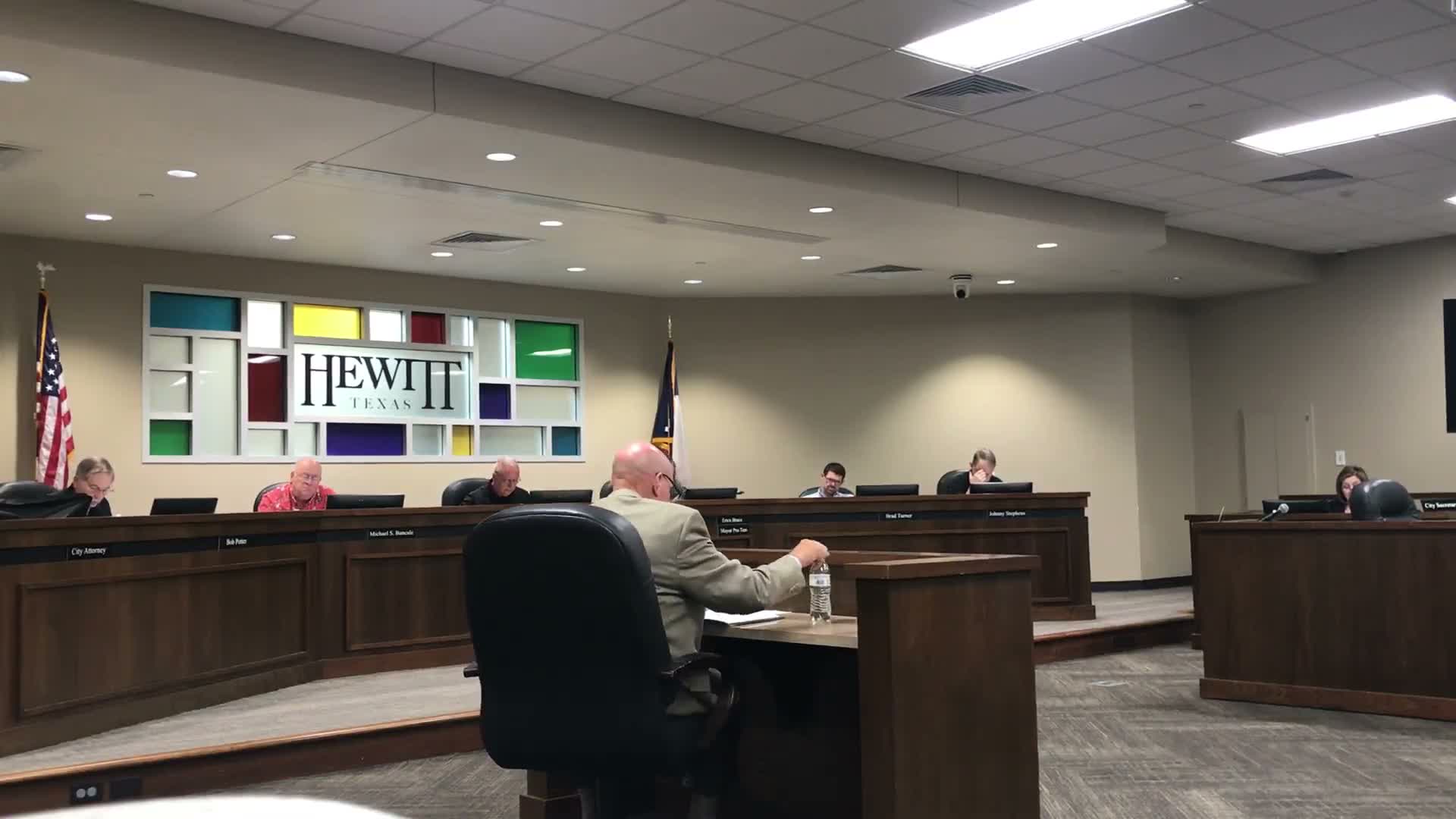
City staff and council members debated which prevailing‑wage survey the city should adopt for construction contracts after a review of a firehouse contract exposed conflicting rate references.
Staff described that earlier documents referenced a single Department of Labor (DOL) "electrician" classification while current procurement materials list multiple classifications — electrician laborer, apprentice, journeyman and master — and said that mismatch contributed to contractor and payroll confusion. "It should've been an ordinance," said Speaker 1, describing how the prior adoption was recorded as a resolution and was harder to find.
Council members and other participants said the Associated General Contractors (AGC) survey is more granular for local trades and therefore could reduce classification ambiguity. "The AGC is more spelled out in each position," said Speaker 4, who argued the AGC survey is specific to McLennan County and therefore easier to apply on city projects. Speaker 4 also cited example numbers, saying, "Electrician is 36.50 on the DOL" and that recent AGC figures list a master at roughly 45 and a journeyman at about 35.
Staff cautioned that some grant funding requires using DOL (Davis‑Bacon) rates. "It depends on what your grant funding says," Speaker 1 said. "I think that most grant funds are gonna require you to use DOL." Members discussed a practical approach: adopt a default survey (the AGC survey was favored by several speakers for its local detail) but retain the flexibility to apply a DOL sheet for specific grant‑funded or anomalous projects.
Several speakers emphasized the need to include the selected wage table clearly in procurement documents so bidders and contractors know the applicable rates. "They're actually in the request for proposals. They should be," Speaker 1 said, recommending that the wage survey be attached to contracts or incorporated into the RFP packet to avoid future disputes.
Participants also discussed enforcement and complaint review. Speaker 5 said the new AGC survey provides more detailed categories and would help staff assign workers to appropriate classifications, but added that when complaints arise the city must perform payroll checks and due diligence: "When they do come in, you're right. We need to do our due diligence on those." Staff and council members noted that the complaint prompting the review appeared to come via a union rather than directly from the affected workers, which added complexity to fact‑finding.
Speaker 1 told the group staff will prepare ordinance language to clarify the city's adopted survey and rates and to update wage tables with future AGC surveys so the rates can be kept current. "Next meeting, we'll have the ordinance to adopt that," Speaker 1 said. At the end of the discussion a motion was announced and seconded (mover identified as Mister McCallie; second identified as Ward), but the provided transcript does not record a vote.
What comes next: staff will draft an ordinance for formal consideration at the next meeting that (per the discussion) will clarify which survey the city adopts, attach the wage tables to procurement documents, and include a mechanism to update wages with new surveys while preserving the option to use DOL sheets when grant terms require them.
Staff described that earlier documents referenced a single Department of Labor (DOL) "electrician" classification while current procurement materials list multiple classifications — electrician laborer, apprentice, journeyman and master — and said that mismatch contributed to contractor and payroll confusion. "It should've been an ordinance," said Speaker 1, describing how the prior adoption was recorded as a resolution and was harder to find.
Council members and other participants said the Associated General Contractors (AGC) survey is more granular for local trades and therefore could reduce classification ambiguity. "The AGC is more spelled out in each position," said Speaker 4, who argued the AGC survey is specific to McLennan County and therefore easier to apply on city projects. Speaker 4 also cited example numbers, saying, "Electrician is 36.50 on the DOL" and that recent AGC figures list a master at roughly 45 and a journeyman at about 35.
Staff cautioned that some grant funding requires using DOL (Davis‑Bacon) rates. "It depends on what your grant funding says," Speaker 1 said. "I think that most grant funds are gonna require you to use DOL." Members discussed a practical approach: adopt a default survey (the AGC survey was favored by several speakers for its local detail) but retain the flexibility to apply a DOL sheet for specific grant‑funded or anomalous projects.
Several speakers emphasized the need to include the selected wage table clearly in procurement documents so bidders and contractors know the applicable rates. "They're actually in the request for proposals. They should be," Speaker 1 said, recommending that the wage survey be attached to contracts or incorporated into the RFP packet to avoid future disputes.
Participants also discussed enforcement and complaint review. Speaker 5 said the new AGC survey provides more detailed categories and would help staff assign workers to appropriate classifications, but added that when complaints arise the city must perform payroll checks and due diligence: "When they do come in, you're right. We need to do our due diligence on those." Staff and council members noted that the complaint prompting the review appeared to come via a union rather than directly from the affected workers, which added complexity to fact‑finding.
Speaker 1 told the group staff will prepare ordinance language to clarify the city's adopted survey and rates and to update wage tables with future AGC surveys so the rates can be kept current. "Next meeting, we'll have the ordinance to adopt that," Speaker 1 said. At the end of the discussion a motion was announced and seconded (mover identified as Mister McCallie; second identified as Ward), but the provided transcript does not record a vote.
What comes next: staff will draft an ordinance for formal consideration at the next meeting that (per the discussion) will clarify which survey the city adopts, attach the wage tables to procurement documents, and include a mechanism to update wages with new surveys while preserving the option to use DOL sheets when grant terms require them.
View the Full Meeting & All Its Details
This article offers just a summary. Unlock complete video, transcripts, and insights as a Founder Member.
✓
Watch full, unedited meeting videos
✓
Search every word spoken in unlimited transcripts
✓
AI summaries & real-time alerts (all government levels)
✓
Permanent access to expanding government content
30-day money-back guarantee
