Historic Resources Commission approves Willard Street church addition with cast-stone condition
May 08, 2026 | Albany City, Albany County, New York
This article was created by AI summarizing key points discussed. AI makes mistakes, so for full details and context, please refer to the video of the full meeting. Please report any errors so we can fix them. Report an error »
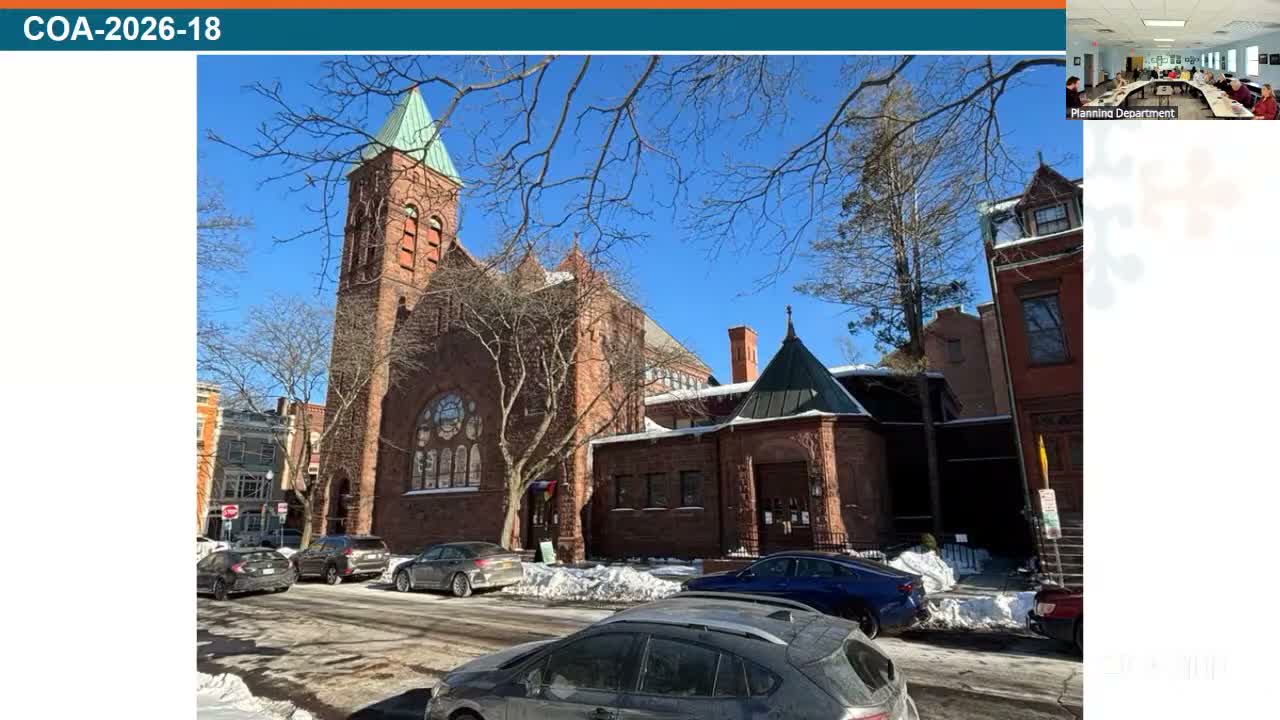
The Albany Historic Resources Commission voted to approve a proposed addition adjacent to the First Presbyterian Church on Willard/Willett Street, approving the design with conditions after public comment and debate over materials and access.
The commission—after hearing applicants and staff presentations and public comment—accepted a motion to approve the project using the rusticated cast-stone option at the addition's corner, provided the design team refines upper trim, cornice and fascia details and modifies the cast-stone patterning to include vertical joints so the addition better reflects the texture of nearby historic stone. The motion was moved, seconded and carried; the formal vote was recorded as 'Aye' and the motion was carried (no roll-call tally was read into the record).
Why it mattered: neighbors and a commissioner cited the city's development ordinance and Secretary of the Interior guidance while urging a contextual solution. Public commenter Bill Brando, who identified himself as a neighbor at 381 State Street and said he spoke for the Washington Park Neighbors Association, read the ordinance language and urged the commission to limit large glazing areas. "It even says the combined openings of the principal plane of the facade should not exceed 1 third of the overall facade," he said, and suggested reducing lobby height or locating the elevator to reduce the visual impact.
Staff response and scope: Planning staff told the commission the project is reviewed under the city's historic resource overlay and the rehabilitation guidelines in the unified sustainable development ordinance; staff said Secretary of the Interior standards are a guiding resource but not the commission's governing standard. Staff also confirmed that roof-mounted HVAC screening is set back and that the proposal's visual impact from the sidewalk should be limited.
Access and security concerns: The architect and church representatives explained that the chosen exterior location for the accessible entrance and elevator provides a discrete entry for basement meeting spaces used by community recovery groups and avoids disturbing interior historic fabric. The team said interior routing options were limited by existing, undeveloped crawl space and the location of finished basement areas.
Archaeology condition: Commissioners added an archaeology clause consistent with the commission's audit/archaeology ordinance. Staff noted the project parcel is less than 0.2 acres and a full archaeological survey is not automatically required, but the approved motion requires the applicant to stop all work and notify the city if any of certain archaeological features are discovered so that a monitor can be engaged as needed.
Next steps: Staff said the commission will circulate the decision and supporting documents to the applicant in the coming days and will review final details under staff-level review per the conditions the commission imposed.
The commission—after hearing applicants and staff presentations and public comment—accepted a motion to approve the project using the rusticated cast-stone option at the addition's corner, provided the design team refines upper trim, cornice and fascia details and modifies the cast-stone patterning to include vertical joints so the addition better reflects the texture of nearby historic stone. The motion was moved, seconded and carried; the formal vote was recorded as 'Aye' and the motion was carried (no roll-call tally was read into the record).
Why it mattered: neighbors and a commissioner cited the city's development ordinance and Secretary of the Interior guidance while urging a contextual solution. Public commenter Bill Brando, who identified himself as a neighbor at 381 State Street and said he spoke for the Washington Park Neighbors Association, read the ordinance language and urged the commission to limit large glazing areas. "It even says the combined openings of the principal plane of the facade should not exceed 1 third of the overall facade," he said, and suggested reducing lobby height or locating the elevator to reduce the visual impact.
Staff response and scope: Planning staff told the commission the project is reviewed under the city's historic resource overlay and the rehabilitation guidelines in the unified sustainable development ordinance; staff said Secretary of the Interior standards are a guiding resource but not the commission's governing standard. Staff also confirmed that roof-mounted HVAC screening is set back and that the proposal's visual impact from the sidewalk should be limited.
Access and security concerns: The architect and church representatives explained that the chosen exterior location for the accessible entrance and elevator provides a discrete entry for basement meeting spaces used by community recovery groups and avoids disturbing interior historic fabric. The team said interior routing options were limited by existing, undeveloped crawl space and the location of finished basement areas.
Archaeology condition: Commissioners added an archaeology clause consistent with the commission's audit/archaeology ordinance. Staff noted the project parcel is less than 0.2 acres and a full archaeological survey is not automatically required, but the approved motion requires the applicant to stop all work and notify the city if any of certain archaeological features are discovered so that a monitor can be engaged as needed.
Next steps: Staff said the commission will circulate the decision and supporting documents to the applicant in the coming days and will review final details under staff-level review per the conditions the commission imposed.
View the Full Meeting & All Its Details
This article offers just a summary. Unlock complete video, transcripts, and insights as a Founder Member.
✓
Watch full, unedited meeting videos
✓
Search every word spoken in unlimited transcripts
✓
AI summaries & real-time alerts (all government levels)
✓
Permanent access to expanding government content
30-day money-back guarantee
