Trinity Financial presents early massing for Hamilton/South Swan infill; commission asks for stepped modules and more detail
May 08, 2026 | Albany City, Albany County, New York
This article was created by AI summarizing key points discussed. AI makes mistakes, so for full details and context, please refer to the video of the full meeting. Please report any errors so we can fix them. Report an error »
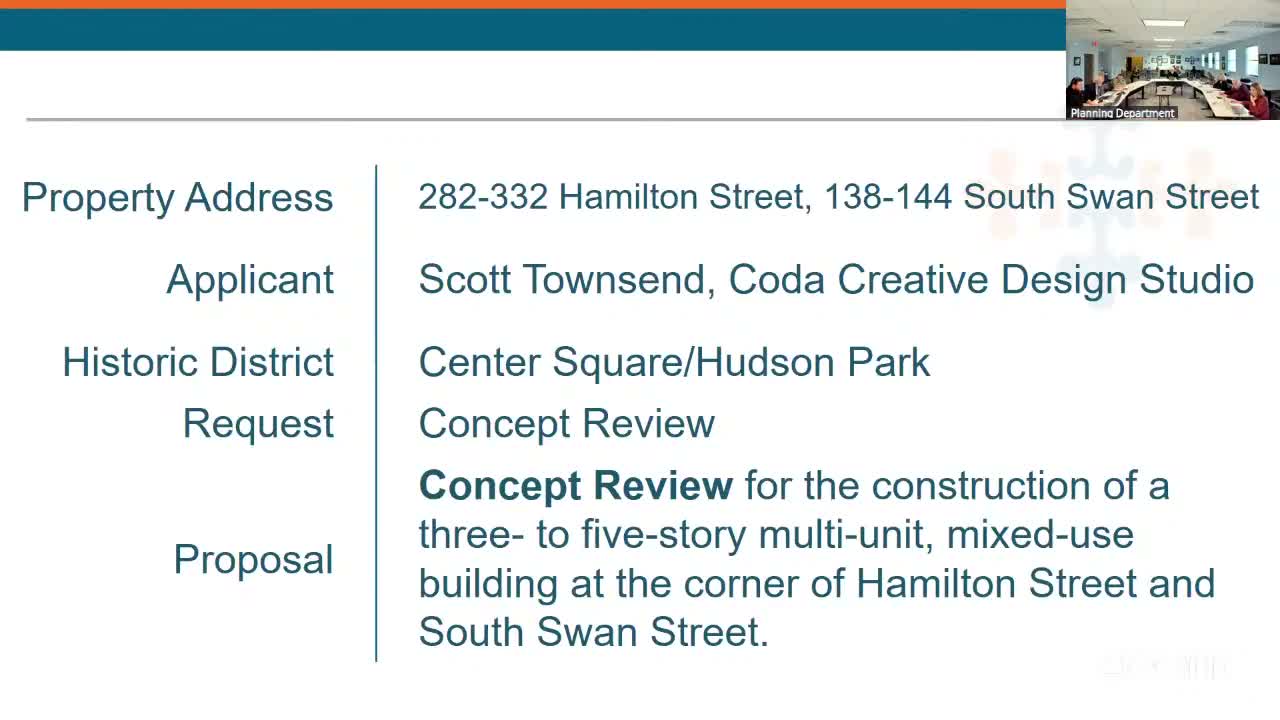
Trinity Financial presented preliminary massing and height concepts for an infill development on a vacant parcel at Hamilton Street and South Swan Street in Albany's Center Square historic area, and the Historic Resources Commission used the workshop to provide early feedback focused on scale and context.
The presenter, identified as representing Trinity Financial and speaking as the project architect/lead, said the team was showing schematic precedents and asked the commission to weigh in on height and massing before the project advanced to materials and fenestration. He emphasized a collaborative approach to ensure the new building "reads" as appropriate to the block while acknowledging it will be contemporary and will likely include residential units and some community-facing ground-floor uses.
Commissioners pushed the team to break the building into readable vertical modules and to step down the massing as the project approaches existing historic structures. One commissioner said the neighborhood's predominant vertical module is roughly 18–22 feet and urged the team to respect that rhythm rather than treat the block as a single uninterrupted façade. Commissioners also recommended exploring mechanical-service independence (to avoid tying many units into a single centralized system) and adding street-level entries and commercial or community spaces to animate the block.
Program and timing: The presenter acknowledged many program elements were undecided (unit tenure and exact community uses) and that planning-board, state environmental review and financing steps remain. Staff said the project will likely require state environmental review and that if state funding is involved the State Historic Preservation Office would be an involved agency. The presenter estimated several months of design and planning work over the coming summer and fall before seeking formal approvals.
Archaeology and outreach: Commissioners and staff said a Phase I archaeological sensitivity assessment would be appropriate for the site given its location and scale. Staff also encouraged the applicant to coordinate with planning staff on future filings and community engagement.
Next steps: The team will return with refined proposals; commissioners expect to see refined massing that breaks the building into distinct modules, more detailed elevations showing how cornice lines and rhythm will respond to the district, and information about how ground-floor spaces will engage the neighborhood.
The presenter, identified as representing Trinity Financial and speaking as the project architect/lead, said the team was showing schematic precedents and asked the commission to weigh in on height and massing before the project advanced to materials and fenestration. He emphasized a collaborative approach to ensure the new building "reads" as appropriate to the block while acknowledging it will be contemporary and will likely include residential units and some community-facing ground-floor uses.
Commissioners pushed the team to break the building into readable vertical modules and to step down the massing as the project approaches existing historic structures. One commissioner said the neighborhood's predominant vertical module is roughly 18–22 feet and urged the team to respect that rhythm rather than treat the block as a single uninterrupted façade. Commissioners also recommended exploring mechanical-service independence (to avoid tying many units into a single centralized system) and adding street-level entries and commercial or community spaces to animate the block.
Program and timing: The presenter acknowledged many program elements were undecided (unit tenure and exact community uses) and that planning-board, state environmental review and financing steps remain. Staff said the project will likely require state environmental review and that if state funding is involved the State Historic Preservation Office would be an involved agency. The presenter estimated several months of design and planning work over the coming summer and fall before seeking formal approvals.
Archaeology and outreach: Commissioners and staff said a Phase I archaeological sensitivity assessment would be appropriate for the site given its location and scale. Staff also encouraged the applicant to coordinate with planning staff on future filings and community engagement.
Next steps: The team will return with refined proposals; commissioners expect to see refined massing that breaks the building into distinct modules, more detailed elevations showing how cornice lines and rhythm will respond to the district, and information about how ground-floor spaces will engage the neighborhood.
View the Full Meeting & All Its Details
This article offers just a summary. Unlock complete video, transcripts, and insights as a Founder Member.
✓
Watch full, unedited meeting videos
✓
Search every word spoken in unlimited transcripts
✓
AI summaries & real-time alerts (all government levels)
✓
Permanent access to expanding government content
30-day money-back guarantee
