Neighbors split over East Hampton proposal to buy 13.5 acres in Wainscott for housing
May 08, 2026 | EAST HAMPTON UNION FREE SCHOOL DISTRICT, School Districts, New York
This article was created by AI summarizing key points discussed. AI makes mistakes, so for full details and context, please refer to the video of the full meeting. Please report any errors so we can fix them. Report an error »
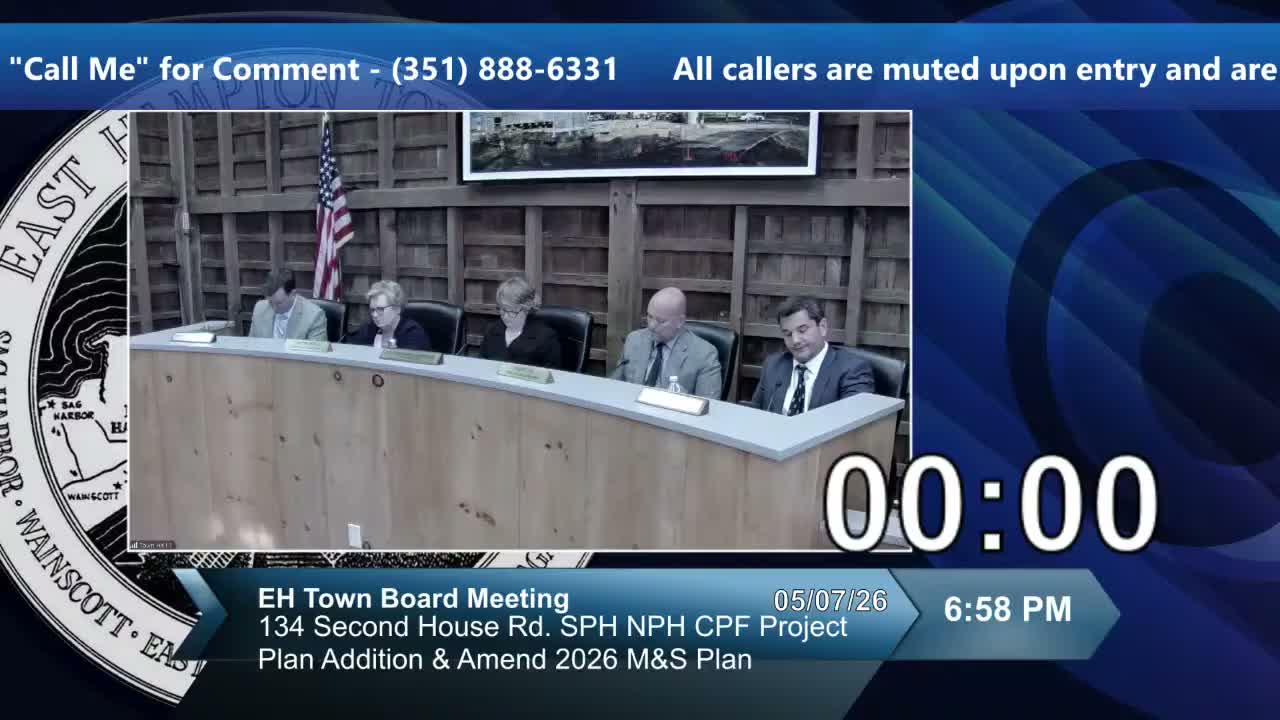
The East Hampton Town Board heard sharply divided public comment on May 7 about a proposed purchase of 13.5 acres at 549 and 550 Wainscott Northwest Road using Community Housing Fund dollars.
Town staff described the parcel as a rare, vacant, flat tract a short walk from Route 114 and recommended acquiring it to preserve options for future affordable housing. "This is a rare opportunity to preserve and land-bank a property for housing purposes," Katie Casey, executive director of the East Hampton Housing Authority, told the board in person.
Opponents — many of them immediate neighbors — urged the board to slow down and fully apply environmental review. Alon Rosenthal said the parcel lies adjacent to his property and argued the town's own preservation plan and water-recharge maps designate the area for aquifer protection. "This is an illegal purchase that does not follow the law," Rosenthal said, adding he and neighbors would challenge the acquisition in court if the board proceeds.
Christopher Kozak, a long-border neighbor, asked whether the town would acknowledge that future development would trigger a SEQRA review and questioned whether land-banking alone is permitted under the Community Housing Fund rules. Several speakers noted the property is within an East Hampton Water Recharge Overlay (WRO) and said any development would be constrained by aquifer protections and clearing limits.
Supporters of the purchase argued the Community Housing Fund was created precisely to enable opportunistic acquisitions to secure land before private developers do. Jane Mearing and other supporters proposed "pocket neighborhood" designs that, they said, could preserve 70% of the parcel while delivering dozens of smaller affordable units.
Board members did not vote on an acquisition at the May 7 meeting; the hearing received written and oral submissions and will be followed by further public review. The town clerk recorded numerous letters and materials for the record.
The hearing underscored competing priorities: environmental protection and long-standing town zoning versus an urgent local demand for affordable housing and the rarity of suitable parcels.
Town staff described the parcel as a rare, vacant, flat tract a short walk from Route 114 and recommended acquiring it to preserve options for future affordable housing. "This is a rare opportunity to preserve and land-bank a property for housing purposes," Katie Casey, executive director of the East Hampton Housing Authority, told the board in person.
Opponents — many of them immediate neighbors — urged the board to slow down and fully apply environmental review. Alon Rosenthal said the parcel lies adjacent to his property and argued the town's own preservation plan and water-recharge maps designate the area for aquifer protection. "This is an illegal purchase that does not follow the law," Rosenthal said, adding he and neighbors would challenge the acquisition in court if the board proceeds.
Christopher Kozak, a long-border neighbor, asked whether the town would acknowledge that future development would trigger a SEQRA review and questioned whether land-banking alone is permitted under the Community Housing Fund rules. Several speakers noted the property is within an East Hampton Water Recharge Overlay (WRO) and said any development would be constrained by aquifer protections and clearing limits.
Supporters of the purchase argued the Community Housing Fund was created precisely to enable opportunistic acquisitions to secure land before private developers do. Jane Mearing and other supporters proposed "pocket neighborhood" designs that, they said, could preserve 70% of the parcel while delivering dozens of smaller affordable units.
Board members did not vote on an acquisition at the May 7 meeting; the hearing received written and oral submissions and will be followed by further public review. The town clerk recorded numerous letters and materials for the record.
The hearing underscored competing priorities: environmental protection and long-standing town zoning versus an urgent local demand for affordable housing and the rarity of suitable parcels.
View the Full Meeting & All Its Details
This article offers just a summary. Unlock complete video, transcripts, and insights as a Founder Member.
✓
Watch full, unedited meeting videos
✓
Search every word spoken in unlimited transcripts
✓
AI summaries & real-time alerts (all government levels)
✓
Permanent access to expanding government content
30-day money-back guarantee
