City auditor verifies $22.9M baseline for Sacramento Children’s Fund; audited cannabis tax lowers FY25 transfer
May 08, 2026 | Sacramento , Sacramento County, California
This article was created by AI summarizing key points discussed. AI makes mistakes, so for full details and context, please refer to the video of the full meeting. Please report any errors so we can fix them. Report an error »
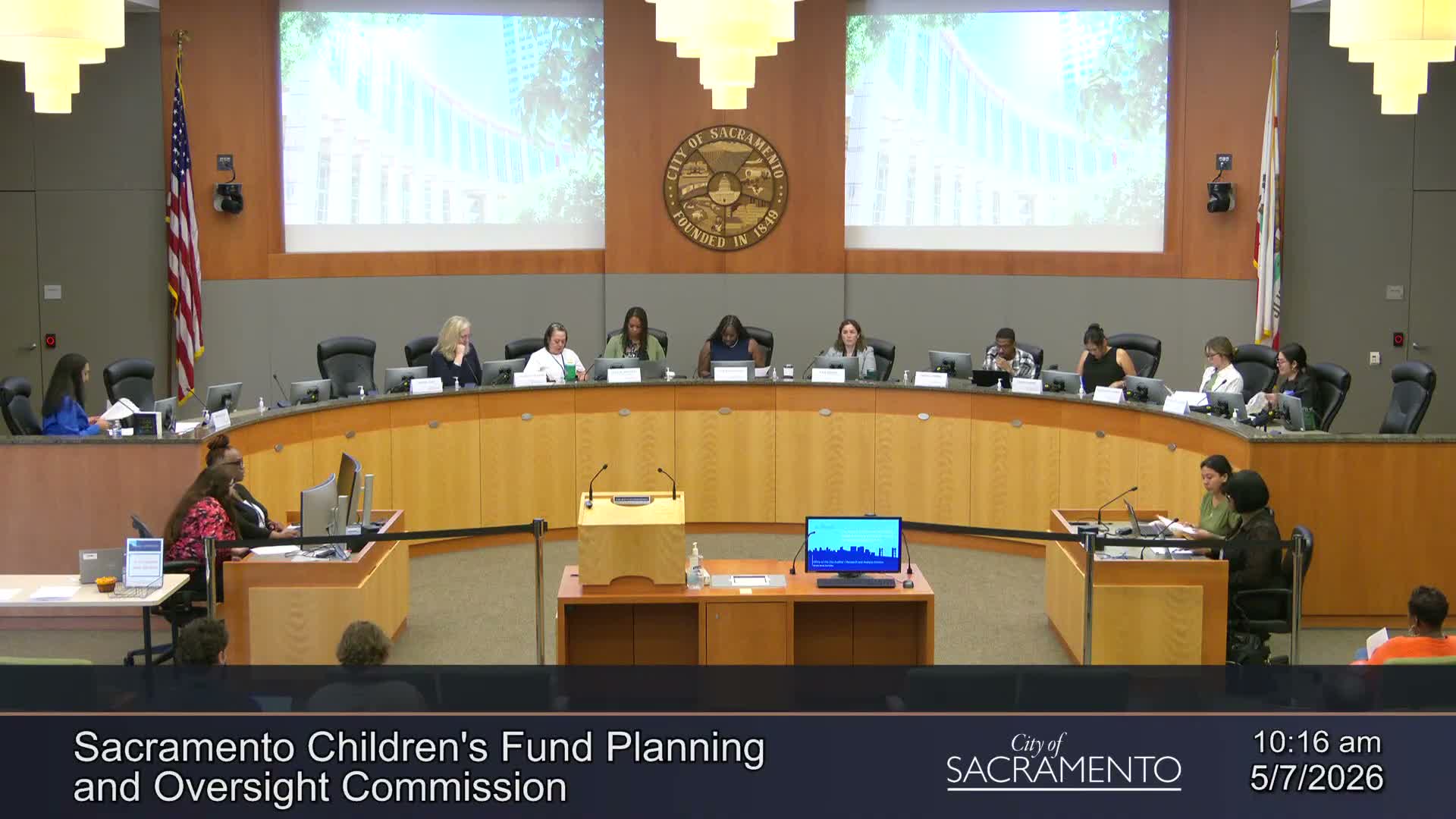
The city auditor’s office told the Sacramento Children’s Fund Planning and Oversight Commission on May 7 that it verified the charter’s baseline funding amount at $22,900,000 for fiscal year 2024–25 and that audited cannabis business operations tax (CBOT) receipts came in below estimate, producing a roughly $9,040,000 contribution to the fund for FY24–25.
"Per section 1 20 of the city charter subsection e 1 c, the city auditor fulfilled its obligation to calculate the baseline funding amount to be $22,900,000," Joe Fleming, the senior fiscal policy analyst who led the audit work, said during the presentation. Fleming told commissioners the audit reviewed city expenditures between July 1, 2024, and June 30, 2025, and verified eligible youth-related expenditures net of program revenues against charter criteria.
Fleming also reported audited CBOT revenue of $22,609,932 for FY24–25 and explained how the year-end true-up produced a contribution of approximately $9,040,000 to the Children’s Fund, equal to 40% of the audited CBOT amount. "For fiscal year 24, 25, the audit amount of the CBOT revenue was approximately 22,600,000," Fleming said; after the finance department’s true-up, "the total amount contributed to the children's fund for fiscal year 25 was approximately $9,040,000."
Why it matters: the charter requires the auditor to verify a baseline so that Measure L dollars supplement, rather than supplant, existing city spending on youth services. The auditor’s verification confirms the baseline calculation and documents which city programs and departments were counted toward that amount.
How the audit was done and limitations: auditor staff said they reviewed programs departments identified as youth-related and confirmed whether expenditures matched charter eligibility criteria; in some cases they relied on management estimates to allocate portions of program or administrative costs to youth services. Fleming cautioned that the team "did not conduct independent audit procedures to validate the accuracy or completeness of management estimations" and said the current report, prepared for an "odd year" baseline verification, focuses on expenditures necessary to reach the baseline rather than all eligible youth spending across all departments.
Commissioners asked whether the audit examined equity in funding distribution and how Measure L and Measure U monies relate to the baseline. "In the language of the charter, it didn't have any stipulations for how we looked at equity," Fleming said, adding that equity fell outside the scope of the charter-defined baseline verification. Staff clarified to the commission that the baseline verification reflects city-funded programs (unrestricted general fund and Measure U) and does not include Measure L grantees.
Department highlights and next steps: Fleming said the Parks and Community Enrichment Department accounted for the largest share of eligible audited expenditures (16 eligible programs totaling just over $13 million), followed by Community Response (about $3.2 million) and the Office of Violence Prevention (across three eligible programs). The auditor’s office said it has updated a web page with the full reports and that next year’s report (an even-year report) will include a more comprehensive accounting of eligible youth expenditures across all departments.
The commission did not take a formal vote on this audit presentation; commissioners asked for follow-up materials and for staff to circulate updated progress- and funding-overview documents.
"Per section 1 20 of the city charter subsection e 1 c, the city auditor fulfilled its obligation to calculate the baseline funding amount to be $22,900,000," Joe Fleming, the senior fiscal policy analyst who led the audit work, said during the presentation. Fleming told commissioners the audit reviewed city expenditures between July 1, 2024, and June 30, 2025, and verified eligible youth-related expenditures net of program revenues against charter criteria.
Fleming also reported audited CBOT revenue of $22,609,932 for FY24–25 and explained how the year-end true-up produced a contribution of approximately $9,040,000 to the Children’s Fund, equal to 40% of the audited CBOT amount. "For fiscal year 24, 25, the audit amount of the CBOT revenue was approximately 22,600,000," Fleming said; after the finance department’s true-up, "the total amount contributed to the children's fund for fiscal year 25 was approximately $9,040,000."
Why it matters: the charter requires the auditor to verify a baseline so that Measure L dollars supplement, rather than supplant, existing city spending on youth services. The auditor’s verification confirms the baseline calculation and documents which city programs and departments were counted toward that amount.
How the audit was done and limitations: auditor staff said they reviewed programs departments identified as youth-related and confirmed whether expenditures matched charter eligibility criteria; in some cases they relied on management estimates to allocate portions of program or administrative costs to youth services. Fleming cautioned that the team "did not conduct independent audit procedures to validate the accuracy or completeness of management estimations" and said the current report, prepared for an "odd year" baseline verification, focuses on expenditures necessary to reach the baseline rather than all eligible youth spending across all departments.
Commissioners asked whether the audit examined equity in funding distribution and how Measure L and Measure U monies relate to the baseline. "In the language of the charter, it didn't have any stipulations for how we looked at equity," Fleming said, adding that equity fell outside the scope of the charter-defined baseline verification. Staff clarified to the commission that the baseline verification reflects city-funded programs (unrestricted general fund and Measure U) and does not include Measure L grantees.
Department highlights and next steps: Fleming said the Parks and Community Enrichment Department accounted for the largest share of eligible audited expenditures (16 eligible programs totaling just over $13 million), followed by Community Response (about $3.2 million) and the Office of Violence Prevention (across three eligible programs). The auditor’s office said it has updated a web page with the full reports and that next year’s report (an even-year report) will include a more comprehensive accounting of eligible youth expenditures across all departments.
The commission did not take a formal vote on this audit presentation; commissioners asked for follow-up materials and for staff to circulate updated progress- and funding-overview documents.
View the Full Meeting & All Its Details
This article offers just a summary. Unlock complete video, transcripts, and insights as a Founder Member.
✓
Watch full, unedited meeting videos
✓
Search every word spoken in unlimited transcripts
✓
AI summaries & real-time alerts (all government levels)
✓
Permanent access to expanding government content
30-day money-back guarantee
