City awards up to $8M for guaranteed income pilot, previews 2027 RFP and data improvements
May 08, 2026 | Sacramento , Sacramento County, California
This article was created by AI summarizing key points discussed. AI makes mistakes, so for full details and context, please refer to the video of the full meeting. Please report any errors so we can fix them. Report an error »
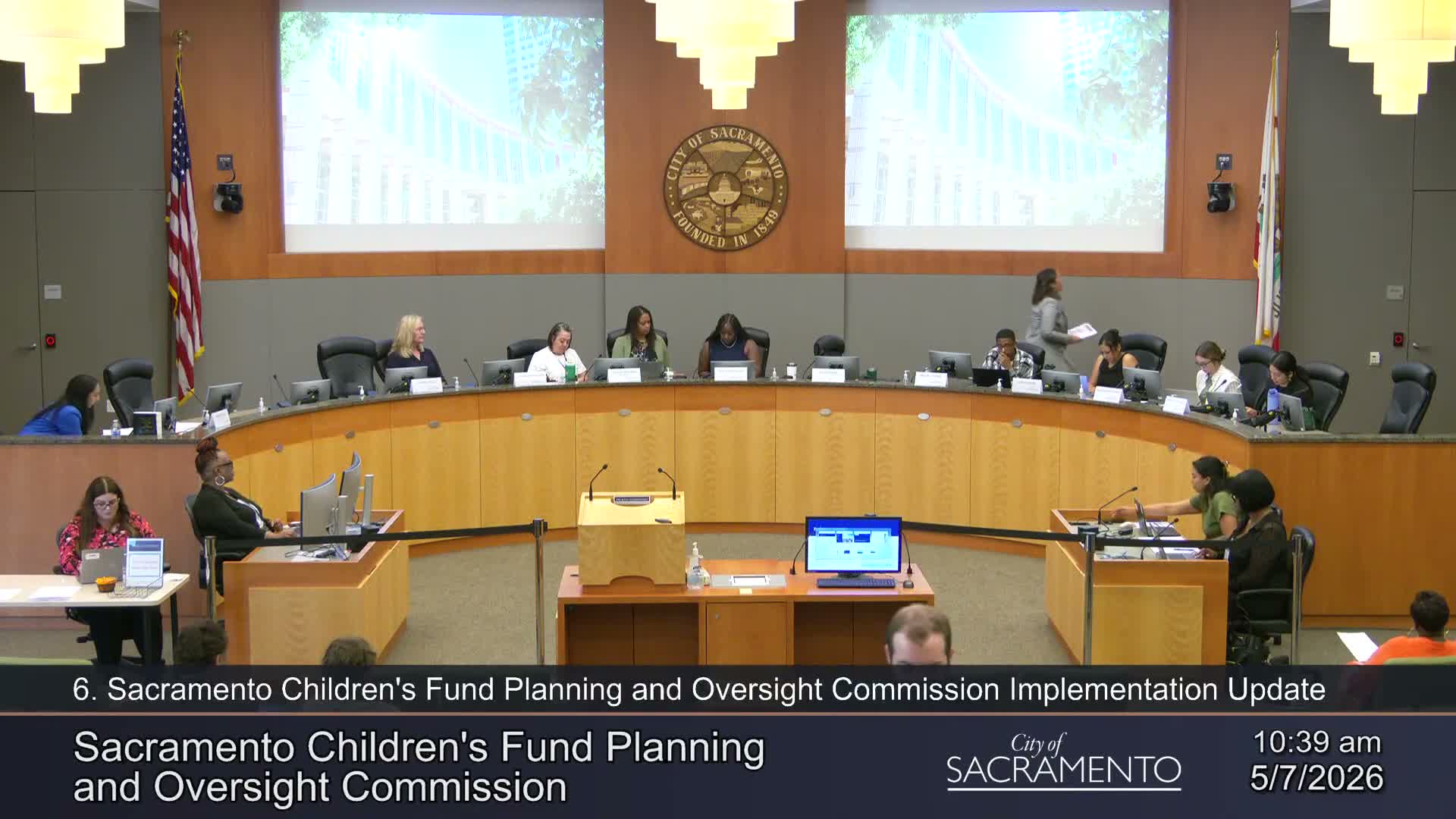
City staff told the Sacramento Children’s Fund Planning and Oversight Commission on May 7 that City Council approved a contract award of up to $8,000,000 to United Way California Capital Region to operate a guaranteed basic income (GBI) program for transitional-age foster youth, and staff outlined plans for a second-round RFP and improvements to data collection and evaluation.
"We have officially awarded United Way California Capital Region with up to $8,000,000 for a guaranteed basic income for transitional age foster youth program," staff said. The presenter said the contract is near execution and the program is slated to begin July 1, 2026.
Staff also described the evaluation and reporting approach. The commission was told that Harder and Company has been contracted for a five-year evaluation and has begun information gathering and planning a monitoring, evaluation and learning framework; staff said they will bring the evaluator to present to the commission at a later date when findings and framework are further developed.
On future funding and RFP timing, staff said a second-round open grant RFP for the five-year strategic investment plan is tentatively set for release in 2027 with a January 1, 2028 funding start. If CBOT remains at FY25 audited levels, staff projected the second-round RFP could be released for approximately $13,800,000 in total, which staff said would split roughly $6.9 million for community-based organizations and $6.9 million for the City and other public entities, with contract language tying payments to performance and funding availability.
Commissioners pressed staff on data and equity. Multiple commissioners noted that reporting from CBOs is incomplete and flagged small counts among priority populations — for example, the draft progress report showed eight youth transitioning out of foster care and about 20 youth exposed to violence — and asked how to improve collection without creating burdensome reporting requirements. Staff said CBO reporting is new, many of the requested demographic indicators are optional in existing templates, and the contracted evaluator will help standardize indicators and balance data needs with trauma-informed practice.
Commissioners also proposed actions for staff and the commission: asking staff to circulate a funding-overview document (already in the follow-up log), consider grant-writing supports for smaller CBOs, and to draft RFP language or SIP recommendations to better direct future funding toward priority goals. One commissioner suggested starting with even percentage splits across the five fund goals (20% each) as a possible approach to ensure more even investment across goals; staff reiterated that while the commission can recommend RFP language, some changes to splits would require City Council action because splits were adopted by council.
Next steps: commissioners agreed to agendize a June discussion to consider proposed edits (for example, to the mental-health definition and target populations), asked staff to circulate the Office of Violence Prevention materials, and to track requests via the follow-up log.
"We have officially awarded United Way California Capital Region with up to $8,000,000 for a guaranteed basic income for transitional age foster youth program," staff said. The presenter said the contract is near execution and the program is slated to begin July 1, 2026.
Staff also described the evaluation and reporting approach. The commission was told that Harder and Company has been contracted for a five-year evaluation and has begun information gathering and planning a monitoring, evaluation and learning framework; staff said they will bring the evaluator to present to the commission at a later date when findings and framework are further developed.
On future funding and RFP timing, staff said a second-round open grant RFP for the five-year strategic investment plan is tentatively set for release in 2027 with a January 1, 2028 funding start. If CBOT remains at FY25 audited levels, staff projected the second-round RFP could be released for approximately $13,800,000 in total, which staff said would split roughly $6.9 million for community-based organizations and $6.9 million for the City and other public entities, with contract language tying payments to performance and funding availability.
Commissioners pressed staff on data and equity. Multiple commissioners noted that reporting from CBOs is incomplete and flagged small counts among priority populations — for example, the draft progress report showed eight youth transitioning out of foster care and about 20 youth exposed to violence — and asked how to improve collection without creating burdensome reporting requirements. Staff said CBO reporting is new, many of the requested demographic indicators are optional in existing templates, and the contracted evaluator will help standardize indicators and balance data needs with trauma-informed practice.
Commissioners also proposed actions for staff and the commission: asking staff to circulate a funding-overview document (already in the follow-up log), consider grant-writing supports for smaller CBOs, and to draft RFP language or SIP recommendations to better direct future funding toward priority goals. One commissioner suggested starting with even percentage splits across the five fund goals (20% each) as a possible approach to ensure more even investment across goals; staff reiterated that while the commission can recommend RFP language, some changes to splits would require City Council action because splits were adopted by council.
Next steps: commissioners agreed to agendize a June discussion to consider proposed edits (for example, to the mental-health definition and target populations), asked staff to circulate the Office of Violence Prevention materials, and to track requests via the follow-up log.
View the Full Meeting & All Its Details
This article offers just a summary. Unlock complete video, transcripts, and insights as a Founder Member.
✓
Watch full, unedited meeting videos
✓
Search every word spoken in unlimited transcripts
✓
AI summaries & real-time alerts (all government levels)
✓
Permanent access to expanding government content
30-day money-back guarantee
