Senate Health & Welfare advances H.938 draft while members haggle over notice, rule dates and case-management language
May 08, 2026 | Health & Welfare, SENATE, Committees, Legislative , Vermont
This article was created by AI summarizing key points discussed. AI makes mistakes, so for full details and context, please refer to the video of the full meeting. Please report any errors so we can fix them. Report an error »
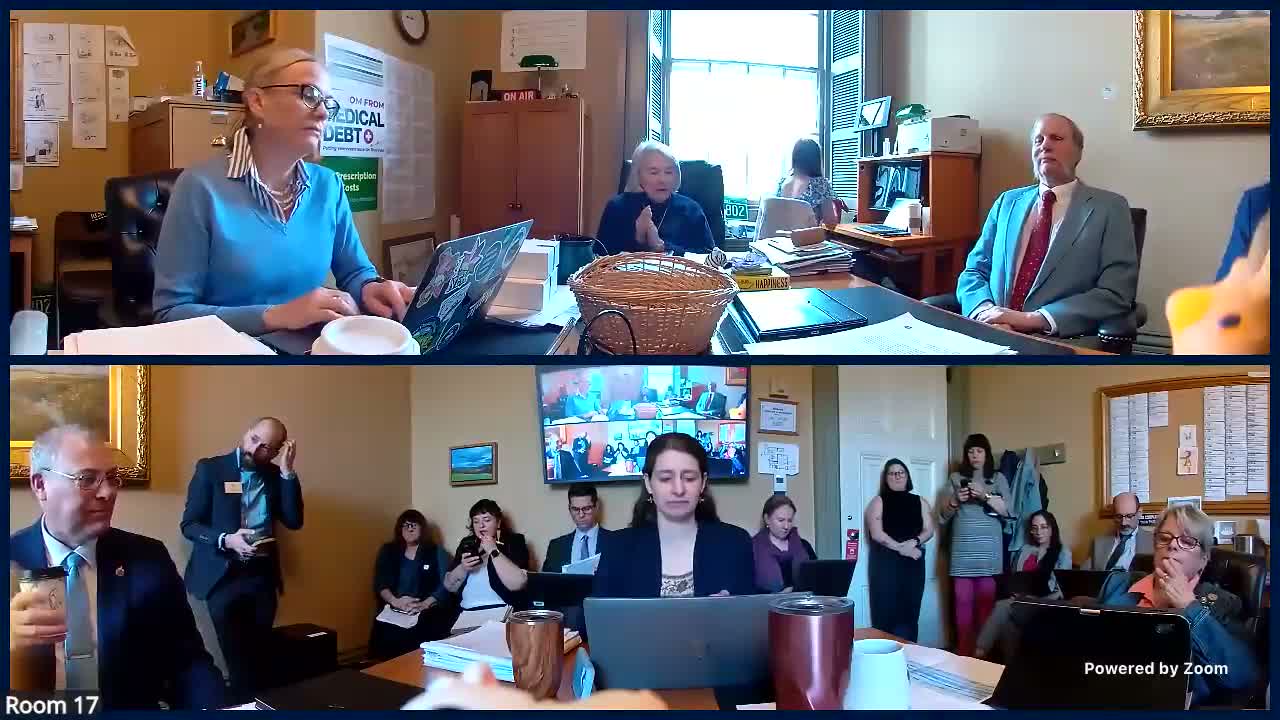
The Senate Health & Welfare Committee reviewed draft 3.1 of H.938 on May 8, with members aiming to complete final markup and vote on the bill at 9:00 a.m. on either Tuesday or Wednesday next week, the committee chair said.
The bill would establish a statewide “continuum” of emergency housing supports and make funding opportunities available to a broader range of entities. Committee members and agency officials focused much of the session on operational details — how and when rules will be drafted, how participants must be notified of reductions or terminations, and what obligations program participants must accept to remain eligible.
Why it matters: H.938 is intended to reduce reliance on hotels and motels for emergency housing and to create coordinated pathways to permanent housing. The committee’s choices about notice procedures, rulemaking timelines and eligibility criteria will shape how quickly the program can be implemented and how providers will operate on the ground.
Agency concerns over a 30‑day notice requirement surfaced early in the discussion. Bridal Atwood of the Agency of Human Services told the committee that “in many cases, in fact, over half participants are not allotted a time period more than 30 days, so it would be infeasible for us to meet that requirement,” arguing the draft’s fixed 30‑day advance notice for terminations or reductions would be operationally unworkable. Committee members and advocates agreed to replace the strict 30‑day trigger with a more flexible ‘‘adequate notice’’ formulation and to limit the statutory list of acceptable delivery methods to modes the agency can reliably provide (email and U.S. mail), with further detail to be refined in rulemaking.
The committee also debated rulemaking deadlines. Staff said the draft had moved an emergency‑rule deadline from July 1, 2026, to Aug. 15, 2026, and required the department to hold five regional stakeholder hearings. Agency representatives pressed for additional time to draft substantive permanent rules; they proposed an emergency rule in September, draft rules in July 2027 and final rules by October 2027. Committee members pressed back, and a compromise timeline (including an earlier draft submission for committee review) was discussed for staff to refine before the next meeting.
Members discussed program scope and priorities for the Vermont Rental Assistance Bridge Program. Susan Aronoff of the Vermont Developmental Disabilities Council referenced the Road Home Report and urged that the bill not exclude people exiting institutional settings or at risk of institutionalization; legislators and agency staff discussed language that would give priority to people exiting homelessness in FY27 while preserving a mechanism for the agency and the state housing authority to identify additional eligible populations after further study.
A central policy tension emerged over household responsibilities: whether items such as developing a housing plan, engaging in case management and participating in employment or treatment programs should be mandatory conditions of eligibility. Alex Grama of the ACLU of Vermont warned against language that could be read as mandating treatment, saying it risked coercing people into services. Provider representatives and AHS countered that active engagement with services is a proven route to housing stability. The group coalesced around requiring participants to “agree to engage with a lead case manager” and to develop an individualized housing plan, while keeping participation in treatment or employment activities as appropriate and preserving explicit exemptions required by federal law.
The draft also includes budget adjustments and reporting requirements: staff noted a $500,000 reduction in the hotels/motels appropriation with a new $500,000 line for a community resource center drawn from base General Assistance funding, and the bill would require periodic written reports about how funds have been spent.
What comes next: staff were directed to redraft the bill language to reflect the committee’s decisions on notice language, case‑management expectations and a workable rulemaking timeline. The chair said the committee will take up the final draft and then vote next week during the scheduled 9:00 a.m. session. No formal vote occurred during the May 8 meeting.
Sources and attributions: reporting in this article is based solely on committee proceedings and statements in the May 8 transcript. Quotes and attributions are limited to speakers recorded in the hearing.
The bill would establish a statewide “continuum” of emergency housing supports and make funding opportunities available to a broader range of entities. Committee members and agency officials focused much of the session on operational details — how and when rules will be drafted, how participants must be notified of reductions or terminations, and what obligations program participants must accept to remain eligible.
Why it matters: H.938 is intended to reduce reliance on hotels and motels for emergency housing and to create coordinated pathways to permanent housing. The committee’s choices about notice procedures, rulemaking timelines and eligibility criteria will shape how quickly the program can be implemented and how providers will operate on the ground.
Agency concerns over a 30‑day notice requirement surfaced early in the discussion. Bridal Atwood of the Agency of Human Services told the committee that “in many cases, in fact, over half participants are not allotted a time period more than 30 days, so it would be infeasible for us to meet that requirement,” arguing the draft’s fixed 30‑day advance notice for terminations or reductions would be operationally unworkable. Committee members and advocates agreed to replace the strict 30‑day trigger with a more flexible ‘‘adequate notice’’ formulation and to limit the statutory list of acceptable delivery methods to modes the agency can reliably provide (email and U.S. mail), with further detail to be refined in rulemaking.
The committee also debated rulemaking deadlines. Staff said the draft had moved an emergency‑rule deadline from July 1, 2026, to Aug. 15, 2026, and required the department to hold five regional stakeholder hearings. Agency representatives pressed for additional time to draft substantive permanent rules; they proposed an emergency rule in September, draft rules in July 2027 and final rules by October 2027. Committee members pressed back, and a compromise timeline (including an earlier draft submission for committee review) was discussed for staff to refine before the next meeting.
Members discussed program scope and priorities for the Vermont Rental Assistance Bridge Program. Susan Aronoff of the Vermont Developmental Disabilities Council referenced the Road Home Report and urged that the bill not exclude people exiting institutional settings or at risk of institutionalization; legislators and agency staff discussed language that would give priority to people exiting homelessness in FY27 while preserving a mechanism for the agency and the state housing authority to identify additional eligible populations after further study.
A central policy tension emerged over household responsibilities: whether items such as developing a housing plan, engaging in case management and participating in employment or treatment programs should be mandatory conditions of eligibility. Alex Grama of the ACLU of Vermont warned against language that could be read as mandating treatment, saying it risked coercing people into services. Provider representatives and AHS countered that active engagement with services is a proven route to housing stability. The group coalesced around requiring participants to “agree to engage with a lead case manager” and to develop an individualized housing plan, while keeping participation in treatment or employment activities as appropriate and preserving explicit exemptions required by federal law.
The draft also includes budget adjustments and reporting requirements: staff noted a $500,000 reduction in the hotels/motels appropriation with a new $500,000 line for a community resource center drawn from base General Assistance funding, and the bill would require periodic written reports about how funds have been spent.
What comes next: staff were directed to redraft the bill language to reflect the committee’s decisions on notice language, case‑management expectations and a workable rulemaking timeline. The chair said the committee will take up the final draft and then vote next week during the scheduled 9:00 a.m. session. No formal vote occurred during the May 8 meeting.
Sources and attributions: reporting in this article is based solely on committee proceedings and statements in the May 8 transcript. Quotes and attributions are limited to speakers recorded in the hearing.
Don't Miss a Word: See the Full Meeting!
Go beyond summaries. Unlock every video, transcript, and key insight with a Founder Membership.
✓
Get instant access to full meeting videos
✓
Search and clip any phrase from complete transcripts
✓
Receive AI-powered summaries & custom alerts
✓
Enjoy lifetime, unrestricted access to government data
30-day money-back guarantee
