Arts Commission debates draft 'Arts in Public Places' ordinance; developers' incentives and thresholds draw scrutiny
May 08, 2026 | Costa Mesa, Orange County, California
This article was created by AI summarizing key points discussed. AI makes mistakes, so for full details and context, please refer to the video of the full meeting. Please report any errors so we can fix them. Report an error »
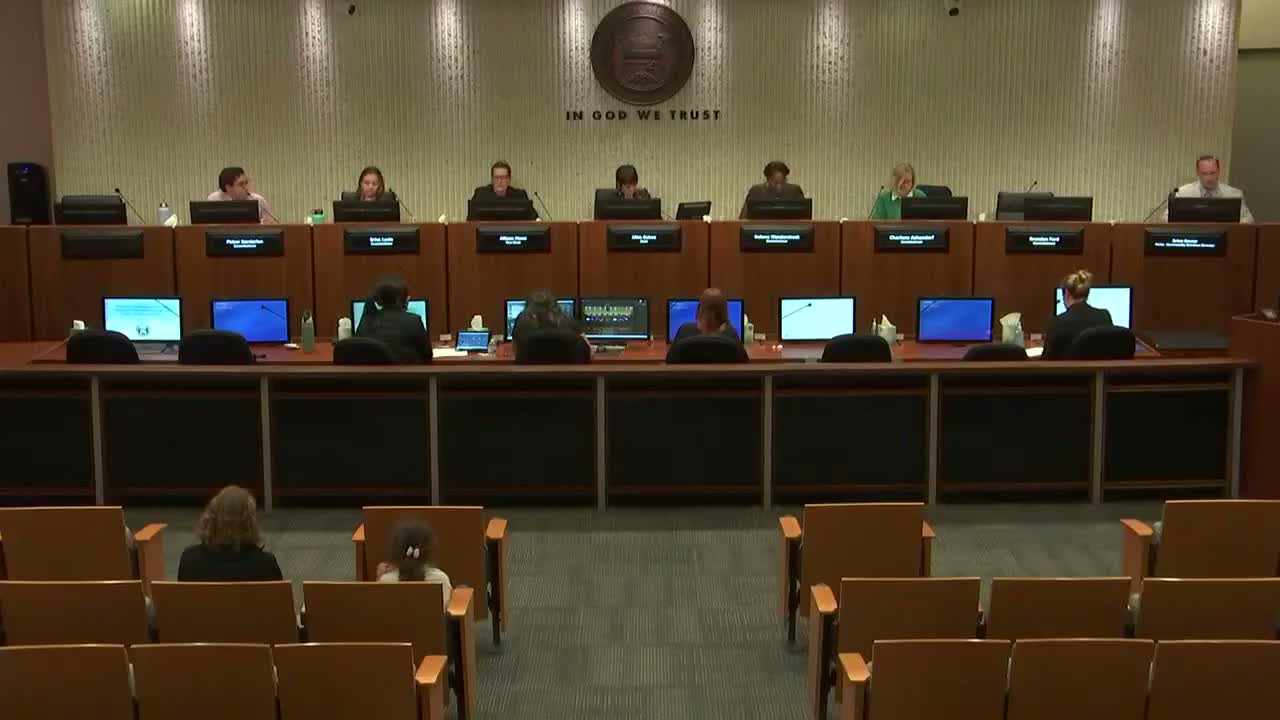
The Costa Mesa Arts Commission reviewed a draft "Arts in Public Places" ordinance on May 7 that would formalize how the city funds public art for capital projects and consider an optional approach for private development.
Staff presented supporting documents — a 2024–25 permit issuance report and the public works five-year capital improvement plan — to show potential project volume and costs. In the draft, staff proposed keeping a 1% allocation for public projects and adding an optional component for private development; the draft includes a $500,000 minimum project threshold for public works to qualify for the program.
"I just added an optional thing for private development," Loretta Garner, the city’s art specialist, said describing the draft. She explained the draft allows the city to consider private projects on a case-by-case basis and flagged the need for further refinement of the language.
Commissioners questioned how incentives would work for private developers. Vice Chair Tederian and Commissioner Duderian discussed a proposed $20,000 contribution option that could be paired with relief through the Economic Recovery and Community Enhancement Fund, including an example that would reduce an interest rate from about 3% to 2% for deferred payments. Commissioner Duderian said he had spoken with developers and representatives of the building industry who found the draft unclear and cautioned it could prompt pushback if requirements were perceived as adding complexity or cost.
Commissioners also asked whether maintenance funding or a deaccessioning policy should be included; staff said different ordinance versions exist and maintenance could be incorporated or handled administratively.
Chair Tara Ochoa moved to forward the draft to city council for deliberation and discussion; the motion was seconded. Staff later clarified that the item had been placed on the agenda for review and discussion only and that a formal vote on an ordinance would require a revised, agendized item. Commissioners asked staff to clean up the draft language and return with a revised version before council submittal.
The discussion identified the draft’s key policy choices — a $500,000 threshold, optional private-development pathway, and incentive structure — and commissioners requested clearer examples and automatic vs. discretionary process language before the commission forwards the proposal to council.
Staff presented supporting documents — a 2024–25 permit issuance report and the public works five-year capital improvement plan — to show potential project volume and costs. In the draft, staff proposed keeping a 1% allocation for public projects and adding an optional component for private development; the draft includes a $500,000 minimum project threshold for public works to qualify for the program.
"I just added an optional thing for private development," Loretta Garner, the city’s art specialist, said describing the draft. She explained the draft allows the city to consider private projects on a case-by-case basis and flagged the need for further refinement of the language.
Commissioners questioned how incentives would work for private developers. Vice Chair Tederian and Commissioner Duderian discussed a proposed $20,000 contribution option that could be paired with relief through the Economic Recovery and Community Enhancement Fund, including an example that would reduce an interest rate from about 3% to 2% for deferred payments. Commissioner Duderian said he had spoken with developers and representatives of the building industry who found the draft unclear and cautioned it could prompt pushback if requirements were perceived as adding complexity or cost.
Commissioners also asked whether maintenance funding or a deaccessioning policy should be included; staff said different ordinance versions exist and maintenance could be incorporated or handled administratively.
Chair Tara Ochoa moved to forward the draft to city council for deliberation and discussion; the motion was seconded. Staff later clarified that the item had been placed on the agenda for review and discussion only and that a formal vote on an ordinance would require a revised, agendized item. Commissioners asked staff to clean up the draft language and return with a revised version before council submittal.
The discussion identified the draft’s key policy choices — a $500,000 threshold, optional private-development pathway, and incentive structure — and commissioners requested clearer examples and automatic vs. discretionary process language before the commission forwards the proposal to council.
View the Full Meeting & All Its Details
This article offers just a summary. Unlock complete video, transcripts, and insights as a Founder Member.
✓
Watch full, unedited meeting videos
✓
Search every word spoken in unlimited transcripts
✓
AI summaries & real-time alerts (all government levels)
✓
Permanent access to expanding government content
30-day money-back guarantee
