Fairfax County School Board rejects several calendar changes after hours of debate
May 08, 2026 | FAIRFAX CO PBLC SCHS, School Districts, Virginia
This article was created by AI summarizing key points discussed. AI makes mistakes, so for full details and context, please refer to the video of the full meeting. Please report any errors so we can fix them. Report an error »
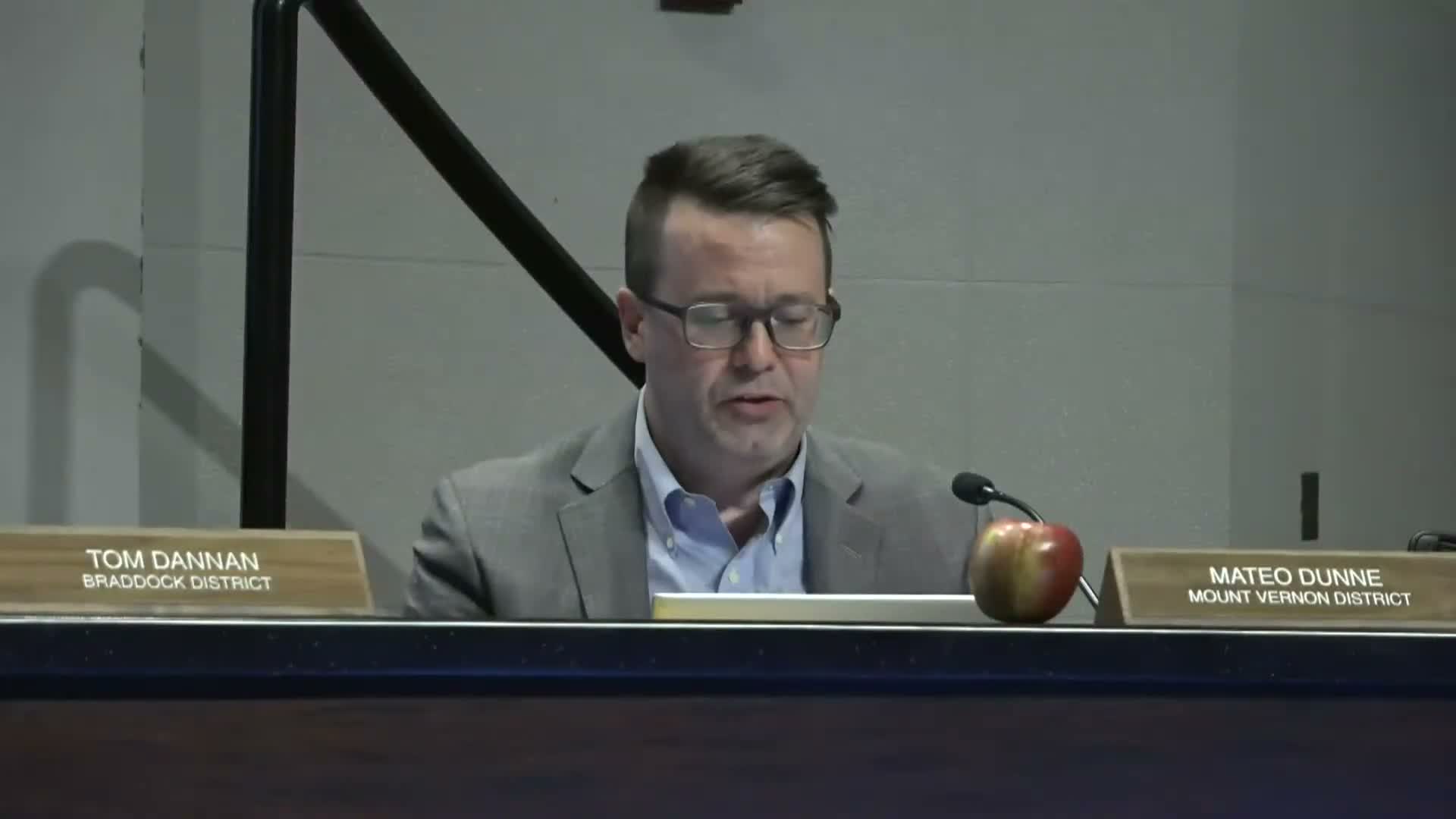
After more than two hours of public and board discussion over calendar policy, the Fairfax County School Board on May 7 rejected a package of motions that would have set concrete targets for restoring five‑day instructional weeks and made other calendar changes, while approving a separate study of year‑round or "balanced" calendars.
Board member James Dunn (speaker 30), who introduced the motion seeking a target of at least two‑thirds of school weeks to be full five‑day weeks, framed his proposal as an equity and instructional‑continuity measure: "The data is unambiguous," he said, arguing that predictable routines benefit students, especially neurodivergent learners. Supporters said fragmentation of the current calendar harms low‑income and special‑education students, creates child‑care burdens for families and disrupts instruction.
Opponents raised implementation concerns, including teacher contracts, religious and cultural observances, winter‑break length and the practical limits of changing calendars quickly. Several members urged advancing the governance committee's policy work and broader community engagement rather than adopting immediate mandates at the dais. Board member McDaniel said the calendar is "fundamentally a math problem" and warned that prior decisions (early‑release Mondays, expanded winter break, and added cultural holidays) constrain easy fixes.
When put to a vote, the motion to target two‑thirds five‑day weeks failed (vote read: 5–7). Separate motions to extend the length of summer and to designate all federal holidays as student holidays also failed later in the night. Board members expressed divergent views about the speed and scope of change; some said the motions responded to intense community input, while others said the governance process and policy drafting should lead.
A motion directing the superintendent to evaluate the academic, financial, and operational impacts of a balanced (year‑round) calendar for particular schools or pyramids passed after amendment. The board removed a requirement that the superintendent solicit community feedback as part of that motion by unanimous consent, and the study direction passed with an 8–4 vote; the superintendent will report back with findings by January 2027.
The board and superintendent emphasized that calendar choices involve trade‑offs: changing to more five‑day weeks could require reducing other days off or teacher planning days, with contractual and equity implications. Several members urged the governance committee to complete its policy work and for staff to bring clear cost and operational analyses to the board before any binding changes are adopted.
The vote outcomes leave the current calendars for 2026–27 unchanged for now. The balanced‑calendar study ensures staff will examine research and FCPS pilot experience and return with actionable analysis early next year.
Board member James Dunn (speaker 30), who introduced the motion seeking a target of at least two‑thirds of school weeks to be full five‑day weeks, framed his proposal as an equity and instructional‑continuity measure: "The data is unambiguous," he said, arguing that predictable routines benefit students, especially neurodivergent learners. Supporters said fragmentation of the current calendar harms low‑income and special‑education students, creates child‑care burdens for families and disrupts instruction.
Opponents raised implementation concerns, including teacher contracts, religious and cultural observances, winter‑break length and the practical limits of changing calendars quickly. Several members urged advancing the governance committee's policy work and broader community engagement rather than adopting immediate mandates at the dais. Board member McDaniel said the calendar is "fundamentally a math problem" and warned that prior decisions (early‑release Mondays, expanded winter break, and added cultural holidays) constrain easy fixes.
When put to a vote, the motion to target two‑thirds five‑day weeks failed (vote read: 5–7). Separate motions to extend the length of summer and to designate all federal holidays as student holidays also failed later in the night. Board members expressed divergent views about the speed and scope of change; some said the motions responded to intense community input, while others said the governance process and policy drafting should lead.
A motion directing the superintendent to evaluate the academic, financial, and operational impacts of a balanced (year‑round) calendar for particular schools or pyramids passed after amendment. The board removed a requirement that the superintendent solicit community feedback as part of that motion by unanimous consent, and the study direction passed with an 8–4 vote; the superintendent will report back with findings by January 2027.
The board and superintendent emphasized that calendar choices involve trade‑offs: changing to more five‑day weeks could require reducing other days off or teacher planning days, with contractual and equity implications. Several members urged the governance committee to complete its policy work and for staff to bring clear cost and operational analyses to the board before any binding changes are adopted.
The vote outcomes leave the current calendars for 2026–27 unchanged for now. The balanced‑calendar study ensures staff will examine research and FCPS pilot experience and return with actionable analysis early next year.
View the Full Meeting & All Its Details
This article offers just a summary. Unlock complete video, transcripts, and insights as a Founder Member.
✓
Watch full, unedited meeting videos
✓
Search every word spoken in unlimited transcripts
✓
AI summaries & real-time alerts (all government levels)
✓
Permanent access to expanding government content
30-day money-back guarantee
