Trotwood‑Madison board hears 6,000‑panel solar proposal, warned of July 1 tax‑credit deadline
May 08, 2026 | Trotwood-Madison City, School Districts, Ohio
This article was created by AI summarizing key points discussed. AI makes mistakes, so for full details and context, please refer to the video of the full meeting. Please report any errors so we can fix them. Report an error »
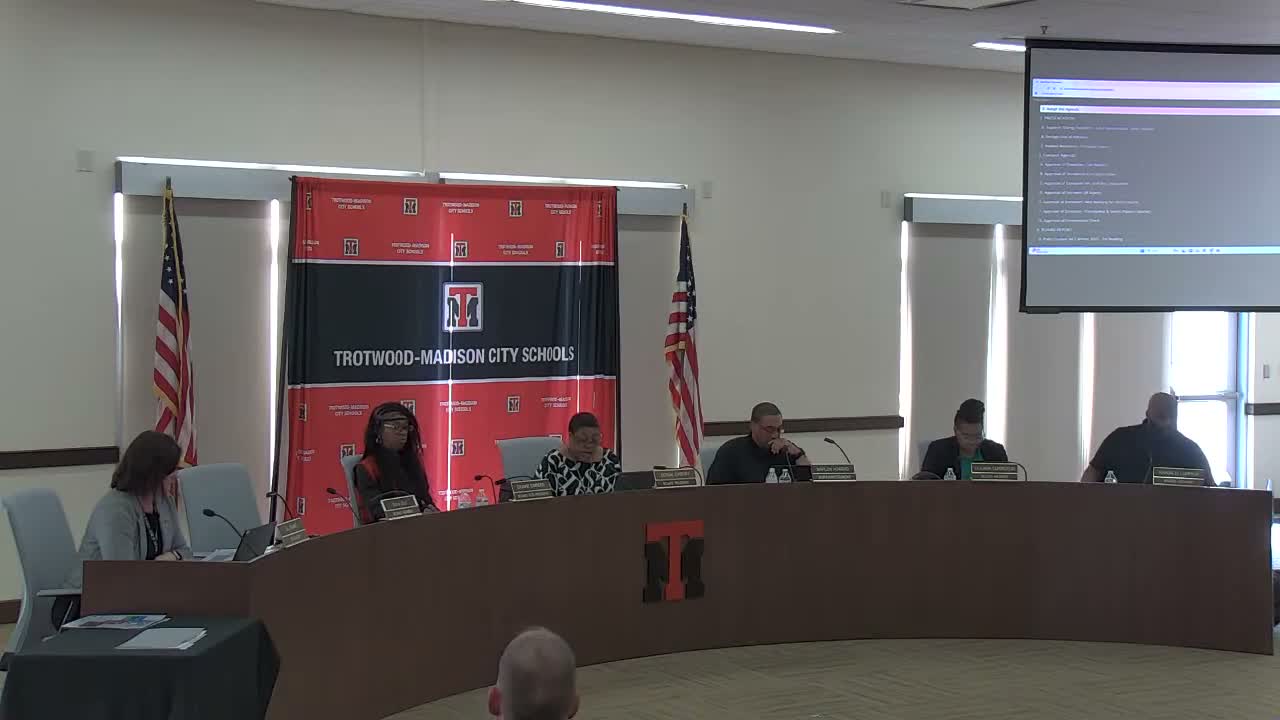
The Trotwood‑Madison City Board of Education on Tuesday heard a detailed presentation from Superior Energy Solutions on a large solar installation that the company said could cover most of the district’s electric load while pairing roof replacement with photovoltaic arrays.
Terry Nielsen, a company representative, told the board the full system as envisioned would include panels on all three high‑school buildings plus a large ground‑mounted field, totaling as many as 6,000 panels. Nielsen described a cash scenario and multiple financed options, and repeatedly warned the board that to capture the current 40 percent federal investment tax credit (ITC) the district would need to start the project and secure a payment or contract before July 1.
Why it matters: The proposal pairs roof replacement with solar to capture a larger tax and financing benefit, and company figures presented to the board show long‑term energy‑cost savings if the district pursues ownership or certain public‑private financing structures. That framing, plus the time‑sensitive federal tax‑credit schedule Nielsen described, frames an expedited decision if the board wants to preserve the current incentives.
Nielsen outlined numbers the company used in examples: a roughly $10.2 million total project, an estimated $3.0 million in tax credits in one cash scenario that the presenter described (producing a lower net cash outlay in that example), and alternative PACE (property assessed clean energy) 30‑year financing that the vendor said would produce loan payments below current projected utility spending. Nielsen said company projections showed about $619,000 of avoided utility cost in one model and that, under a long‑term financed ownership scenario, the district could see savings that grow over time (the presenter cited "$1,400,000 after 10 years," "$6,500,000 after 20 years," and "$16,480,000 after 30 years" as examples from the company model).
On contracting and compliance, Superintendent Howard told the board that one provision of Ohio Revised Code allows a district that secures an energy‑savings opportunity to forgo the regular public‑bidding process in certain cases; the vendor recommended a board resolution to remove the project from competitive bidding as a way to preserve the tax‑credit safe harbor while the district completes financing. "Solar always pays," Nielsen said during the presentation, arguing the district would lock in lower per‑kilowatt costs over the loan term.
Nielsen described two common structures: a power‑purchase agreement (PPA), in which a third party installs and retains ownership while the district buys the power (he quoted an example rate of about 8.7 cents per kilowatt‑hour for a PPA without roof replacement), and a financed‑ownership route using PACE financing or similar loans, which he said would put the district in ownership and maintenance while spreading costs over 30 years. He emphasized the company’s projections assume modest annual utility price inflation and included an example of guaranteed production with contractual remedies if output fell short.
Board members asked timing and cost questions; Nielsen estimated permitting, load studies and structural reviews would take several months and that full installation could take roughly four to six months after approvals. He and superintendent staff said other Ohio districts of similar or larger size have installed comparable systems, naming several communities in northwest Ohio and noting Columbus City Schools has installed arrays on multiple high schools.
No formal action was taken. Superintendent Howard said staff would continue discussing options and bring more detailed proposals to the board in the coming weeks; staff also flagged that a resolution to take the project out of competitive bidding has been a path other districts used to preserve tax credits while finalizing financing. The board scheduled further conversation rather than approving a contract at this meeting.
Terry Nielsen, a company representative, told the board the full system as envisioned would include panels on all three high‑school buildings plus a large ground‑mounted field, totaling as many as 6,000 panels. Nielsen described a cash scenario and multiple financed options, and repeatedly warned the board that to capture the current 40 percent federal investment tax credit (ITC) the district would need to start the project and secure a payment or contract before July 1.
Why it matters: The proposal pairs roof replacement with solar to capture a larger tax and financing benefit, and company figures presented to the board show long‑term energy‑cost savings if the district pursues ownership or certain public‑private financing structures. That framing, plus the time‑sensitive federal tax‑credit schedule Nielsen described, frames an expedited decision if the board wants to preserve the current incentives.
Nielsen outlined numbers the company used in examples: a roughly $10.2 million total project, an estimated $3.0 million in tax credits in one cash scenario that the presenter described (producing a lower net cash outlay in that example), and alternative PACE (property assessed clean energy) 30‑year financing that the vendor said would produce loan payments below current projected utility spending. Nielsen said company projections showed about $619,000 of avoided utility cost in one model and that, under a long‑term financed ownership scenario, the district could see savings that grow over time (the presenter cited "$1,400,000 after 10 years," "$6,500,000 after 20 years," and "$16,480,000 after 30 years" as examples from the company model).
On contracting and compliance, Superintendent Howard told the board that one provision of Ohio Revised Code allows a district that secures an energy‑savings opportunity to forgo the regular public‑bidding process in certain cases; the vendor recommended a board resolution to remove the project from competitive bidding as a way to preserve the tax‑credit safe harbor while the district completes financing. "Solar always pays," Nielsen said during the presentation, arguing the district would lock in lower per‑kilowatt costs over the loan term.
Nielsen described two common structures: a power‑purchase agreement (PPA), in which a third party installs and retains ownership while the district buys the power (he quoted an example rate of about 8.7 cents per kilowatt‑hour for a PPA without roof replacement), and a financed‑ownership route using PACE financing or similar loans, which he said would put the district in ownership and maintenance while spreading costs over 30 years. He emphasized the company’s projections assume modest annual utility price inflation and included an example of guaranteed production with contractual remedies if output fell short.
Board members asked timing and cost questions; Nielsen estimated permitting, load studies and structural reviews would take several months and that full installation could take roughly four to six months after approvals. He and superintendent staff said other Ohio districts of similar or larger size have installed comparable systems, naming several communities in northwest Ohio and noting Columbus City Schools has installed arrays on multiple high schools.
No formal action was taken. Superintendent Howard said staff would continue discussing options and bring more detailed proposals to the board in the coming weeks; staff also flagged that a resolution to take the project out of competitive bidding has been a path other districts used to preserve tax credits while finalizing financing. The board scheduled further conversation rather than approving a contract at this meeting.
Don't Miss a Word: See the Full Meeting!
Go beyond summaries. Unlock every video, transcript, and key insight with a Founder Membership.
✓
Get instant access to full meeting videos
✓
Search and clip any phrase from complete transcripts
✓
Receive AI-powered summaries & custom alerts
✓
Enjoy lifetime, unrestricted access to government data
30-day money-back guarantee
