Town Manager Andy presents recommended FY 2026–27 budget for Nags Head; no tax‑rate increase proposed
May 08, 2026 | Nags Head Town, Dare County, North Carolina
This article was created by AI summarizing key points discussed. AI makes mistakes, so for full details and context, please refer to the video of the full meeting. Please report any errors so we can fix them. Report an error »
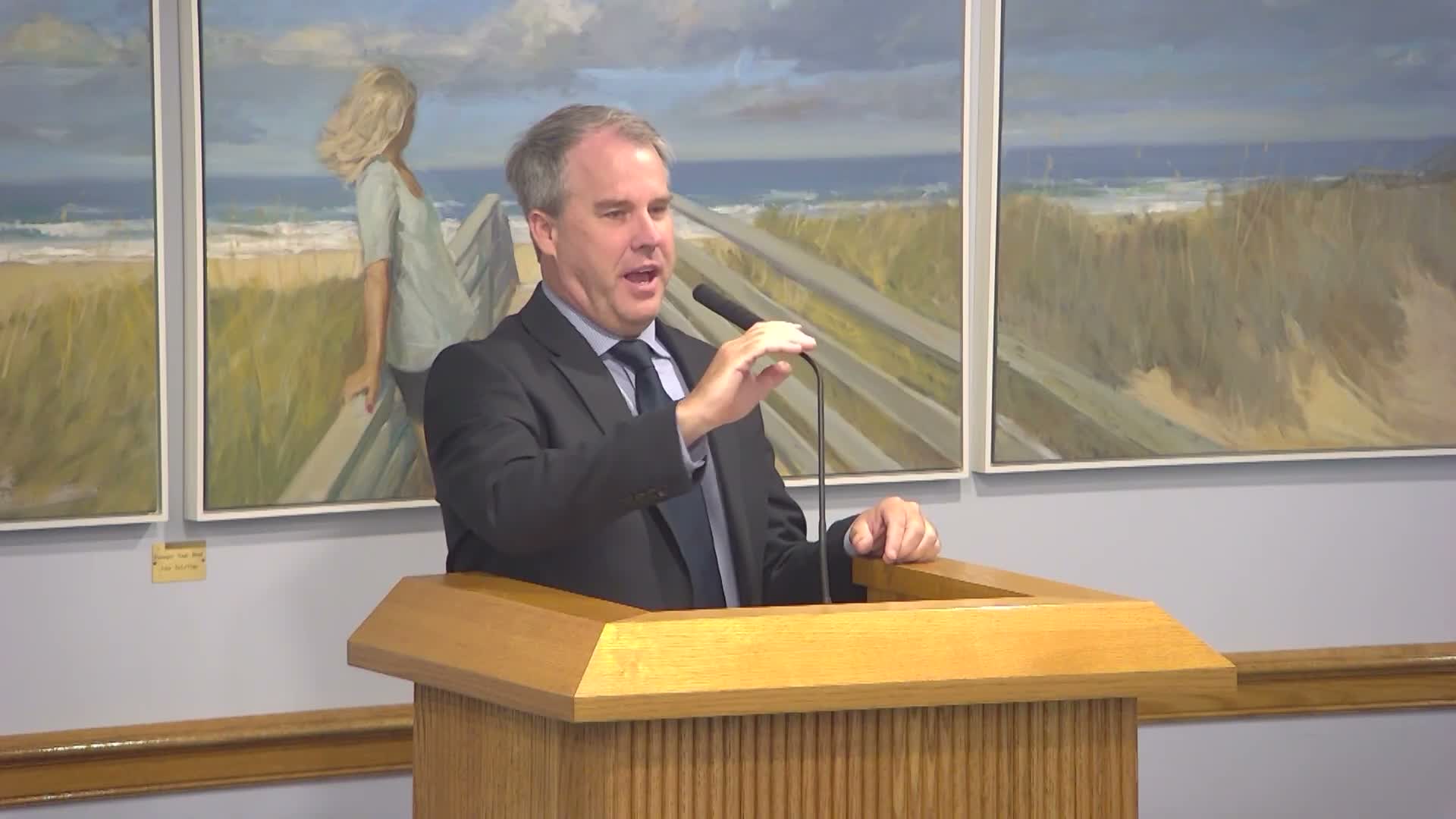
Town Manager Andy presented the Nags Head Town Board with the recommended fiscal year 2026–27 budget on May 8, proposing no tax‑rate increase for the coming year while flagging large capital costs, including a roughly $38 million beach nourishment project that drives much of the increase from last year.
The budget, described in the presentation as approximately $35 million for the general fund, funds a mix of capital projects, equipment replacements and personnel adjustments. Andy said staff will hold a workshop on the recommended budget on May 20 and a public hearing on June 3 before the board considers adoption.
Why it matters: Staff and board members said the beach nourishment debt service is the primary factor increasing the town’s budget compared with last year, and that one‑time funding sources used to close the current gap are not sustainable—prompting staff to model a potential tax adjustment in 2028.
In his overview, Andy summarized the budget’s priorities as protecting the natural environment, guiding responsible development, supporting a sustainable economy and maintaining efficient government services. He highlighted several major capital items in the recommended plan: a multiuse path linking the West Side of U.S. 158 and the Jockey’s Ridge State Park entrance (estimated cost about $1.6 million, with a $100,000 state trails grant and $750,000 from the Outer Banks Visitors Bureau for design and project support); annual beach nourishment of roughly 2.5 million cubic yards of sand at an estimated cost of about $38 million funded through property taxes, municipal service districts, Dare County contributions and the town’s beach nourishment fund; and replacement or repairs of several beach accesses.
Amy, who completed the finance presentation, said the town will submit the document to the Government Finance Officers Association for review and that required transparency sections—fund balance, revenue assumptions and long‑range planning—are included. Amy told the board the town experienced an $180,000 (about 8%) increase in health‑insurance costs this year and that the town’s state‑set retirement contribution totals about $1.8 million, both of which contributed to budgetary pressure.
On revenues, Amy said shared revenues (sales, occupancy and land‑transfer taxes) have not kept pace with expenses in recent years, noting the town used one‑time sources—including appropriations from fund balance and capital investment funds—to close prior gaps. She warned that those one‑time sources are not recurring and that staff included a planning scenario that shows a possible 2‑cent tax increase in 2028 if revenue trends and cost pressures continue.
Other items in the proposed budget include:
- Transportation and drainage: continued streets and stormwater work (year 7 of a 20‑year plan), resurfacing listed east‑west streets, a new drainage collection system in project area 4 with a reconstructed Bond Street Bathhouse parking lot and subsurface infiltration; staff cited a $2,360,000 state grant for related drainage projects.
- Facilities and shore infrastructure: $50,000 budgeted for schematic design of the Hargrove bathhouse replacement (staff said the town previously received a $400,000 grant for Hargrove) and regular replacement of beach accesses.
- Water and septic programs: a recommended 5% water‑rate increase; planned water main extensions on South Croatan Highway and between Dune Street and East Southside Road; continuation of a 0% interest septic replacement program and a proposed $10,000 budget for a septic‑program marketing campaign.
- Public safety and equipment: replacement of police vehicles and the department drone used for accident reconstruction and search and rescue; fire department Knox key management system replacement and a new training prop.
- Personnel and benefits: the budget includes funding for a pay‑and‑class study the board approved earlier, a 3% cost‑of‑living adjustment, full employee health insurance coverage and 80% family coverage, and continued employer 401(k) contribution levels; staff also proposed a new heavy equipment operator position, a part‑time year‑round event planning position and a reorganization that creates a human resources assistant role without adding net headcount. The budget also includes a retainer for mental‑health counseling services primarily for public‑safety staff.
Andy emphasized that, while the budget for 2027 does not propose a tax‑rate increase, the board and staff will need to review midyear results and may consider changes if revenues fail to recover. "We are not proposing a tax rate increase this year," Andy said during his closing remarks. Amy reiterated the scale of the cost pressures and the town’s plan to continue seeking grants and legislative appropriations for major capital projects.
Next steps: staff will present more detailed analyses at the May 20 workshop and accept questions from board members ahead of a June 3 public hearing, after which the board may adopt the budget.
The budget, described in the presentation as approximately $35 million for the general fund, funds a mix of capital projects, equipment replacements and personnel adjustments. Andy said staff will hold a workshop on the recommended budget on May 20 and a public hearing on June 3 before the board considers adoption.
Why it matters: Staff and board members said the beach nourishment debt service is the primary factor increasing the town’s budget compared with last year, and that one‑time funding sources used to close the current gap are not sustainable—prompting staff to model a potential tax adjustment in 2028.
In his overview, Andy summarized the budget’s priorities as protecting the natural environment, guiding responsible development, supporting a sustainable economy and maintaining efficient government services. He highlighted several major capital items in the recommended plan: a multiuse path linking the West Side of U.S. 158 and the Jockey’s Ridge State Park entrance (estimated cost about $1.6 million, with a $100,000 state trails grant and $750,000 from the Outer Banks Visitors Bureau for design and project support); annual beach nourishment of roughly 2.5 million cubic yards of sand at an estimated cost of about $38 million funded through property taxes, municipal service districts, Dare County contributions and the town’s beach nourishment fund; and replacement or repairs of several beach accesses.
Amy, who completed the finance presentation, said the town will submit the document to the Government Finance Officers Association for review and that required transparency sections—fund balance, revenue assumptions and long‑range planning—are included. Amy told the board the town experienced an $180,000 (about 8%) increase in health‑insurance costs this year and that the town’s state‑set retirement contribution totals about $1.8 million, both of which contributed to budgetary pressure.
On revenues, Amy said shared revenues (sales, occupancy and land‑transfer taxes) have not kept pace with expenses in recent years, noting the town used one‑time sources—including appropriations from fund balance and capital investment funds—to close prior gaps. She warned that those one‑time sources are not recurring and that staff included a planning scenario that shows a possible 2‑cent tax increase in 2028 if revenue trends and cost pressures continue.
Other items in the proposed budget include:
- Transportation and drainage: continued streets and stormwater work (year 7 of a 20‑year plan), resurfacing listed east‑west streets, a new drainage collection system in project area 4 with a reconstructed Bond Street Bathhouse parking lot and subsurface infiltration; staff cited a $2,360,000 state grant for related drainage projects.
- Facilities and shore infrastructure: $50,000 budgeted for schematic design of the Hargrove bathhouse replacement (staff said the town previously received a $400,000 grant for Hargrove) and regular replacement of beach accesses.
- Water and septic programs: a recommended 5% water‑rate increase; planned water main extensions on South Croatan Highway and between Dune Street and East Southside Road; continuation of a 0% interest septic replacement program and a proposed $10,000 budget for a septic‑program marketing campaign.
- Public safety and equipment: replacement of police vehicles and the department drone used for accident reconstruction and search and rescue; fire department Knox key management system replacement and a new training prop.
- Personnel and benefits: the budget includes funding for a pay‑and‑class study the board approved earlier, a 3% cost‑of‑living adjustment, full employee health insurance coverage and 80% family coverage, and continued employer 401(k) contribution levels; staff also proposed a new heavy equipment operator position, a part‑time year‑round event planning position and a reorganization that creates a human resources assistant role without adding net headcount. The budget also includes a retainer for mental‑health counseling services primarily for public‑safety staff.
Andy emphasized that, while the budget for 2027 does not propose a tax‑rate increase, the board and staff will need to review midyear results and may consider changes if revenues fail to recover. "We are not proposing a tax rate increase this year," Andy said during his closing remarks. Amy reiterated the scale of the cost pressures and the town’s plan to continue seeking grants and legislative appropriations for major capital projects.
Next steps: staff will present more detailed analyses at the May 20 workshop and accept questions from board members ahead of a June 3 public hearing, after which the board may adopt the budget.
View the Full Meeting & All Its Details
This article offers just a summary. Unlock complete video, transcripts, and insights as a Founder Member.
✓
Watch full, unedited meeting videos
✓
Search every word spoken in unlimited transcripts
✓
AI summaries & real-time alerts (all government levels)
✓
Permanent access to expanding government content
30-day money-back guarantee
