Philadelphia council lays out FY27 spending plan as residents press for fuller school funding
May 08, 2026 | Philadelphia City, Pennsylvania
This article was created by AI summarizing key points discussed. AI makes mistakes, so for full details and context, please refer to the video of the full meeting. Please report any errors so we can fix them. Report an error »
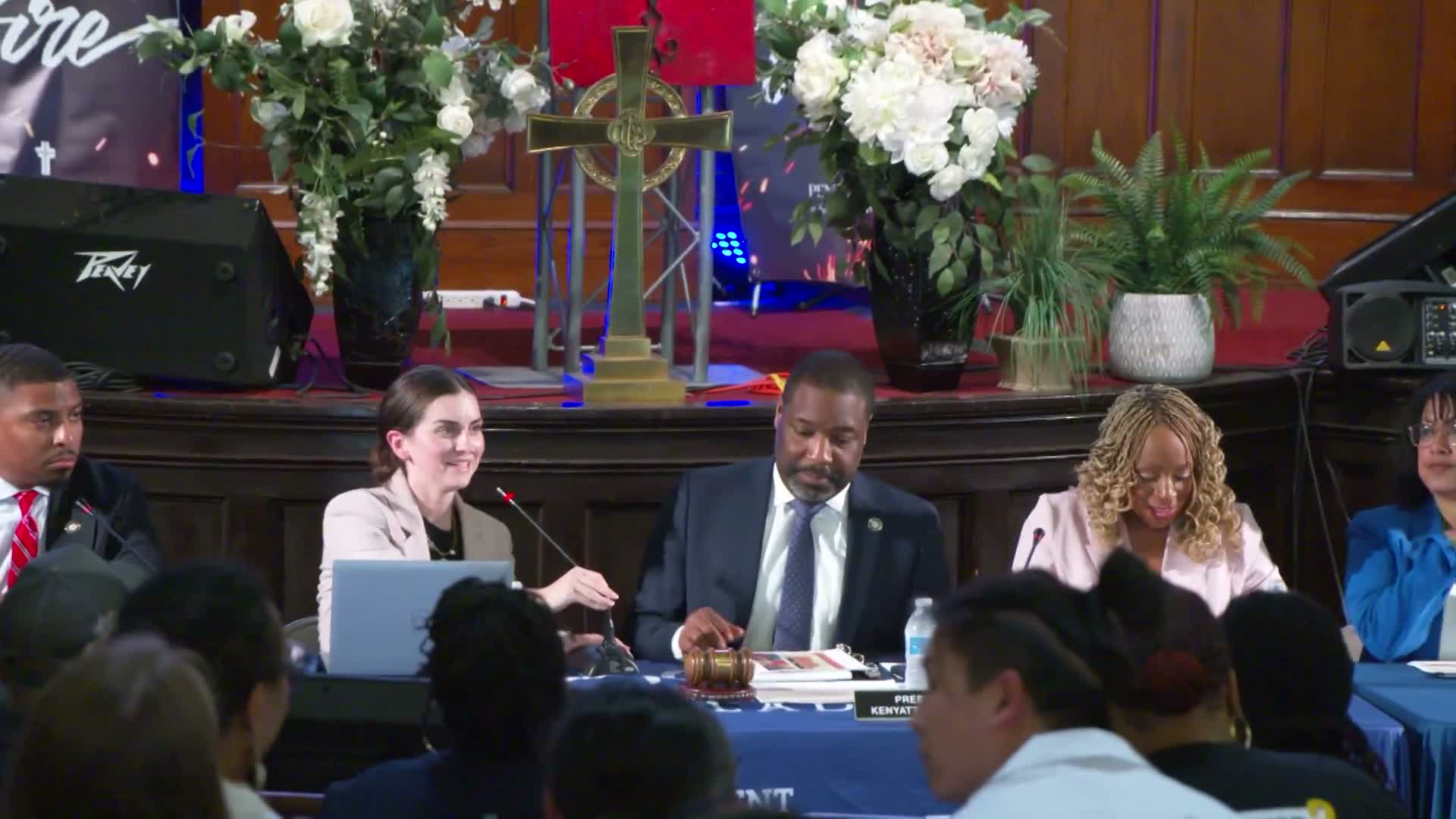
Philadelphia City Council President Kenyatta Johnson and Councilmember Jamie Gauthier co‑hosted a budget town hall at Salt and Light Church where finance staff outlined the administration’s proposed Fiscal Year 2027 spending plan and residents delivered hours of testimony demanding stronger protections for schools and housing.
Council finance director Helen Lloyd walked the room through the headline numbers, describing the operating plan as “nearly $7 billion” and the capital program as about $8.2 billion with roughly $281 million in new borrowing proposed to pay for long‑term projects. Lloyd also summarized proposed revenue measures, including a proposed 2% hotel tax (estimated about $20 million annually) to expand homeless services, a 25‑cent per‑order retail delivery fee (about $15 million) to fund street repairs and a $1 per‑ride fee on certain trips originating in the city proposed to support the School District of Philadelphia (estimated roughly $48 million).
“We are presenting a proposed budget from the administration,” Council President Kenyatta Johnson said at the start of the meeting, emphasizing that council will deliberate and may amend the plan before final passage.
Councilmember Jamie Gauthier used her presentation time to highlight housing and neighborhood investments she said matter most to Southwest Philadelphia residents: “One of the things I’m most excited about is the HOME initiative,” she said, describing it as an $800 million investment the council negotiated with Mayor Parker to build and preserve affordable housing. Gauthier and other members also touted continued investments in violence‑prevention programs, expansion of PHL Pre‑K seats, an initiative to add shelter beds and a proposed pothole crew.
Public testimony dominated the evening. Parents, school‑based staff and advocacy groups repeatedly urged council to go further than the mayor’s proposal to protect school positions. “First, $50,000,000 is not enough, and it does not protect building substitutes,” said Siani Boland, a West Philadelphia parent and school staff member, arguing that the district needs more funding to avoid disruptions when teachers are absent. Several community speakers and groups asked council to use the city’s fund balance or other tools to reach $75 million and to require the district to release preliminary, disaggregated school budgets so families can see which positions and schools are at risk.
“We are asking city council to reject the narrative that only 340 positions are at risk,” said Latisse Spence of Lift Every Voice Philly, summarizing the group’s demands for a larger allocation and more transparency. Julie Krug, a parent with the same coalition, pressed the council to “use every tool at your disposal to reach $75,000,000 to fully protect school based staff.”
Speakers raised other priorities and concerns through the night: calls to preserve 925 affordable units in neighborhood restorations, requests for stronger anti‑displacement protections, questions about how the Turn the Key program and inclusionary zoning will expand homeownership, and critiques about corporate taxation and who should bear the burden of new revenue measures. Several speakers urged investment in early‑childhood services, crisis behavioral health capacity and transit reliability rather than reliance on punitive or back‑end public safety spending.
Council members responded in part by pointing to the limits of local taxing authority and the “uniformity” doctrine the city must observe, and by noting tools the council can use, such as contract wage floors and property‑tax relief programs. Council leaders also pledged follow‑up meetings with community groups and said staff would provide additional budget detail as deliberations continue.
The town hall made clear the core trade‑offs the council will weigh in the coming weeks: whether to rely more on reserves and existing fund balances, whether to adopt new taxes and fees and how to target large housing and public‑safety investments while protecting school staffing. Councilmembers closed the session by thanking residents and announcing further opportunities for testimony as the budget process proceeds.
Next steps: Council will continue budget deliberations after public hearings and may propose amendments before final votes in the coming weeks.
Council finance director Helen Lloyd walked the room through the headline numbers, describing the operating plan as “nearly $7 billion” and the capital program as about $8.2 billion with roughly $281 million in new borrowing proposed to pay for long‑term projects. Lloyd also summarized proposed revenue measures, including a proposed 2% hotel tax (estimated about $20 million annually) to expand homeless services, a 25‑cent per‑order retail delivery fee (about $15 million) to fund street repairs and a $1 per‑ride fee on certain trips originating in the city proposed to support the School District of Philadelphia (estimated roughly $48 million).
“We are presenting a proposed budget from the administration,” Council President Kenyatta Johnson said at the start of the meeting, emphasizing that council will deliberate and may amend the plan before final passage.
Councilmember Jamie Gauthier used her presentation time to highlight housing and neighborhood investments she said matter most to Southwest Philadelphia residents: “One of the things I’m most excited about is the HOME initiative,” she said, describing it as an $800 million investment the council negotiated with Mayor Parker to build and preserve affordable housing. Gauthier and other members also touted continued investments in violence‑prevention programs, expansion of PHL Pre‑K seats, an initiative to add shelter beds and a proposed pothole crew.
Public testimony dominated the evening. Parents, school‑based staff and advocacy groups repeatedly urged council to go further than the mayor’s proposal to protect school positions. “First, $50,000,000 is not enough, and it does not protect building substitutes,” said Siani Boland, a West Philadelphia parent and school staff member, arguing that the district needs more funding to avoid disruptions when teachers are absent. Several community speakers and groups asked council to use the city’s fund balance or other tools to reach $75 million and to require the district to release preliminary, disaggregated school budgets so families can see which positions and schools are at risk.
“We are asking city council to reject the narrative that only 340 positions are at risk,” said Latisse Spence of Lift Every Voice Philly, summarizing the group’s demands for a larger allocation and more transparency. Julie Krug, a parent with the same coalition, pressed the council to “use every tool at your disposal to reach $75,000,000 to fully protect school based staff.”
Speakers raised other priorities and concerns through the night: calls to preserve 925 affordable units in neighborhood restorations, requests for stronger anti‑displacement protections, questions about how the Turn the Key program and inclusionary zoning will expand homeownership, and critiques about corporate taxation and who should bear the burden of new revenue measures. Several speakers urged investment in early‑childhood services, crisis behavioral health capacity and transit reliability rather than reliance on punitive or back‑end public safety spending.
Council members responded in part by pointing to the limits of local taxing authority and the “uniformity” doctrine the city must observe, and by noting tools the council can use, such as contract wage floors and property‑tax relief programs. Council leaders also pledged follow‑up meetings with community groups and said staff would provide additional budget detail as deliberations continue.
The town hall made clear the core trade‑offs the council will weigh in the coming weeks: whether to rely more on reserves and existing fund balances, whether to adopt new taxes and fees and how to target large housing and public‑safety investments while protecting school staffing. Councilmembers closed the session by thanking residents and announcing further opportunities for testimony as the budget process proceeds.
Next steps: Council will continue budget deliberations after public hearings and may propose amendments before final votes in the coming weeks.
View the Full Meeting & All Its Details
This article offers just a summary. Unlock complete video, transcripts, and insights as a Founder Member.
✓
Watch full, unedited meeting videos
✓
Search every word spoken in unlimited transcripts
✓
AI summaries & real-time alerts (all government levels)
✓
Permanent access to expanding government content
30-day money-back guarantee
