Council designates behavioral health and homelessness items for reconciliation amid state funding concerns
May 08, 2026 | Montgomery County, Maryland
This article was created by AI summarizing key points discussed. AI makes mistakes, so for full details and context, please refer to the video of the full meeting. Please report any errors so we can fix them. Report an error »
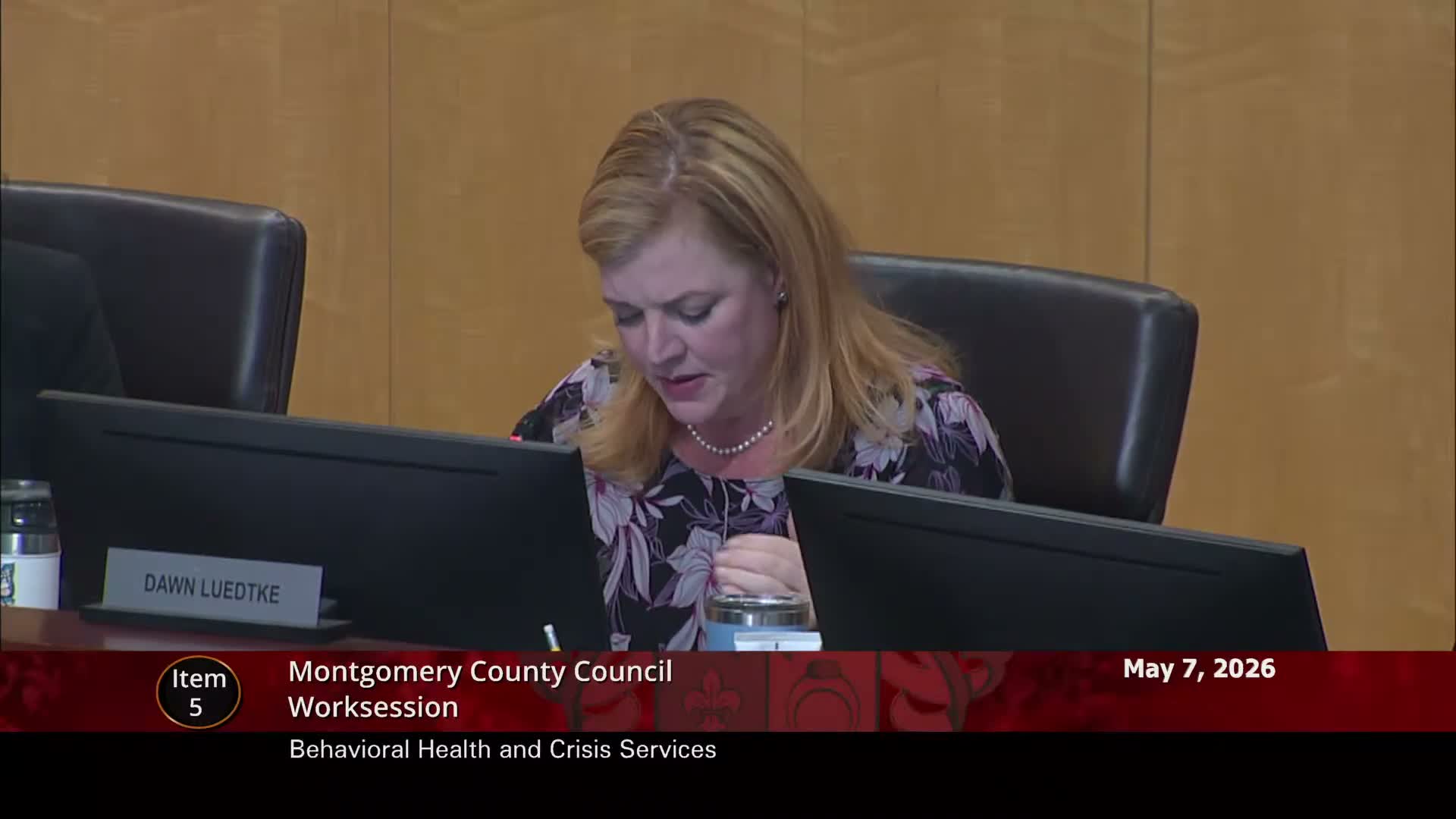
Montgomery County Council on May 7 advanced several behavioral health and homelessness-related items to the reconciliation list, after DHHS and county staff detailed operational needs, state licensing requirements and looming federal funding reductions that could reduce county supports.
Chief Monica Martin, head of Behavioral Health and Crisis Services, told the council that $3,104,903 in operating funds is necessary to support the renovated behavioral health crisis stabilization center and to meet Maryland Code of Regulations (COMAR) requirements released in May 2024. Martin said those requirements expand expectations for crisis-stabilization centers to accept walk-ins, serve residents across the lifespan (including minors), and meet specific operational standards. Without the requested operating funding the renovated stabilization center would not be able to operate at the planned scale and county licensure renewal would be at risk.
Council and staff also reviewed three homeless-system items the committee unanimously recommended: continued funding for the SHARP family rapid rehousing program, one-time funding for overflow emergency shelter supports, and $438,909 to fill a gap in outreach contracts for providers such as EveryMind, Bethesda Cares and Pathways to Housing. Christine Hong, chief of Services to End and Prevent Homelessness, emphasized that SHARP and related investments produce cost-effective results (reducing motel stays) and explained the county is preparing for a potential 40% federal reduction in permanent supportive housing NOFO funding that could displace roughly 350 households.
The council discussed options to use non-tax supported housing initiative funds or reallocate contingency dollars to ease general-fund pressure; staff reminded members that moving roughly $1.4 million from contingency would reduce county flexibility amid uncertain federal changes, and the committee declined that option. Members stressed the priority of preventing destabilization for households already in permanent supportive housing.
Ending: The council approved committee recommendations for the morning session, placed the behavioral health operating funding and homelessness outreach/shelter items on the reconciliation list for final action, and recessed; staff and department leaders will continue coordinating with the council ahead of reconciliation votes.
Chief Monica Martin, head of Behavioral Health and Crisis Services, told the council that $3,104,903 in operating funds is necessary to support the renovated behavioral health crisis stabilization center and to meet Maryland Code of Regulations (COMAR) requirements released in May 2024. Martin said those requirements expand expectations for crisis-stabilization centers to accept walk-ins, serve residents across the lifespan (including minors), and meet specific operational standards. Without the requested operating funding the renovated stabilization center would not be able to operate at the planned scale and county licensure renewal would be at risk.
Council and staff also reviewed three homeless-system items the committee unanimously recommended: continued funding for the SHARP family rapid rehousing program, one-time funding for overflow emergency shelter supports, and $438,909 to fill a gap in outreach contracts for providers such as EveryMind, Bethesda Cares and Pathways to Housing. Christine Hong, chief of Services to End and Prevent Homelessness, emphasized that SHARP and related investments produce cost-effective results (reducing motel stays) and explained the county is preparing for a potential 40% federal reduction in permanent supportive housing NOFO funding that could displace roughly 350 households.
The council discussed options to use non-tax supported housing initiative funds or reallocate contingency dollars to ease general-fund pressure; staff reminded members that moving roughly $1.4 million from contingency would reduce county flexibility amid uncertain federal changes, and the committee declined that option. Members stressed the priority of preventing destabilization for households already in permanent supportive housing.
Ending: The council approved committee recommendations for the morning session, placed the behavioral health operating funding and homelessness outreach/shelter items on the reconciliation list for final action, and recessed; staff and department leaders will continue coordinating with the council ahead of reconciliation votes.
View the Full Meeting & All Its Details
This article offers just a summary. Unlock complete video, transcripts, and insights as a Founder Member.
✓
Watch full, unedited meeting videos
✓
Search every word spoken in unlimited transcripts
✓
AI summaries & real-time alerts (all government levels)
✓
Permanent access to expanding government content
30-day money-back guarantee
