Montgomery County hearing features broad support and sharp questions on Bicycle Master Plan
May 08, 2026 | Montgomery County, Maryland
This article was created by AI summarizing key points discussed. AI makes mistakes, so for full details and context, please refer to the video of the full meeting. Please report any errors so we can fix them. Report an error »
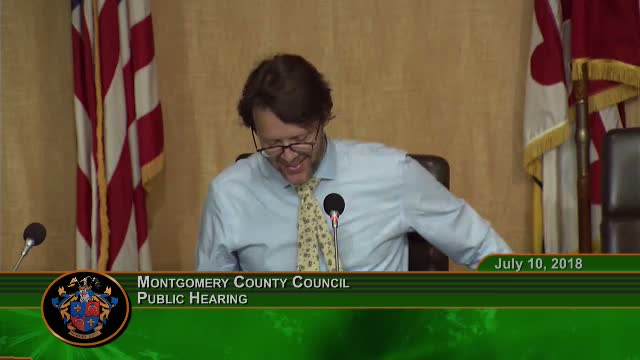
The Montgomery County Council heard more than three hours of testimony on the county’s proposed Bicycle Master Plan, with residents, bicycle advocates and public‑health groups urging adoption while raising detailed concerns about safety prioritization, costs and implementation.
Supporters said the plan’s data‑driven methods and emphasis on low‑stress, connected routes could expand bicycling, improve public health and help meet the county’s Vision 0 goals. "This plan applies quantitative methods and tools of analysis," said Casey Anderson, chair of the Maryland‑National Capital Park and Planning Commission, describing a countywide heat‑map and a full road‑network safety analysis that identify priority corridors including Downtown Wheaton, Downtown Silver Spring, White Flint and parts of the I‑270 corridor.
The nut of the debate was how the plan should be implemented. Jared Blue of the American Heart Association and Peter Gray of the Washington Area Bicyclists Association urged the council to adopt the planning board’s recommendations and to prioritize funding for low‑ and moderate‑income neighborhoods. "By focusing on these communities, the county can start to help to connect those residents in a safe and healthy way to places that they need to go," Jared Blue said.
Other witnesses welcomed the plan but pressed the council for changes. Susan Swift, executive director of the Suburban Maryland Transportation Alliance, urged that safety be elevated to the plan’s top priority and questioned whether the prioritization methodology and the plan’s design toolkit should be mandatory or advisory. "Safety should be the number one goal," Swift said, noting the draft currently lists it as goal four. Peggy Dennis of the County Civic Federation and several other speakers urged expanding and funding Safe Routes to Schools and adding explicit guidance for high‑risk freeway ramp crossings.
Business representatives raised separate concerns about impacts on parking and travel lanes. "We fear that this plan will reduce the space for other users of transportation because travel lanes and on‑site street parking will be reduced or eliminated," said Susan Rudersham, chair of the economic development committee for the Greater Silver Spring Chamber of Commerce, who said the chamber submitted a written letter with detailed examples.
Participants also debated cost and programmatic details. The Pedestrian, Bike and Traffic Safety Advisory Committee noted that of the plan’s 356 miles, only 23 miles are currently programmed and funded, and that more than 150 miles would not be programmed within the plan’s 25‑year horizon without additional funding. Several speakers said the county will need sustained funding streams, with one witness describing required annual funding as "tens of millions of dollars." Jack Cochran of Mobike urged retaining shoulders on some roads so faster, confident cyclists retain options.
Council members pressed witnesses on outreach and equity. Council member Craig Rice asked whether the panel had examples of successful prioritization in communities of color; witnesses pointed to school‑based education, community centers and faith institutions as places to build trust and usage. In response to concerns about equity, Casey Anderson said the plan includes an equity layer that weights low‑income areas and forecasts how phased implementation would affect equity outcomes.
The hearing produced few formal outcomes: it was a public testimony session rather than a vote. The council president said the plan will go to the Transportation and Environment (T&E) Committee for a work session scheduled for Monday, September 17; written comments will be accepted through the close of business on August 24.
The council now faces choices about prioritization criteria, funding mechanisms and whether to change the plan’s implementation language from recommended guidance to requirement in certain sections. Supporters and critics agreed the draft is thorough; their disagreement focused on how quickly and on what terms the county should build the network.
Supporters said the plan’s data‑driven methods and emphasis on low‑stress, connected routes could expand bicycling, improve public health and help meet the county’s Vision 0 goals. "This plan applies quantitative methods and tools of analysis," said Casey Anderson, chair of the Maryland‑National Capital Park and Planning Commission, describing a countywide heat‑map and a full road‑network safety analysis that identify priority corridors including Downtown Wheaton, Downtown Silver Spring, White Flint and parts of the I‑270 corridor.
The nut of the debate was how the plan should be implemented. Jared Blue of the American Heart Association and Peter Gray of the Washington Area Bicyclists Association urged the council to adopt the planning board’s recommendations and to prioritize funding for low‑ and moderate‑income neighborhoods. "By focusing on these communities, the county can start to help to connect those residents in a safe and healthy way to places that they need to go," Jared Blue said.
Other witnesses welcomed the plan but pressed the council for changes. Susan Swift, executive director of the Suburban Maryland Transportation Alliance, urged that safety be elevated to the plan’s top priority and questioned whether the prioritization methodology and the plan’s design toolkit should be mandatory or advisory. "Safety should be the number one goal," Swift said, noting the draft currently lists it as goal four. Peggy Dennis of the County Civic Federation and several other speakers urged expanding and funding Safe Routes to Schools and adding explicit guidance for high‑risk freeway ramp crossings.
Business representatives raised separate concerns about impacts on parking and travel lanes. "We fear that this plan will reduce the space for other users of transportation because travel lanes and on‑site street parking will be reduced or eliminated," said Susan Rudersham, chair of the economic development committee for the Greater Silver Spring Chamber of Commerce, who said the chamber submitted a written letter with detailed examples.
Participants also debated cost and programmatic details. The Pedestrian, Bike and Traffic Safety Advisory Committee noted that of the plan’s 356 miles, only 23 miles are currently programmed and funded, and that more than 150 miles would not be programmed within the plan’s 25‑year horizon without additional funding. Several speakers said the county will need sustained funding streams, with one witness describing required annual funding as "tens of millions of dollars." Jack Cochran of Mobike urged retaining shoulders on some roads so faster, confident cyclists retain options.
Council members pressed witnesses on outreach and equity. Council member Craig Rice asked whether the panel had examples of successful prioritization in communities of color; witnesses pointed to school‑based education, community centers and faith institutions as places to build trust and usage. In response to concerns about equity, Casey Anderson said the plan includes an equity layer that weights low‑income areas and forecasts how phased implementation would affect equity outcomes.
The hearing produced few formal outcomes: it was a public testimony session rather than a vote. The council president said the plan will go to the Transportation and Environment (T&E) Committee for a work session scheduled for Monday, September 17; written comments will be accepted through the close of business on August 24.
The council now faces choices about prioritization criteria, funding mechanisms and whether to change the plan’s implementation language from recommended guidance to requirement in certain sections. Supporters and critics agreed the draft is thorough; their disagreement focused on how quickly and on what terms the county should build the network.
View the Full Meeting & All Its Details
This article offers just a summary. Unlock complete video, transcripts, and insights as a Founder Member.
✓
Watch full, unedited meeting videos
✓
Search every word spoken in unlimited transcripts
✓
AI summaries & real-time alerts (all government levels)
✓
Permanent access to expanding government content
30-day money-back guarantee
