Haddon Township School District board adopts 4.5% tax levy to balance 2026–27 budget
May 08, 2026 | Haddon Township School District, School Districts, New Jersey
This article was created by AI summarizing key points discussed. AI makes mistakes, so for full details and context, please refer to the video of the full meeting. Please report any errors so we can fix them. Report an error »
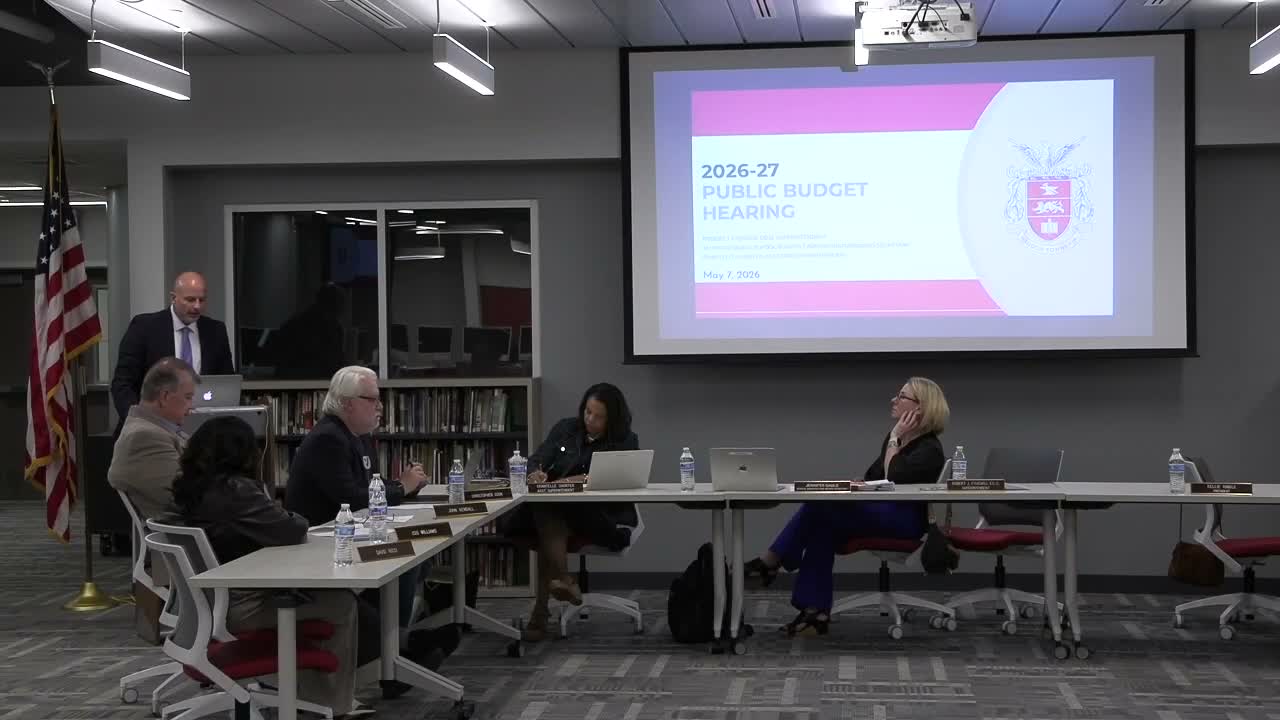
The Haddon Township School District board voted to adopt a $40 million 2026–27 budget that raises the district tax levy by 4.5%, the board confirmed at its May 1 meeting.
The superintendent, identified in the transcript as S2, framed the spending plan as “the most complex budget that I’ve worked on in the last decade,” saying it responds to multi-year reductions in state aid and a large increase in health-benefit costs. He told the board the district faces a multi-year shortfall that he quantified as $2,161,621 and said the fund balance has slipped below the state’s 2% operating-budget threshold — about $143,000 short of the $820,000 target — which creates an operational risk if not addressed.
Why it matters: the levy decision shifts more of the local cost burden onto taxpayers to preserve classroom programs and avoid deeper cuts to student services. The superintendent said the board considered several levy options, including a 6% ceiling that would produce a small surplus and a 4.25% proposal, but the board settled on 4.5% as the practical path to balance fiscal stability and taxpayer impact.
The administrator highlighted academic and programmatic strengths alongside the budget pressures. He said middle-school language-arts proficiency rose substantially in recent years (from about 41% to nearly 77% meeting or exceeding NJSLA expectations) and reported growing enrollment — up 147 students over five years to 2,124 total — plus improvements in math and reduced discipline referrals. He argued those gains and the need to preserve programs informed the budget choices.
On savings and trade-offs, the superintendent outlined recommended changes to align with the levy: not replacing a retired high-school math teacher; reducing one elementary teaching position; cutting about $100,000 from daily substitute spending through classroom reconfiguration; converting one elementary music consultant to a 0.5 FTE (saving roughly $30,000); and reserving about $30,000 for English-language–learner services required by law. He warned that rising health-benefit costs (cited in the presentation as an increase of about $1,033,922) limit the district’s ability to add positions that carry benefits.
Board discussion focused on implementation and legal/payroll constraints. Members asked whether instructional aides could be used as substitutes to lower costs; the superintendent warned that using aides consistently as substitutes creates certification and pay-structure complications. Several board members urged exploring county-level shared services (for example, county busing or shared special-services arrangements) as longer-term cost-control measures, while stressing quality oversight would be essential.
There were no public comments during the hearing period. Committee member S3 moved to adopt the budget “as prescribed.” The board then held a roll-call vote and approved the 2026–27 budget (item 5.1) and a set of related items including a change in prescription-carrier to AmeriHealth (item 5.2), the continuation grant for mandatory K–3 universal screening (item 6.1), and personnel actions (items 7.1–7.13). The motion carried on recorded roll call; the transcript records multiple “yes” responses during the roll call.
What’s next: with board approval the district will submit the adopted budget to the county as part of the statutory review and certification process. The superintendent and administrative team said they will continue to monitor enrollment and staffing needs and return to the board with adjustments if circumstances change.
The superintendent, identified in the transcript as S2, framed the spending plan as “the most complex budget that I’ve worked on in the last decade,” saying it responds to multi-year reductions in state aid and a large increase in health-benefit costs. He told the board the district faces a multi-year shortfall that he quantified as $2,161,621 and said the fund balance has slipped below the state’s 2% operating-budget threshold — about $143,000 short of the $820,000 target — which creates an operational risk if not addressed.
Why it matters: the levy decision shifts more of the local cost burden onto taxpayers to preserve classroom programs and avoid deeper cuts to student services. The superintendent said the board considered several levy options, including a 6% ceiling that would produce a small surplus and a 4.25% proposal, but the board settled on 4.5% as the practical path to balance fiscal stability and taxpayer impact.
The administrator highlighted academic and programmatic strengths alongside the budget pressures. He said middle-school language-arts proficiency rose substantially in recent years (from about 41% to nearly 77% meeting or exceeding NJSLA expectations) and reported growing enrollment — up 147 students over five years to 2,124 total — plus improvements in math and reduced discipline referrals. He argued those gains and the need to preserve programs informed the budget choices.
On savings and trade-offs, the superintendent outlined recommended changes to align with the levy: not replacing a retired high-school math teacher; reducing one elementary teaching position; cutting about $100,000 from daily substitute spending through classroom reconfiguration; converting one elementary music consultant to a 0.5 FTE (saving roughly $30,000); and reserving about $30,000 for English-language–learner services required by law. He warned that rising health-benefit costs (cited in the presentation as an increase of about $1,033,922) limit the district’s ability to add positions that carry benefits.
Board discussion focused on implementation and legal/payroll constraints. Members asked whether instructional aides could be used as substitutes to lower costs; the superintendent warned that using aides consistently as substitutes creates certification and pay-structure complications. Several board members urged exploring county-level shared services (for example, county busing or shared special-services arrangements) as longer-term cost-control measures, while stressing quality oversight would be essential.
There were no public comments during the hearing period. Committee member S3 moved to adopt the budget “as prescribed.” The board then held a roll-call vote and approved the 2026–27 budget (item 5.1) and a set of related items including a change in prescription-carrier to AmeriHealth (item 5.2), the continuation grant for mandatory K–3 universal screening (item 6.1), and personnel actions (items 7.1–7.13). The motion carried on recorded roll call; the transcript records multiple “yes” responses during the roll call.
What’s next: with board approval the district will submit the adopted budget to the county as part of the statutory review and certification process. The superintendent and administrative team said they will continue to monitor enrollment and staffing needs and return to the board with adjustments if circumstances change.
Don't Miss a Word: See the Full Meeting!
Go beyond summaries. Unlock every video, transcript, and key insight with a Founder Membership.
✓
Get instant access to full meeting videos
✓
Search and clip any phrase from complete transcripts
✓
Receive AI-powered summaries & custom alerts
✓
Enjoy lifetime, unrestricted access to government data
30-day money-back guarantee
