District maps layered school safety plan; board weighs federal SRO grant with local match
May 08, 2026 | Simi Valley Unified, School Districts, California
This article was created by AI summarizing key points discussed. AI makes mistakes, so for full details and context, please refer to the video of the full meeting. Please report any errors so we can fix them. Report an error »
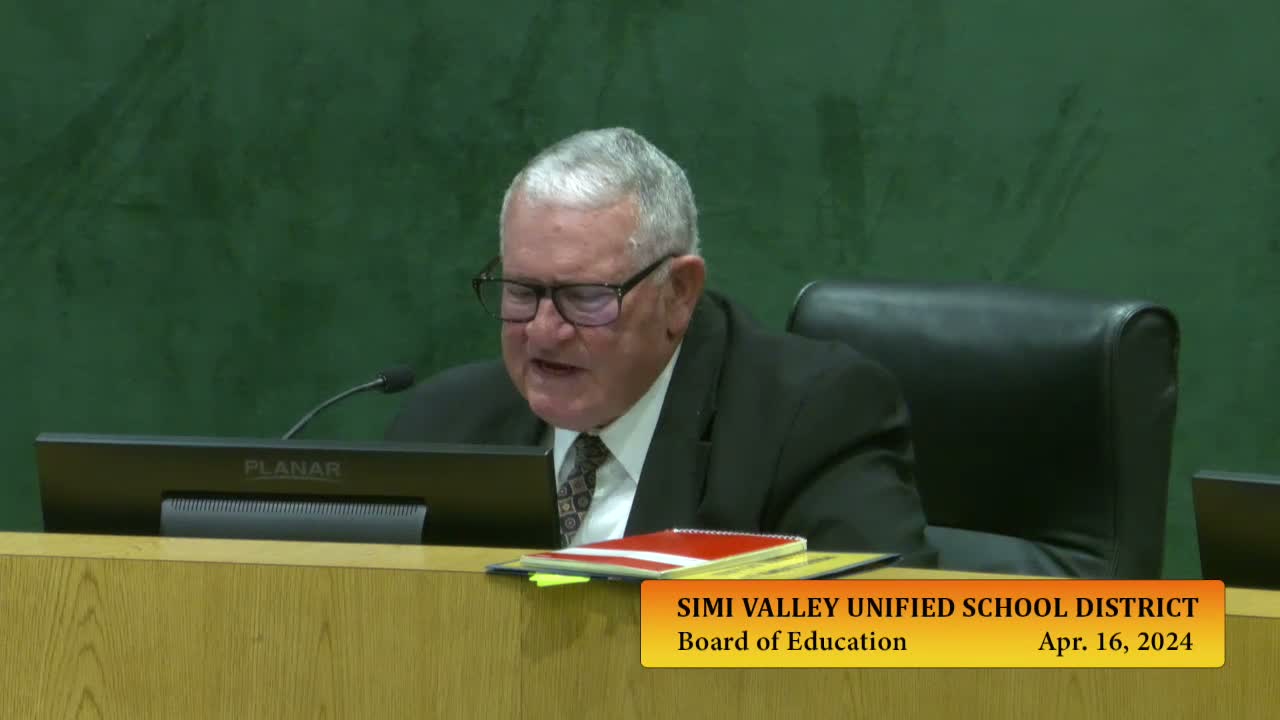
District safety and administrative staff presented a comprehensive, data-driven approach to school safety that combines prevention, mitigation and response strategies and includes mental-health supports, threat and risk assessment protocols and targeted training.
Presenters described perimeter and access-control measures (fencing, single-point-of-entry pilot at two schools), visitor management using the Raptor system, classroom locksets that secure from inside, surveillance cameras (noted as forensic tools rather than prevention), and rollout of an emergency communications app (Emergent) and digital clocks with on-screen emergency notifications. They also outlined an active-assailant training session to be provided by Stratagos in November and a review by a former Secret Service agent of stadium and large-event procedures with recommended sweeps, security operation centers and separate ingress/egress points.
The district described its mental-health infrastructure: threat- and risk-assessment teams using Salem Keizer methodology, crisis intervention teams, school psychologists, counselors, nurses, outside counseling partners (Daybreak, Aspire), and planned student-facing suicide-prevention curriculum. Presenters said annual LCAP survey results show high perceived safety (parents ~92%, students ~84%, staff ~89%) but emphasized continuous monitoring through CHKS and SEL surveys.
Board and staff discussed the federal COPS hiring grant (75% salary/benefit coverage for three years with a 25% local match and full local cost thereafter) to fund an additional School Resource Officer. Staff cautioned that the city would have to review the change in SRO count, that the police department has staffing challenges for SRO assignments, and that the district lacks designated categorical funds for the grant match; staff provided an illustrative 4‑year district cost estimate of about $621,000 if the district continued an SRO position beyond the grant period.
No final vote to pursue the COPS grant was recorded at the meeting; staff recommended further review of costs, city engagement and operational feasibility before deciding.
Presenters described perimeter and access-control measures (fencing, single-point-of-entry pilot at two schools), visitor management using the Raptor system, classroom locksets that secure from inside, surveillance cameras (noted as forensic tools rather than prevention), and rollout of an emergency communications app (Emergent) and digital clocks with on-screen emergency notifications. They also outlined an active-assailant training session to be provided by Stratagos in November and a review by a former Secret Service agent of stadium and large-event procedures with recommended sweeps, security operation centers and separate ingress/egress points.
The district described its mental-health infrastructure: threat- and risk-assessment teams using Salem Keizer methodology, crisis intervention teams, school psychologists, counselors, nurses, outside counseling partners (Daybreak, Aspire), and planned student-facing suicide-prevention curriculum. Presenters said annual LCAP survey results show high perceived safety (parents ~92%, students ~84%, staff ~89%) but emphasized continuous monitoring through CHKS and SEL surveys.
Board and staff discussed the federal COPS hiring grant (75% salary/benefit coverage for three years with a 25% local match and full local cost thereafter) to fund an additional School Resource Officer. Staff cautioned that the city would have to review the change in SRO count, that the police department has staffing challenges for SRO assignments, and that the district lacks designated categorical funds for the grant match; staff provided an illustrative 4‑year district cost estimate of about $621,000 if the district continued an SRO position beyond the grant period.
No final vote to pursue the COPS grant was recorded at the meeting; staff recommended further review of costs, city engagement and operational feasibility before deciding.
Don't Miss a Word: See the Full Meeting!
Go beyond summaries. Unlock every video, transcript, and key insight with a Founder Membership.
✓
Get instant access to full meeting videos
✓
Search and clip any phrase from complete transcripts
✓
Receive AI-powered summaries & custom alerts
✓
Enjoy lifetime, unrestricted access to government data
30-day money-back guarantee
