City council denies appeal and approves 5-year Crestview Pond vegetation management permit
May 07, 2026 | Pacific Grove City, Monterey County, California
This article was created by AI summarizing key points discussed. AI makes mistakes, so for full details and context, please refer to the video of the full meeting. Please report any errors so we can fix them. Report an error »
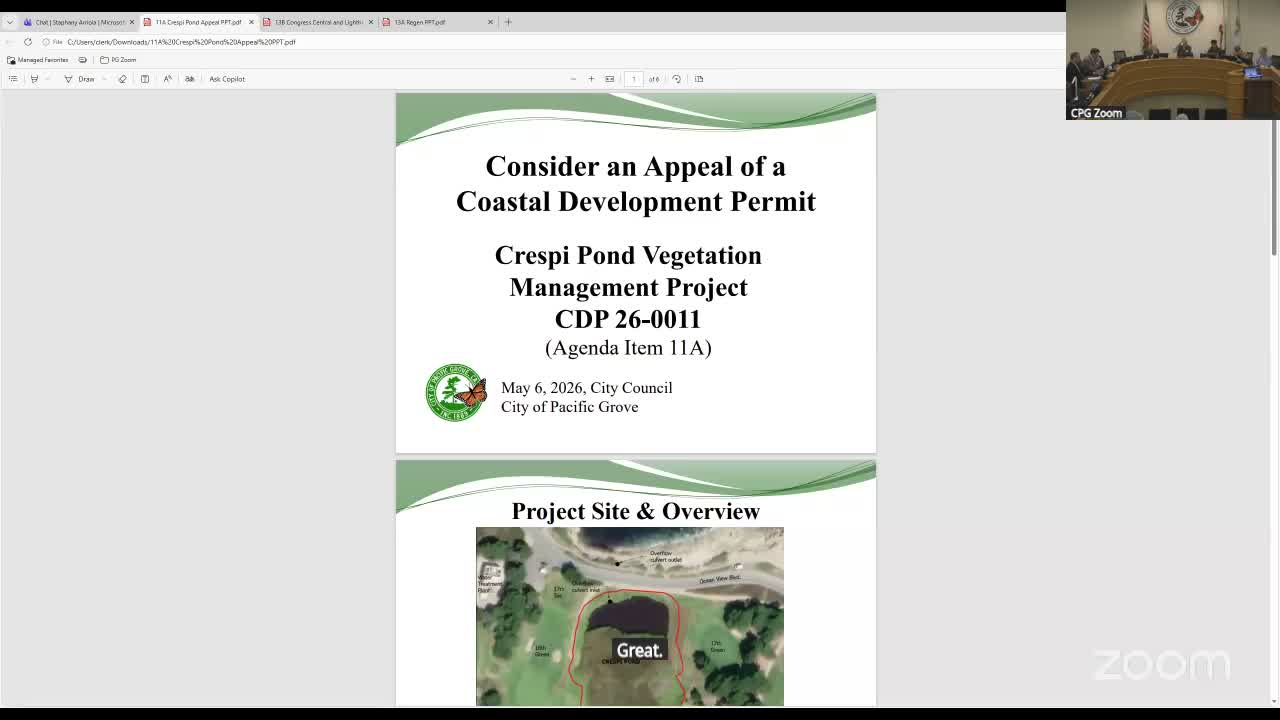
The Pacific Grove City Council voted unanimously on May 6 to deny an appeal and approve a five‑year coastal development permit for vegetation management at Crestview Pond, along with an adopted mitigation monitoring and reporting plan.
City planning staff and consulting planner Joe Sedor presented the project as a maintenance program to restore roughly a 70% open‑water / 30% vegetation ratio at the pond, remove 0.78 acres of vegetation, and use barged excavation with off‑site disposal. Staff said the city circulated a draft initial study/mitigated negative declaration (ISMND) for public review, revised the acreage to correct an earlier error, and incorporated mitigation measures to reduce potential impacts to biological resources and water quality.
Appellant Anthony Chiani told the council he supported vegetation removal but asked the council to add three conditions: require the work to occur only between Sept. 1 and Sept. 30 in years 1, 2 and 5 to avoid nesting and rainy seasons; require revegetation with native coastal and wetland species; and require a qualified biologist as the designated monitor.
“First, require the work to occur between September 1 to September 30,” Chiani said, listing the three requests he said were based on science and empirical evidence. He cited local policies in the certified Local Coastal Program and municipal code to argue the council can make consistency findings with those additional conditions.
Public Works Director Daniel Gough, speaking as the applicant, said the project followed a typical mitigation approach: a preconstruction biologist survey outside nesting season, then construction if no nests are found. He told the council that extensive on‑site biological monitoring for many weeks would be cost‑prohibitive and that the city has submitted required regulatory applications to state agencies; any additional restrictions from those agencies would be implemented after their decisions.
Council members discussed the narrow scope of the appeal versus broader restoration proposals from the Monterey Audubon Society and the California Native Plant Society, and noted the planning commission had set a January/February 2028 check‑in to review steps for future vegetation work. Several council members said removal to reach the target water‑to‑vegetation ratio is an important first step and that larger restoration would require a separate, more extensive environmental review.
A council member moved to follow staff recommendations: deny the appeal, adopt the ISMND pursuant to CEQA, approve the five‑year coastal development permit subject to the findings and conditions of approval, and adopt the mitigation monitoring and reporting plan. The motion was seconded and passed unanimously by voice vote.
Next steps: staff will proceed with the project consistent with the permit conditions and incorporated MMRP, and will comply with any additional requirements imposed by the Central Coast Regional Water Quality Control Board or the California Department of Fish and Wildlife following their regulatory review.
City planning staff and consulting planner Joe Sedor presented the project as a maintenance program to restore roughly a 70% open‑water / 30% vegetation ratio at the pond, remove 0.78 acres of vegetation, and use barged excavation with off‑site disposal. Staff said the city circulated a draft initial study/mitigated negative declaration (ISMND) for public review, revised the acreage to correct an earlier error, and incorporated mitigation measures to reduce potential impacts to biological resources and water quality.
Appellant Anthony Chiani told the council he supported vegetation removal but asked the council to add three conditions: require the work to occur only between Sept. 1 and Sept. 30 in years 1, 2 and 5 to avoid nesting and rainy seasons; require revegetation with native coastal and wetland species; and require a qualified biologist as the designated monitor.
“First, require the work to occur between September 1 to September 30,” Chiani said, listing the three requests he said were based on science and empirical evidence. He cited local policies in the certified Local Coastal Program and municipal code to argue the council can make consistency findings with those additional conditions.
Public Works Director Daniel Gough, speaking as the applicant, said the project followed a typical mitigation approach: a preconstruction biologist survey outside nesting season, then construction if no nests are found. He told the council that extensive on‑site biological monitoring for many weeks would be cost‑prohibitive and that the city has submitted required regulatory applications to state agencies; any additional restrictions from those agencies would be implemented after their decisions.
Council members discussed the narrow scope of the appeal versus broader restoration proposals from the Monterey Audubon Society and the California Native Plant Society, and noted the planning commission had set a January/February 2028 check‑in to review steps for future vegetation work. Several council members said removal to reach the target water‑to‑vegetation ratio is an important first step and that larger restoration would require a separate, more extensive environmental review.
A council member moved to follow staff recommendations: deny the appeal, adopt the ISMND pursuant to CEQA, approve the five‑year coastal development permit subject to the findings and conditions of approval, and adopt the mitigation monitoring and reporting plan. The motion was seconded and passed unanimously by voice vote.
Next steps: staff will proceed with the project consistent with the permit conditions and incorporated MMRP, and will comply with any additional requirements imposed by the Central Coast Regional Water Quality Control Board or the California Department of Fish and Wildlife following their regulatory review.
View the Full Meeting & All Its Details
This article offers just a summary. Unlock complete video, transcripts, and insights as a Founder Member.
✓
Watch full, unedited meeting videos
✓
Search every word spoken in unlimited transcripts
✓
AI summaries & real-time alerts (all government levels)
✓
Permanent access to expanding government content
30-day money-back guarantee
