Athletic director: Whitman‑Hanson underfunded as user fees climb and participation slips
May 07, 2026 | Whitman-Hanson Regional School District, School Boards, Massachusetts
This article was created by AI summarizing key points discussed. AI makes mistakes, so for full details and context, please refer to the video of the full meeting. Please report any errors so we can fix them. Report an error »
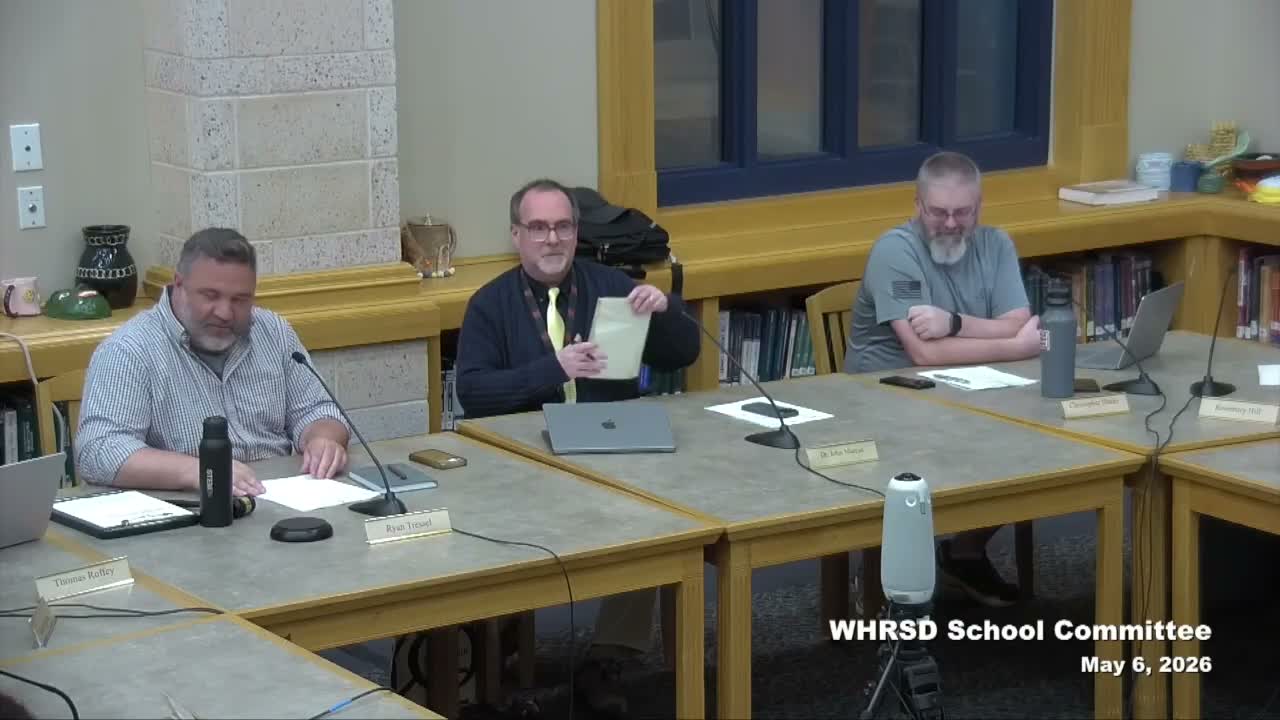
Bob Rogers, the district’s athletic director, told the Whitman‑Hanson Regional School Committee on May 6 that the district fields 27 sports and "this year, we had 503 student athletes," a decline from 522 the prior year and 531 two years earlier. Rogers said the program currently operates on a $100,000 annual budget line and estimated a conservative fully funded athletic budget at $718,000.
Rogers said the user‑fee structure and gate receipts do not cover costs: "that fund that that user fee does not even come close to covering the cost of running the athletic program," and he put the district’s projected net loss for the year at "$152,696." He listed major costs (coaching stipends, transportation, officials, an athletic trainer) and said many teams rely on fundraising and donations for uniforms, travel and equipment.
The presentation responded directly to concerns from parent Jennifer Roback, who during public comment said she hopes the committee "really think long and hard" before increasing user fees because families are struggling and that fees can prevent students from participating. Rogers acknowledged the burden on families and said the district offers scholarships and fundraising options: "we do give the parents the option to take 40% of whatever was raised and apply it directly to their user fees," and he named the Panther Pals program and a SNAP fundraising effort that returned money to participating families.
Board members asked numerous clarifying questions about how participation was counted, the size of outstanding fees and whether payment plans or automated collection options exist. Rogers said the 503 figure counts students not slots (some students play multiple seasons), confirmed outstanding fees were listed as about $23,000 for fall and $23,000 for winter on the packet, and said the district does follow up and sometimes permits payment plans but does not have a fully automated installment system for user fees.
Rogers outlined possible revenue options to reduce family burden: a season pass (which he said could be provided free to families who pay the user fee), advertising on stadium scoreboards and gym screens, and hosting tournaments and camps (noting camps bring in variable net revenue after expenses). He also repeatedly emphasized that staff would work to prevent students from being excluded for inability to pay: "If anybody's watching at home, just know that if you can't afford to play... contact me because I will we will make it work."
The superintendent, Doctor Marcus, and several committee members said athletics is an important district priority and that the FY28 budget process will revisit staffing and funding choices. Marcus said the administration will use the newly compiled participation and financial data in planning, and board members suggested examining fee structures, revolving accounts for camp revenue and whether stipend lines could be handled differently in future budgets.
Next steps: the committee received Rogers’s report and packet (a QR code to the full report was provided) and discussed options the administration will explore for FY28, including revenue strategies and targeted budget shifts; no formal policy change or fee increase was adopted at the meeting.
Rogers said the user‑fee structure and gate receipts do not cover costs: "that fund that that user fee does not even come close to covering the cost of running the athletic program," and he put the district’s projected net loss for the year at "$152,696." He listed major costs (coaching stipends, transportation, officials, an athletic trainer) and said many teams rely on fundraising and donations for uniforms, travel and equipment.
The presentation responded directly to concerns from parent Jennifer Roback, who during public comment said she hopes the committee "really think long and hard" before increasing user fees because families are struggling and that fees can prevent students from participating. Rogers acknowledged the burden on families and said the district offers scholarships and fundraising options: "we do give the parents the option to take 40% of whatever was raised and apply it directly to their user fees," and he named the Panther Pals program and a SNAP fundraising effort that returned money to participating families.
Board members asked numerous clarifying questions about how participation was counted, the size of outstanding fees and whether payment plans or automated collection options exist. Rogers said the 503 figure counts students not slots (some students play multiple seasons), confirmed outstanding fees were listed as about $23,000 for fall and $23,000 for winter on the packet, and said the district does follow up and sometimes permits payment plans but does not have a fully automated installment system for user fees.
Rogers outlined possible revenue options to reduce family burden: a season pass (which he said could be provided free to families who pay the user fee), advertising on stadium scoreboards and gym screens, and hosting tournaments and camps (noting camps bring in variable net revenue after expenses). He also repeatedly emphasized that staff would work to prevent students from being excluded for inability to pay: "If anybody's watching at home, just know that if you can't afford to play... contact me because I will we will make it work."
The superintendent, Doctor Marcus, and several committee members said athletics is an important district priority and that the FY28 budget process will revisit staffing and funding choices. Marcus said the administration will use the newly compiled participation and financial data in planning, and board members suggested examining fee structures, revolving accounts for camp revenue and whether stipend lines could be handled differently in future budgets.
Next steps: the committee received Rogers’s report and packet (a QR code to the full report was provided) and discussed options the administration will explore for FY28, including revenue strategies and targeted budget shifts; no formal policy change or fee increase was adopted at the meeting.
View the Full Meeting & All Its Details
This article offers just a summary. Unlock complete video, transcripts, and insights as a Founder Member.
✓
Watch full, unedited meeting videos
✓
Search every word spoken in unlimited transcripts
✓
AI summaries & real-time alerts (all government levels)
✓
Permanent access to expanding government content
30-day money-back guarantee
