Clark County study finds roughly half of landfill‑bound trash is recoverable; food waste tops the list
May 07, 2026 | Clark County, Washington
This article was created by AI summarizing key points discussed. AI makes mistakes, so for full details and context, please refer to the video of the full meeting. Please report any errors so we can fix them. Report an error »
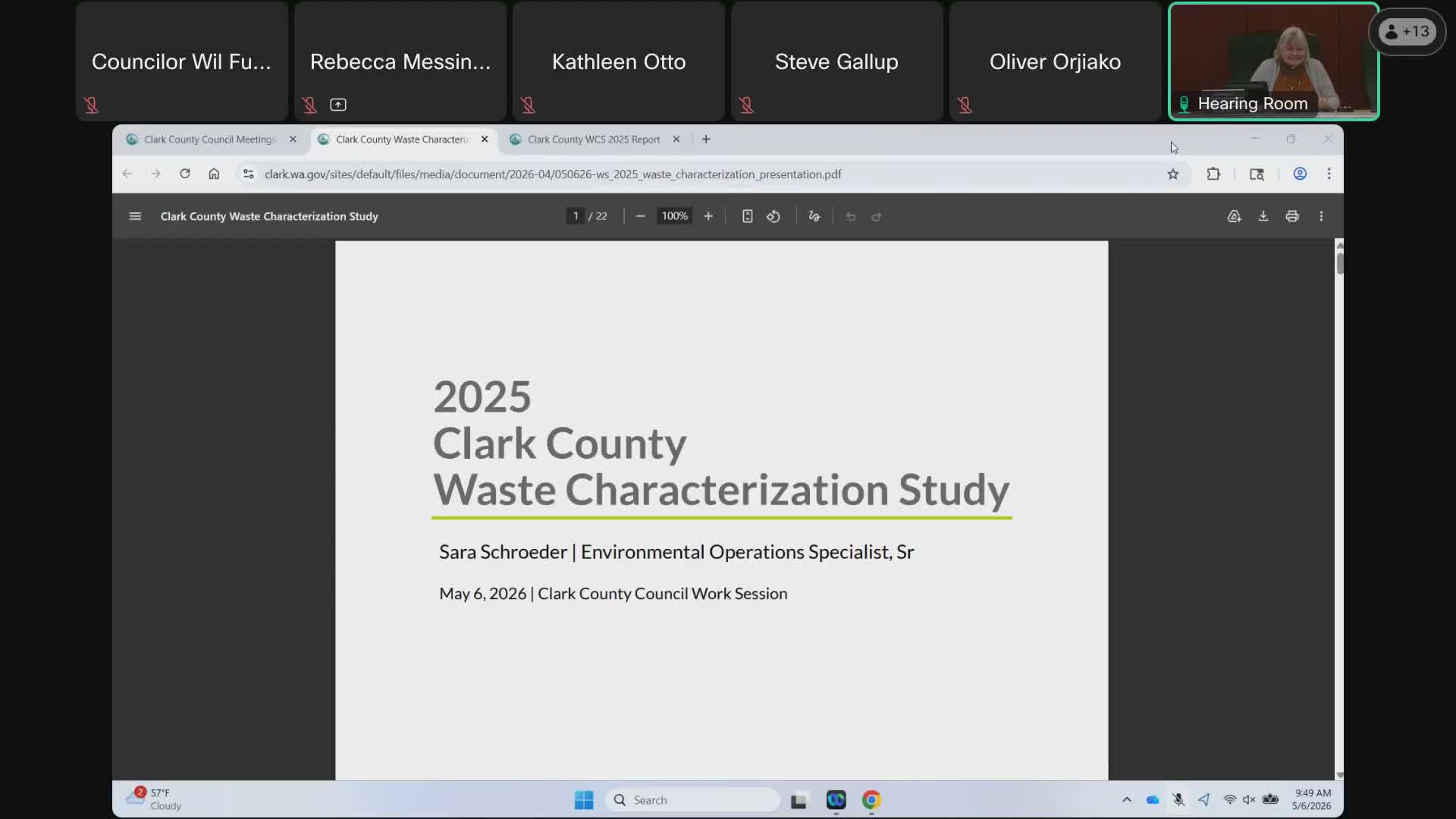
Joelle Loescher, solid waste and recycling division manager for Clark County Public Works, and Sarah Schroeder, the county’s environmental operations specialist senior, presented the results of a Cascadia Consulting‑led waste characterization study at a Clark County Council work session.
The study sampled garbage (not materials already routed for recycling or composting) across the county’s three transfer stations over four seasons and included 244 field samples. "45% to 46% were recoverable material that came through as garbage," Sarah Schroeder told the council, and staff reported a total of 190,009 tons identified as recoverable in the study.
Why it matters: staff said the findings will be folded into the county’s next solid and hazardous waste management plan revision and will inform transfer‑station operations, collection contracts and targeted outreach. Loescher said the data will help the county compare local patterns with statewide findings and better tailor programs for Clark County’s border‑county conditions.
Key findings and methods
- The study analyzed only landfill‑bound garbage; recyclable or composting streams already captured by existing programs were excluded from the sort. Samples were categorized by generator type (single‑family, multifamily, nonresidential curbside, roll‑off/compactor and self‑haul residential/nonresidential) and by transfer station location.
- Countywide shares in landfill‑bound loads included about 10% commonly recyclable material, 8% less‑recyclable material, 15% commonly compostable material and roughly 10% potentially recoverable items (those that require specialized processing). Top materials countywide included edible food/vegetative waste, furniture and cardboard/craft packaging.
- Single‑family curbside households showed higher commonly compostable shares (edible food/vegetative waste ~12%) and about 11% commonly recyclable material. Multifamily housing presented more barriers to composting and recycling access, staff said. Self‑haul residential trips were dominated by bulky, potentially recoverable items (furniture accounted for about 14.5% of that subgroup).
- Staff surveyed 5,100 self‑haul customers during the study and said roughly 70% of self‑haul respondents were from Vancouver; 75% of self‑haul respondents were residential.
Program and infrastructure implications
Staff said the study highlights substantial opportunities to divert food and other materials using targeted programs and infrastructure changes. Actions under consideration and already underway include expanding outreach tools (an existing recycling app and an expanded commercial 'A‑to‑Z' tool), using the data in food‑waste prevention campaigns, and coordinating an RFP with the City of Vancouver to relocate the material recovery facility (MRF) currently at West Vancouver to free capacity for organics.
On siting, staff said they are pursuing a North County transfer station to increase capacity but face site‑suitability constraints; they referenced a 2023 regional solid waste system study included as an appendix to the adopted plan that evaluated current facilities.
Policy and operational notes raised in Q&A
- Batteries: staff said existing drop‑off battery collection is changing under new requirements. They stated the battery collection program "has to end 07/01/2027" and that county/city partners are preparing "beginning 01/01/2027" for the change; staff pledged to present detailed data and outreach plans at a future session.
- Clamshell plastics: staff explained that clear clamshell containers and similar items often damage processing equipment (they break and contaminate paper bales), so curbside systems currently reject many of those plastics; some retail drop‑offs (for example, New Seasons) and specialized end markets accept certain items.
- Diversion at transfer stations: staff said samples were taken from loads placed in front of sorters before transportation staff perform diversion, and that contractor agreements include diversion requirements (staff estimated a ~10% diversion pull but noted the figure was an off‑the‑top estimate).
What’s next
Staff said the study will be incorporated into the county’s next plan revision cycle, inform RFP and contract decisions, and support outreach and pilot programs (including the 'We Compost' program). Staff offered to bring updated reports or have program staff present metrics on participation and outcomes. The work session concluded and the council reconvened for regular business at 1:00 p.m.
The study sampled garbage (not materials already routed for recycling or composting) across the county’s three transfer stations over four seasons and included 244 field samples. "45% to 46% were recoverable material that came through as garbage," Sarah Schroeder told the council, and staff reported a total of 190,009 tons identified as recoverable in the study.
Why it matters: staff said the findings will be folded into the county’s next solid and hazardous waste management plan revision and will inform transfer‑station operations, collection contracts and targeted outreach. Loescher said the data will help the county compare local patterns with statewide findings and better tailor programs for Clark County’s border‑county conditions.
Key findings and methods
- The study analyzed only landfill‑bound garbage; recyclable or composting streams already captured by existing programs were excluded from the sort. Samples were categorized by generator type (single‑family, multifamily, nonresidential curbside, roll‑off/compactor and self‑haul residential/nonresidential) and by transfer station location.
- Countywide shares in landfill‑bound loads included about 10% commonly recyclable material, 8% less‑recyclable material, 15% commonly compostable material and roughly 10% potentially recoverable items (those that require specialized processing). Top materials countywide included edible food/vegetative waste, furniture and cardboard/craft packaging.
- Single‑family curbside households showed higher commonly compostable shares (edible food/vegetative waste ~12%) and about 11% commonly recyclable material. Multifamily housing presented more barriers to composting and recycling access, staff said. Self‑haul residential trips were dominated by bulky, potentially recoverable items (furniture accounted for about 14.5% of that subgroup).
- Staff surveyed 5,100 self‑haul customers during the study and said roughly 70% of self‑haul respondents were from Vancouver; 75% of self‑haul respondents were residential.
Program and infrastructure implications
Staff said the study highlights substantial opportunities to divert food and other materials using targeted programs and infrastructure changes. Actions under consideration and already underway include expanding outreach tools (an existing recycling app and an expanded commercial 'A‑to‑Z' tool), using the data in food‑waste prevention campaigns, and coordinating an RFP with the City of Vancouver to relocate the material recovery facility (MRF) currently at West Vancouver to free capacity for organics.
On siting, staff said they are pursuing a North County transfer station to increase capacity but face site‑suitability constraints; they referenced a 2023 regional solid waste system study included as an appendix to the adopted plan that evaluated current facilities.
Policy and operational notes raised in Q&A
- Batteries: staff said existing drop‑off battery collection is changing under new requirements. They stated the battery collection program "has to end 07/01/2027" and that county/city partners are preparing "beginning 01/01/2027" for the change; staff pledged to present detailed data and outreach plans at a future session.
- Clamshell plastics: staff explained that clear clamshell containers and similar items often damage processing equipment (they break and contaminate paper bales), so curbside systems currently reject many of those plastics; some retail drop‑offs (for example, New Seasons) and specialized end markets accept certain items.
- Diversion at transfer stations: staff said samples were taken from loads placed in front of sorters before transportation staff perform diversion, and that contractor agreements include diversion requirements (staff estimated a ~10% diversion pull but noted the figure was an off‑the‑top estimate).
What’s next
Staff said the study will be incorporated into the county’s next plan revision cycle, inform RFP and contract decisions, and support outreach and pilot programs (including the 'We Compost' program). Staff offered to bring updated reports or have program staff present metrics on participation and outcomes. The work session concluded and the council reconvened for regular business at 1:00 p.m.
View the Full Meeting & All Its Details
This article offers just a summary. Unlock complete video, transcripts, and insights as a Founder Member.
✓
Watch full, unedited meeting videos
✓
Search every word spoken in unlimited transcripts
✓
AI summaries & real-time alerts (all government levels)
✓
Permanent access to expanding government content
30-day money-back guarantee
