Brentwood UFSD proposes $727 million budget, seeks 2.5% tax-levy increase; two child‑safety propositions set for May vote
May 07, 2026 | BRENTWOOD UNION FREE SCHOOL DISTRICT, School Districts, New York
This article was created by AI summarizing key points discussed. AI makes mistakes, so for full details and context, please refer to the video of the full meeting. Please report any errors so we can fix them. Report an error »
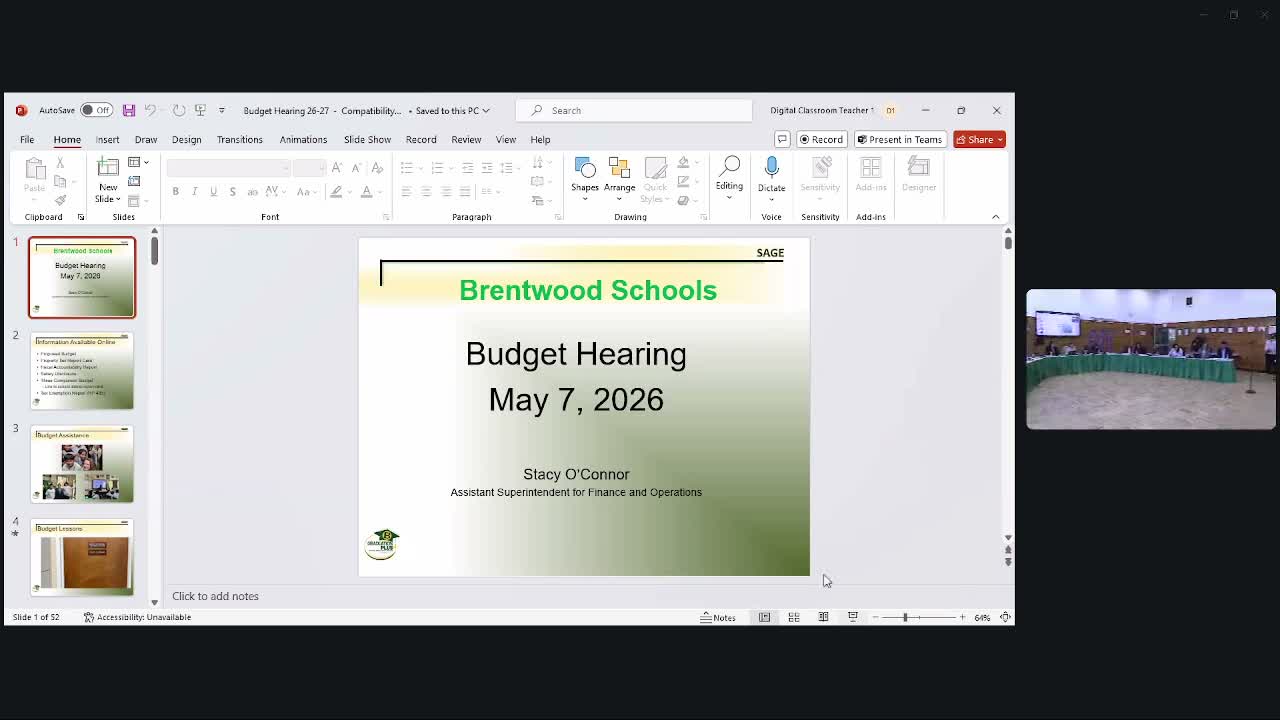
Assistant Superintendent for Finance and Operations Stacy O'Connor presented a proposed $727,000,000 budget for the Brentwood Union Free School District at the district's seventh annual budget hearing, saying the plan represents a $38,000,000 increase over the current year and that the board is proposing a 2.5% tax-levy increase to raise about $2.8 million.
O'Connor said the district remains heavily dependent on state aid — roughly 74% of district revenue — and that unresolved state budget decisions and declining enrollment reduced the district's estimated foundation aid by about $7 million compared with January projections. "That's a $38,000,000 increase over the current year's budget, or 5.6%," O'Connor said during the presentation.
Why it matters: the proposal preserves all current programs and expands several, while asking residents to accept a modest levy increase. O'Connor emphasized that the district did not cut instructional programs: Graduation Plus, expanded middle‑school music, extended‑day and Saturday academies, mental health staff, librarians and career programs will be maintained or grown.
Major drivers and fiscal details
O'Connor said certificated salaries are the largest cost driver; the district employs more than 1,500 teachers and contractual salary increases account for a substantial portion of the budgetary rise. Benefits — which O'Connor estimated contributed nearly $10 million of the change — and higher transportation and utility costs were additional factors. She said an itemized, line‑by‑line budget is posted on the district website under Business Office → Financial Reports.
The presentation included several quantitative details the board highlighted for voters: the proposed 2.5% levy would increase school taxes for the district's defined "average" household (assessed at $35,000 for these calculations) by about $136 a year, O'Connor said. The district also plans a $36,000,000 transfer from the general fund to capital projects within the 2627 budget; that transfer is not a separate proposition and would take effect if the general fund budget is approved.
Capital projects and planned work
O'Connor outlined a multi‑year facilities program funded from current resources and the capital transfer. Projects named include classroom additions to bring UPK classes into district buildings (Southeast, Southwest, East K and Twin Pines), continuation of athletic-complex work and culinary building construction, renovation of the district‑owned property at 1734 Brentwood Road for STEM and high‑school classroom use, and multiple air‑conditioning and HVAC upgrades across elementary, middle and high schools. She said the district received a $3,000,000 E‑rate award to improve Wi‑Fi and cybersecurity.
Child‑safety zone propositions
Transportation coordinator David Estevez, introduced by O'Connor, explained the child‑safety zone designation and the role of independent transportation studies required for such zones. "If that threshold is met, the board of education can then decide whether transportation should be provided within the boundaries of the new child safety zone," Estevez said, describing how hazard points are assigned under New York State Education criteria in coordination with DMV, DOT and State Police standards. Propositions 2 and 3, he said, would establish the borders of potential child‑safety zones for the Freshman Campus and Brentwood High School; if approved by voters, the district could provide bus transportation and seek transportation aid for any additional costs.
Public questions and concerns
During the community Q&A attendees pressed for additional transparency on several items. One resident asked whether passing the two propositions would increase the district's total spending; O'Connor said the propositions are separate votes and, if approved, would raise the overall total above the $727,000,000 baseline (she estimated the two propositions would add about $1 million). A resident asked about carryover funds; O'Connor said the district's unspent funds projected to carry forward were $55,000,000, of which $36,000,000 is proposed for the capital transfer mentioned above. Supply and equipment spending was cited at $11,900,000.
Questions about personnel costs prompted requests for written follow‑up. One attendee pressed the board on pay for a non‑teaching position reportedly receiving more than $200,000; a board member said staff would provide the legal and payroll pathway information in writing.
What comes next
The budget vote is scheduled for Tuesday, May 19 at local elementary schools; the propositions for child‑safety zones will appear on the same ballot. O'Connor outlined revote and contingent‑budget procedures should the budget fail: the board may submit the same or a revised budget for a June revote, or adopt a contingent budget with restrictions (no levy increase, caps on administrative component growth and limits on certain purchases).
The board adjourned the hearing after public comment; no formal board vote on the budget occurred at the hearing itself.
O'Connor said the district remains heavily dependent on state aid — roughly 74% of district revenue — and that unresolved state budget decisions and declining enrollment reduced the district's estimated foundation aid by about $7 million compared with January projections. "That's a $38,000,000 increase over the current year's budget, or 5.6%," O'Connor said during the presentation.
Why it matters: the proposal preserves all current programs and expands several, while asking residents to accept a modest levy increase. O'Connor emphasized that the district did not cut instructional programs: Graduation Plus, expanded middle‑school music, extended‑day and Saturday academies, mental health staff, librarians and career programs will be maintained or grown.
Major drivers and fiscal details
O'Connor said certificated salaries are the largest cost driver; the district employs more than 1,500 teachers and contractual salary increases account for a substantial portion of the budgetary rise. Benefits — which O'Connor estimated contributed nearly $10 million of the change — and higher transportation and utility costs were additional factors. She said an itemized, line‑by‑line budget is posted on the district website under Business Office → Financial Reports.
The presentation included several quantitative details the board highlighted for voters: the proposed 2.5% levy would increase school taxes for the district's defined "average" household (assessed at $35,000 for these calculations) by about $136 a year, O'Connor said. The district also plans a $36,000,000 transfer from the general fund to capital projects within the 2627 budget; that transfer is not a separate proposition and would take effect if the general fund budget is approved.
Capital projects and planned work
O'Connor outlined a multi‑year facilities program funded from current resources and the capital transfer. Projects named include classroom additions to bring UPK classes into district buildings (Southeast, Southwest, East K and Twin Pines), continuation of athletic-complex work and culinary building construction, renovation of the district‑owned property at 1734 Brentwood Road for STEM and high‑school classroom use, and multiple air‑conditioning and HVAC upgrades across elementary, middle and high schools. She said the district received a $3,000,000 E‑rate award to improve Wi‑Fi and cybersecurity.
Child‑safety zone propositions
Transportation coordinator David Estevez, introduced by O'Connor, explained the child‑safety zone designation and the role of independent transportation studies required for such zones. "If that threshold is met, the board of education can then decide whether transportation should be provided within the boundaries of the new child safety zone," Estevez said, describing how hazard points are assigned under New York State Education criteria in coordination with DMV, DOT and State Police standards. Propositions 2 and 3, he said, would establish the borders of potential child‑safety zones for the Freshman Campus and Brentwood High School; if approved by voters, the district could provide bus transportation and seek transportation aid for any additional costs.
Public questions and concerns
During the community Q&A attendees pressed for additional transparency on several items. One resident asked whether passing the two propositions would increase the district's total spending; O'Connor said the propositions are separate votes and, if approved, would raise the overall total above the $727,000,000 baseline (she estimated the two propositions would add about $1 million). A resident asked about carryover funds; O'Connor said the district's unspent funds projected to carry forward were $55,000,000, of which $36,000,000 is proposed for the capital transfer mentioned above. Supply and equipment spending was cited at $11,900,000.
Questions about personnel costs prompted requests for written follow‑up. One attendee pressed the board on pay for a non‑teaching position reportedly receiving more than $200,000; a board member said staff would provide the legal and payroll pathway information in writing.
What comes next
The budget vote is scheduled for Tuesday, May 19 at local elementary schools; the propositions for child‑safety zones will appear on the same ballot. O'Connor outlined revote and contingent‑budget procedures should the budget fail: the board may submit the same or a revised budget for a June revote, or adopt a contingent budget with restrictions (no levy increase, caps on administrative component growth and limits on certain purchases).
The board adjourned the hearing after public comment; no formal board vote on the budget occurred at the hearing itself.
View the Full Meeting & All Its Details
This article offers just a summary. Unlock complete video, transcripts, and insights as a Founder Member.
✓
Watch full, unedited meeting videos
✓
Search every word spoken in unlimited transcripts
✓
AI summaries & real-time alerts (all government levels)
✓
Permanent access to expanding government content
30-day money-back guarantee
