Senate Economic Development, Housing & General Affairs advances H.757 language to ease grant access for limited‑equity mobile‑home co‑ops
May 08, 2026 | Economic Development, Housing & General Affairs, SENATE, Committees, Legislative , Vermont
This article was created by AI summarizing key points discussed. AI makes mistakes, so for full details and context, please refer to the video of the full meeting. Please report any errors so we can fix them. Report an error »
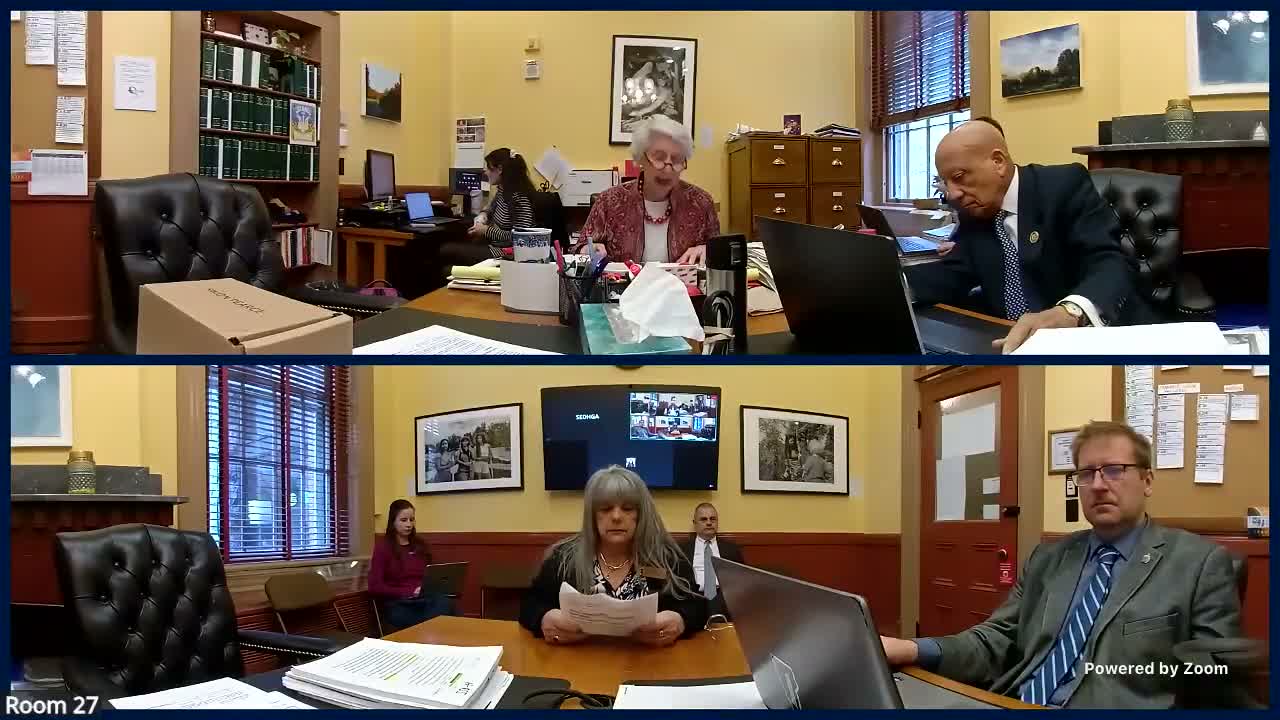
The Senate Economic Development, Housing & General Affairs committee on May 7 agreed to advance language in H.757 intended to help manufactured‑home limited‑equity cooperatives (LECs) qualify for state grants, but asked state agencies to provide a report and recommended a sunset review before final action.
Rep. Gail Pezzo, sponsor of the bill, told the committee that Section 7 would “treat mobile home LECs as nonprofit corporations for the purpose of state funding and grants” and emphasized that “this change does not affect tax treatment.” Pezzo said the intent is to align Vermont statutory language with how grant makers determine eligibility so resident‑owned parks are not automatically excluded when a registration lists them as a business rather than a nonprofit.
The committee’s discussion focused on a mismatch between how some limited‑equity cooperatives are registered with the Secretary of State and the eligibility screens used by grant programs. "What the Secretary of State's office has testified is, moving forward ... they determined that they should not be designating these entities as nonprofits when they register with the secretary of state," Cameron Wood, legislative counsel, told the panel, summarizing testimony the committee had received. Wood cautioned that the bill’s language would signal to funding sources that LECs should be treated as nonprofits for grant purposes but would not itself convert an entity into a federal 501(c)(3) organization.
Committee members raised practical questions about scope and implementation. Pezzo said the proposal was intended to focus on manufactured‑home LECs and noted the state’s current records list 19 such entities, 17 of which are resident‑owned communities. Members discussed that some grant programs (for example, certain wastewater or water infrastructure grants administered by ANR or AOT) explicitly require nonprofit or 501(c)(3) status, while others determine eligibility based on income limits; the bill would not change federal tax filings and may not by itself satisfy programs that strictly require federal nonprofit status.
To address the uncertainty, members agreed to advance the bill with an amendment: add a sunset provision and require coordinated reports. The committee asked that the Department of Housing and Community Development’s mobile‑home park unit, the Secretary of State’s office and the Department of Taxes work together to identify which state and non‑state grants LECs currently access, what statutory or administrative barriers remain, and recommend how to resolve registration and eligibility problems. The group was asked to report back to the committee in January; members discussed whether a one‑ or two‑year sunset would be appropriate.
The committee also directed that the Finance Committee review fee and fiscal implications related to the language. No formal floor vote on H.757 was recorded in the meeting; members scheduled formal consideration of the amendment for the next morning.
A representative of the committee summarized the committee’s intent: the statutory adjustment is meant to be a targeted administrative fix to reduce hurdles LECs face when applying for grants, not a change to federal tax status. The committee recessed and signaled it would reconvene to consider a CHIP amendment next.
Rep. Gail Pezzo, sponsor of the bill, told the committee that Section 7 would “treat mobile home LECs as nonprofit corporations for the purpose of state funding and grants” and emphasized that “this change does not affect tax treatment.” Pezzo said the intent is to align Vermont statutory language with how grant makers determine eligibility so resident‑owned parks are not automatically excluded when a registration lists them as a business rather than a nonprofit.
The committee’s discussion focused on a mismatch between how some limited‑equity cooperatives are registered with the Secretary of State and the eligibility screens used by grant programs. "What the Secretary of State's office has testified is, moving forward ... they determined that they should not be designating these entities as nonprofits when they register with the secretary of state," Cameron Wood, legislative counsel, told the panel, summarizing testimony the committee had received. Wood cautioned that the bill’s language would signal to funding sources that LECs should be treated as nonprofits for grant purposes but would not itself convert an entity into a federal 501(c)(3) organization.
Committee members raised practical questions about scope and implementation. Pezzo said the proposal was intended to focus on manufactured‑home LECs and noted the state’s current records list 19 such entities, 17 of which are resident‑owned communities. Members discussed that some grant programs (for example, certain wastewater or water infrastructure grants administered by ANR or AOT) explicitly require nonprofit or 501(c)(3) status, while others determine eligibility based on income limits; the bill would not change federal tax filings and may not by itself satisfy programs that strictly require federal nonprofit status.
To address the uncertainty, members agreed to advance the bill with an amendment: add a sunset provision and require coordinated reports. The committee asked that the Department of Housing and Community Development’s mobile‑home park unit, the Secretary of State’s office and the Department of Taxes work together to identify which state and non‑state grants LECs currently access, what statutory or administrative barriers remain, and recommend how to resolve registration and eligibility problems. The group was asked to report back to the committee in January; members discussed whether a one‑ or two‑year sunset would be appropriate.
The committee also directed that the Finance Committee review fee and fiscal implications related to the language. No formal floor vote on H.757 was recorded in the meeting; members scheduled formal consideration of the amendment for the next morning.
A representative of the committee summarized the committee’s intent: the statutory adjustment is meant to be a targeted administrative fix to reduce hurdles LECs face when applying for grants, not a change to federal tax status. The committee recessed and signaled it would reconvene to consider a CHIP amendment next.
View the Full Meeting & All Its Details
This article offers just a summary. Unlock complete video, transcripts, and insights as a Founder Member.
✓
Watch full, unedited meeting videos
✓
Search every word spoken in unlimited transcripts
✓
AI summaries & real-time alerts (all government levels)
✓
Permanent access to expanding government content
30-day money-back guarantee
