Council declares 75 Oliver Street surplus and approves RFP with preservation and public‑benefit conditions
May 07, 2026 | Easthampton, School Boards, Massachusetts
This article was created by AI summarizing key points discussed. AI makes mistakes, so for full details and context, please refer to the video of the full meeting. Please report any errors so we can fix them. Report an error »
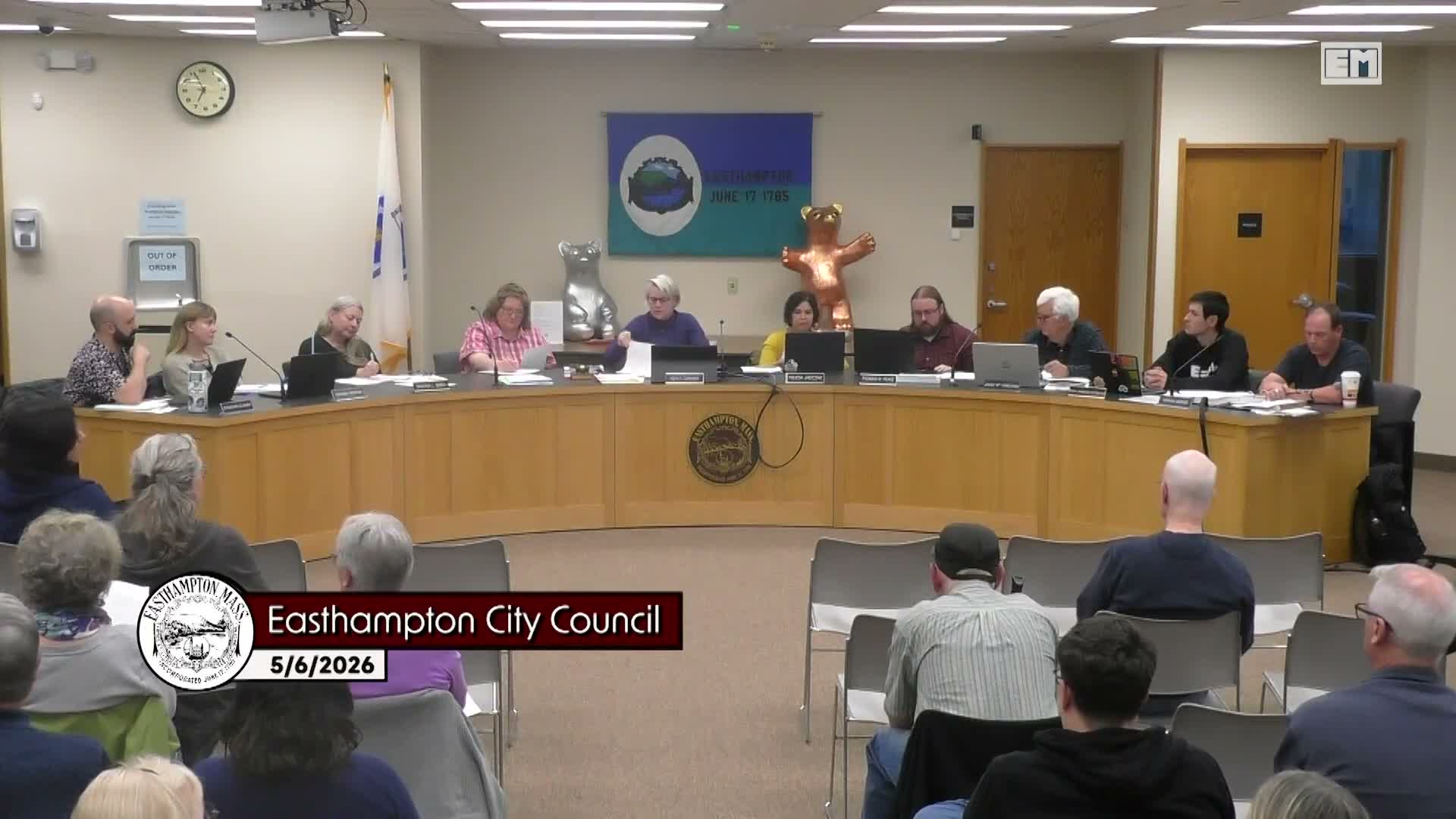
East Hampton's City Council voted on May 6 to declare 75 Oliver Street — the Town Lodging House and its adjoining farmland — surplus and to publish a request for proposals (RFP) guiding its disposal and reuse.
Councilors framed the vote as a step to move a long‑stalled property toward private‑sector investment while keeping legal restrictions in place: the parcel is subject to an agricultural preservation restriction, an historic preservation restriction and an affordable‑housing restriction, officials said. Planning director Allison Manuel told the council the current proposal is to keep the property intact rather than divide it.
Council debate and amendments focused on whether the city should condition sale terms to secure continued public benefit. The adopted RFP and attached draft agreement require that any reuse "provide a substantial public benefit to vulnerable and/or underserved communities," that purchasers assume recorded encumbrances, and that the city retain a right of first refusal and a non‑voting observer seat on the managing board in certain circumstances. Councilor amendments struck language exempting the pilot (payment‑in‑lieu) requirement only when sale is "for less than appraised value," broadening the standard so the payment‑in‑lieu requirement applies regardless of price negotiations.
Procurement officer Michael Owens summarized prior city investments in the property and public‑funded studies: slate roof and envelope work in the late 1990s using a mix of city, Massachusetts Historic Commission and Community Development Block Grant funds; further restoration and a 2019 capital needs assessment that identified roughly 44 work items with 2020 cost estimates of about $1.5 million. The Valley CDC previously did due diligence and pursued affordable‑housing proposals that did not advance to construction, the procurement officer said.
Public comment was extensive. Supporters urged keeping the housing and farmland together, prioritizing regenerative agriculture that could support schools and food pantries, and choosing partners with long‑term financial capacity. Opponents and others expressed frustration that the city allowed the lodging house to deteriorate and asked for stronger assurances about maintenance and public benefit.
The council set the property‑committee as the RFP review body; the committee will solicit proposals in compliance with state procurement law and the RFP scoring criteria. Comparative evaluation categories listed in the RFP include public benefit, consistency with deed restrictions (historic and agricultural), financial feasibility and project timing, with a stated preference for substantial investment, preservation of historic fabric, regenerative agricultural practices and a target timeline for renovations and occupancy milestones.
The final motion (as amended) passed on roll call; the property committee will receive proposals and make recommendations to the mayor per the RFP schedule. The RFP will be posted publicly and include relevant site reports and prior environmental and archaeological studies the city retains. Councilors and staff said committee review will solicit input from other municipal boards (historic, agricultural, housing) and community groups before recommendation.
Next steps: the city will post the RFP, accept proposals per the schedule set by the property committee and state procurement rules, and the committee will score and recommend finalists to the mayor for further negotiation and possible conveyance.
Councilors framed the vote as a step to move a long‑stalled property toward private‑sector investment while keeping legal restrictions in place: the parcel is subject to an agricultural preservation restriction, an historic preservation restriction and an affordable‑housing restriction, officials said. Planning director Allison Manuel told the council the current proposal is to keep the property intact rather than divide it.
Council debate and amendments focused on whether the city should condition sale terms to secure continued public benefit. The adopted RFP and attached draft agreement require that any reuse "provide a substantial public benefit to vulnerable and/or underserved communities," that purchasers assume recorded encumbrances, and that the city retain a right of first refusal and a non‑voting observer seat on the managing board in certain circumstances. Councilor amendments struck language exempting the pilot (payment‑in‑lieu) requirement only when sale is "for less than appraised value," broadening the standard so the payment‑in‑lieu requirement applies regardless of price negotiations.
Procurement officer Michael Owens summarized prior city investments in the property and public‑funded studies: slate roof and envelope work in the late 1990s using a mix of city, Massachusetts Historic Commission and Community Development Block Grant funds; further restoration and a 2019 capital needs assessment that identified roughly 44 work items with 2020 cost estimates of about $1.5 million. The Valley CDC previously did due diligence and pursued affordable‑housing proposals that did not advance to construction, the procurement officer said.
Public comment was extensive. Supporters urged keeping the housing and farmland together, prioritizing regenerative agriculture that could support schools and food pantries, and choosing partners with long‑term financial capacity. Opponents and others expressed frustration that the city allowed the lodging house to deteriorate and asked for stronger assurances about maintenance and public benefit.
The council set the property‑committee as the RFP review body; the committee will solicit proposals in compliance with state procurement law and the RFP scoring criteria. Comparative evaluation categories listed in the RFP include public benefit, consistency with deed restrictions (historic and agricultural), financial feasibility and project timing, with a stated preference for substantial investment, preservation of historic fabric, regenerative agricultural practices and a target timeline for renovations and occupancy milestones.
The final motion (as amended) passed on roll call; the property committee will receive proposals and make recommendations to the mayor per the RFP schedule. The RFP will be posted publicly and include relevant site reports and prior environmental and archaeological studies the city retains. Councilors and staff said committee review will solicit input from other municipal boards (historic, agricultural, housing) and community groups before recommendation.
Next steps: the city will post the RFP, accept proposals per the schedule set by the property committee and state procurement rules, and the committee will score and recommend finalists to the mayor for further negotiation and possible conveyance.
View the Full Meeting & All Its Details
This article offers just a summary. Unlock complete video, transcripts, and insights as a Founder Member.
✓
Watch full, unedited meeting videos
✓
Search every word spoken in unlimited transcripts
✓
AI summaries & real-time alerts (all government levels)
✓
Permanent access to expanding government content
30-day money-back guarantee
