House Transportation debates MBUF changes and whether inspection updates require emergency rulemaking
May 07, 2026 | Transportation, HOUSE OF REPRESENTATIVES, Committees, Legislative , Vermont
This article was created by AI summarizing key points discussed. AI makes mistakes, so for full details and context, please refer to the video of the full meeting. Please report any errors so we can fix them. Report an error »
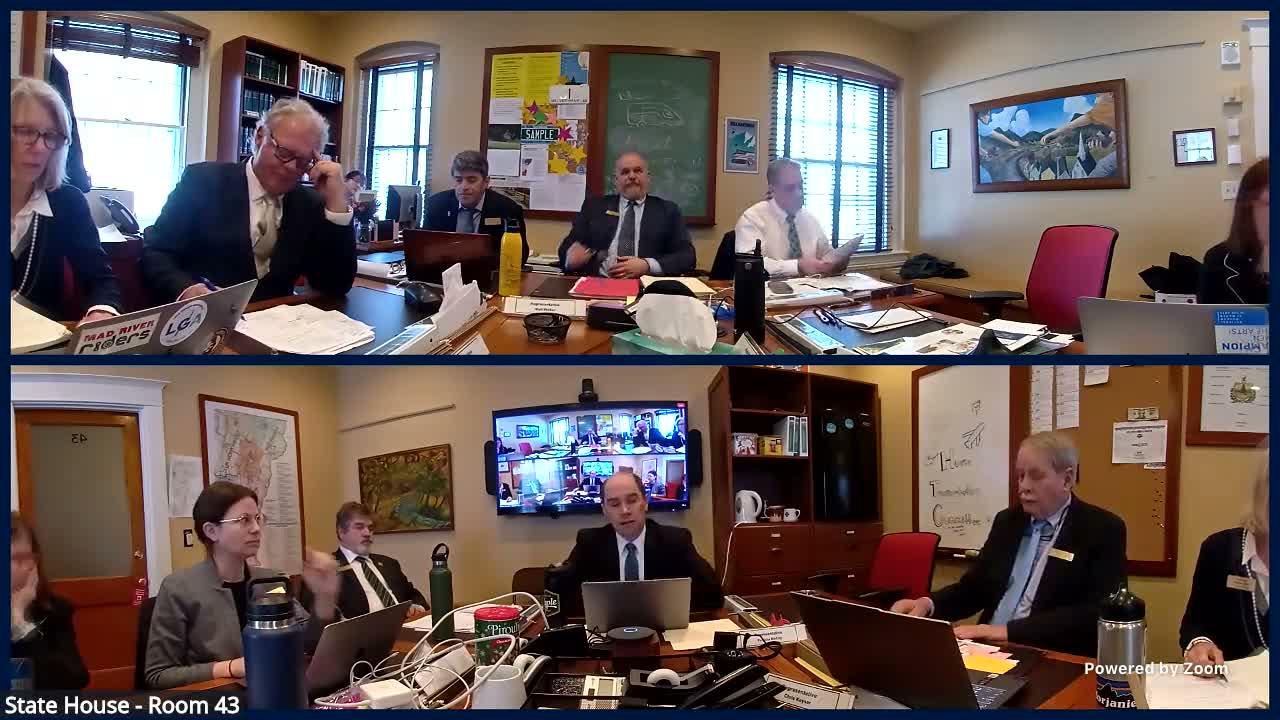
A legislative staff member told the House Transportation Committee on May 7 that the T bill is expected for second reading the next day and for third reading the following Tuesday and that the Senate Finance substitute narrows the planned expansion of the mileage‑based user fee (MBUF).
The staff member summarized the substitute as deleting the 2031 expansion to all light‑duty vehicles and limiting the 2029 expansion to hybrids (plug‑in and mild hybrids), leaving internal‑combustion vehicles out of the 2029 expansion. "So, t bill should be up for second reading tomorrow with third reading on Tuesday," the staff member said. He also said both chambers plan an EV rollout in 2027 but differ on payment options and caps.
Why it matters: The committee is reconciling House and Senate versions ahead of floor action; decisions on vehicle classes, payment options and the pace of expansion will affect which drivers pay a per‑mile fee and when.
The staff member described key differences: the House proposes a single year‑end payment option, while the Senate lists four options (estimated payment, year‑end payment, pay‑as‑you‑go and a flat‑rate option) and applies a two‑year cap at $178, a figure the staff member said matches the current two‑year EV infrastructure fee. He also said a fuel tax credit in the draft is intended to prevent double taxation of hybrid owners.
Committee members pressed on fairness and administrative details. One member pointed to a concern raised in Finance that a 10,000‑pound gross vehicle weight rating cutoff could arbitrarily put similar pickup trucks into different treatment buckets — "one [truck] at 9,501 [lb] would be subject to a capped amount and the other at 10,200 [lb] would pay the full fuel tax," the staff member recounted — and urged more time to observe how initial rollout works before a broader expansion.
The committee also debated proposed changes to vehicle inspection rules submitted by the DMV. Staff cited 23VSA3305B to show the Department of Public Safety (DPS) has statutory authority over certain safety instruction rules, while registration functions remain with the DMV. The chair asked whether outreach and public‑education duties should be moved from DMV to DPS, and members generally signaled support to designate DPS the lead while keeping DMV in consultation.
A key procedural dispute centered on whether DMV's inspection adjustments should be adopted through emergency rulemaking (faster, limited‑notice process) or the standard rulemaking process with public input. "I'm absolutely not for doing an emergency rule," one committee member said, arguing the changes should go through the public process. Another member said affordability concerns and prompt engagement with mechanics and owners argue in favor of using an emergency process so the public can see concrete proposals and comment.
Committee members also discussed specific inspection items — backup lights, license‑plate lights, windshield wipers and other criteria — and asked staff to clarify text inconsistencies. Staff emphasized that several recommendations came from the program experts and from inspection‑station input but acknowledged some members were uncomfortable altering safety‑related requirements without more public review.
What the committee decided and what’s next: The panel gave informal consensus to include the discussed sections and to circulate revised language to stakeholders for feedback; this was not a formal committee vote. The chair said motorcycle‑related language remained the last open item and that the committee aims to take a formal committee vote on the bill the next morning after finalizing that language and any floor amendments.
Notable quotes from the meeting include the staff member’s scheduling update — "So, t bill should be up for second reading tomorrow with third reading on Tuesday" — and a committee member’s objection to emergency rulemaking: "I'm absolutely not for doing an emergency rule." The session closed with the chair asking staff to circulate language and members to be prepared for a reconvened vote the following morning.
Authorities cited during discussion included statute 23VSA3305B (cited by staff in relation to boating/voting safety instruction and DPS rule authority).
The staff member summarized the substitute as deleting the 2031 expansion to all light‑duty vehicles and limiting the 2029 expansion to hybrids (plug‑in and mild hybrids), leaving internal‑combustion vehicles out of the 2029 expansion. "So, t bill should be up for second reading tomorrow with third reading on Tuesday," the staff member said. He also said both chambers plan an EV rollout in 2027 but differ on payment options and caps.
Why it matters: The committee is reconciling House and Senate versions ahead of floor action; decisions on vehicle classes, payment options and the pace of expansion will affect which drivers pay a per‑mile fee and when.
The staff member described key differences: the House proposes a single year‑end payment option, while the Senate lists four options (estimated payment, year‑end payment, pay‑as‑you‑go and a flat‑rate option) and applies a two‑year cap at $178, a figure the staff member said matches the current two‑year EV infrastructure fee. He also said a fuel tax credit in the draft is intended to prevent double taxation of hybrid owners.
Committee members pressed on fairness and administrative details. One member pointed to a concern raised in Finance that a 10,000‑pound gross vehicle weight rating cutoff could arbitrarily put similar pickup trucks into different treatment buckets — "one [truck] at 9,501 [lb] would be subject to a capped amount and the other at 10,200 [lb] would pay the full fuel tax," the staff member recounted — and urged more time to observe how initial rollout works before a broader expansion.
The committee also debated proposed changes to vehicle inspection rules submitted by the DMV. Staff cited 23VSA3305B to show the Department of Public Safety (DPS) has statutory authority over certain safety instruction rules, while registration functions remain with the DMV. The chair asked whether outreach and public‑education duties should be moved from DMV to DPS, and members generally signaled support to designate DPS the lead while keeping DMV in consultation.
A key procedural dispute centered on whether DMV's inspection adjustments should be adopted through emergency rulemaking (faster, limited‑notice process) or the standard rulemaking process with public input. "I'm absolutely not for doing an emergency rule," one committee member said, arguing the changes should go through the public process. Another member said affordability concerns and prompt engagement with mechanics and owners argue in favor of using an emergency process so the public can see concrete proposals and comment.
Committee members also discussed specific inspection items — backup lights, license‑plate lights, windshield wipers and other criteria — and asked staff to clarify text inconsistencies. Staff emphasized that several recommendations came from the program experts and from inspection‑station input but acknowledged some members were uncomfortable altering safety‑related requirements without more public review.
What the committee decided and what’s next: The panel gave informal consensus to include the discussed sections and to circulate revised language to stakeholders for feedback; this was not a formal committee vote. The chair said motorcycle‑related language remained the last open item and that the committee aims to take a formal committee vote on the bill the next morning after finalizing that language and any floor amendments.
Notable quotes from the meeting include the staff member’s scheduling update — "So, t bill should be up for second reading tomorrow with third reading on Tuesday" — and a committee member’s objection to emergency rulemaking: "I'm absolutely not for doing an emergency rule." The session closed with the chair asking staff to circulate language and members to be prepared for a reconvened vote the following morning.
Authorities cited during discussion included statute 23VSA3305B (cited by staff in relation to boating/voting safety instruction and DPS rule authority).
Don't Miss a Word: See the Full Meeting!
Go beyond summaries. Unlock every video, transcript, and key insight with a Founder Membership.
✓
Get instant access to full meeting videos
✓
Search and clip any phrase from complete transcripts
✓
Receive AI-powered summaries & custom alerts
✓
Enjoy lifetime, unrestricted access to government data
30-day money-back guarantee
