Committee debates study‑committee rules, voluntary mergers and state school‑construction timing
May 07, 2026 | Education, SENATE, Committees, Legislative , Vermont
This article was created by AI summarizing key points discussed. AI makes mistakes, so for full details and context, please refer to the video of the full meeting. Please report any errors so we can fix them. Report an error »
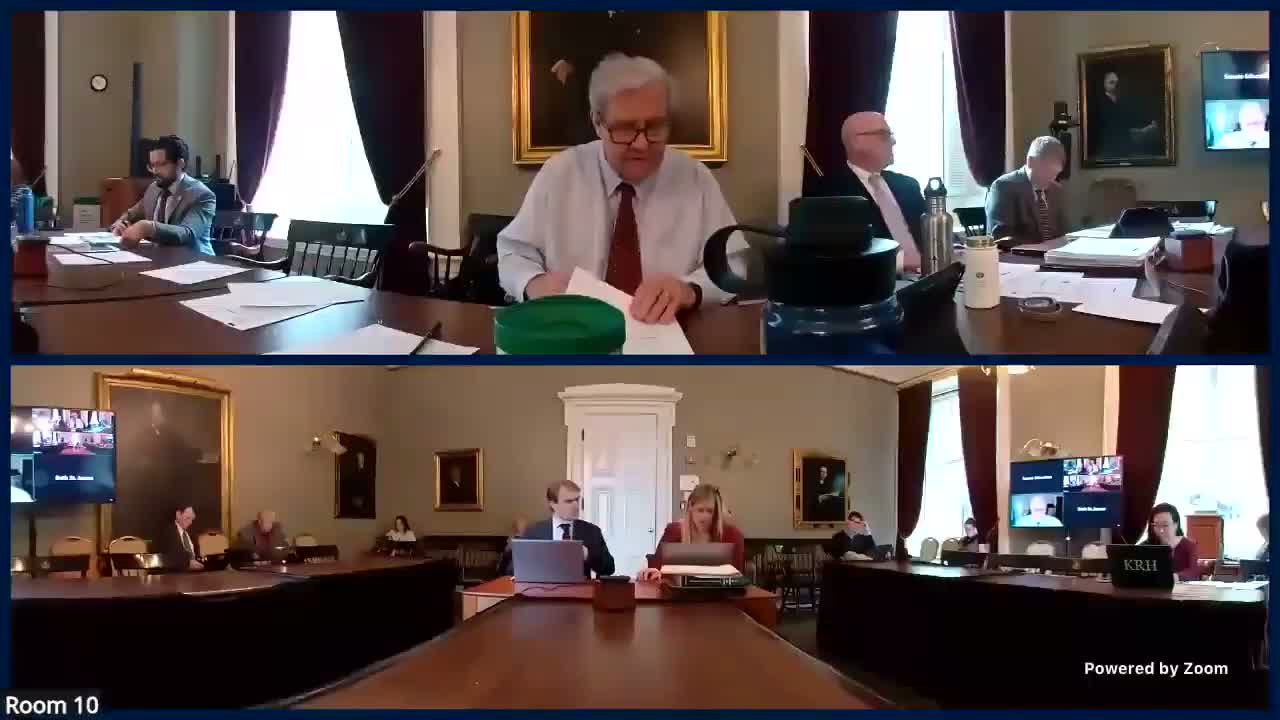
Lawmakers on the Education Committee spent the bulk of the meeting revising section 13 of a comprehensive Education bill that would require school districts to participate in study committees to examine the advisability of forming new unified union school districts and to provide a detailed final report.
Legislative counsel (speaker 2) walked members through new language that (1) sets legislative intent for regional education systems and universal access to career technical education, (2) requires districts to participate in the study‑committee process in good faith, and (3) expands final‑report requirements to include names of participating districts, analyses of educational and financial advantages and disadvantages, operational viability under the foundation formula, and a statement of any minority view.
"A study committee formed pursuant to this section shall prepare a report with its final recommendations as to whether it is advisable or inadvisable to form a new Unified Union School District," legislative counsel said, listing the elements the final report must include. (Legislative Counsel)
Major points of contention: members debated whether early language could be read as compelling districts to merge. One member proposed deleting lines 1–6 on page 33 to avoid implying compulsion; others favored rewording to affirm voluntariness while retaining guardrails. The committee tentatively agreed to strike duplicative lines and consolidate the reporting obligations around a single summary requirement (subdivision 7 on page 35), while keeping analytical obligations and the minority‑view requirement.
Agency concerns and implementation risks: the deputy secretary of education (speaker 5) testified that the state currently lacks the staffing capacity to administer an ambitious state aid for school construction program and cautioned against using short‑term "education transformation" funds to stand up that work.
"The agency cannot do rulemaking, the building on the construction guides, the updating of our capital outlay funding formula, and the setting of minimum and maximum square footage ... with zero resources," the deputy secretary said, warning that diverting transformation funds could undercut other directed work and that the timing of major construction aid should follow decisions about district governance. (Deputy Secretary of Education)
Members discussed models in other states: the Massachusetts School Development Authority (noted as operating with roughly 70 staff in the testimony) and Rhode Island's model were cited as reference points for structuring a school‑construction program, but witnesses and members said replicating those models would require significant staffing and dedicated resources.
Why it matters: committee decisions on reporting content and the sequence of governance changes and construction aid will shape whether districts pursue mergers, how facilities are prioritized, and whether limited state dollars risk funding projects that become misaligned with future governance changes.
Next steps: the committee agreed to continue markup and to have sponsors and legislative counsel produce refined language that addresses voluntariness, reporting consolidation and implementation details (including potential staffing or an oversight mechanism to track study‑committee progress).
Legislative counsel (speaker 2) walked members through new language that (1) sets legislative intent for regional education systems and universal access to career technical education, (2) requires districts to participate in the study‑committee process in good faith, and (3) expands final‑report requirements to include names of participating districts, analyses of educational and financial advantages and disadvantages, operational viability under the foundation formula, and a statement of any minority view.
"A study committee formed pursuant to this section shall prepare a report with its final recommendations as to whether it is advisable or inadvisable to form a new Unified Union School District," legislative counsel said, listing the elements the final report must include. (Legislative Counsel)
Major points of contention: members debated whether early language could be read as compelling districts to merge. One member proposed deleting lines 1–6 on page 33 to avoid implying compulsion; others favored rewording to affirm voluntariness while retaining guardrails. The committee tentatively agreed to strike duplicative lines and consolidate the reporting obligations around a single summary requirement (subdivision 7 on page 35), while keeping analytical obligations and the minority‑view requirement.
Agency concerns and implementation risks: the deputy secretary of education (speaker 5) testified that the state currently lacks the staffing capacity to administer an ambitious state aid for school construction program and cautioned against using short‑term "education transformation" funds to stand up that work.
"The agency cannot do rulemaking, the building on the construction guides, the updating of our capital outlay funding formula, and the setting of minimum and maximum square footage ... with zero resources," the deputy secretary said, warning that diverting transformation funds could undercut other directed work and that the timing of major construction aid should follow decisions about district governance. (Deputy Secretary of Education)
Members discussed models in other states: the Massachusetts School Development Authority (noted as operating with roughly 70 staff in the testimony) and Rhode Island's model were cited as reference points for structuring a school‑construction program, but witnesses and members said replicating those models would require significant staffing and dedicated resources.
Why it matters: committee decisions on reporting content and the sequence of governance changes and construction aid will shape whether districts pursue mergers, how facilities are prioritized, and whether limited state dollars risk funding projects that become misaligned with future governance changes.
Next steps: the committee agreed to continue markup and to have sponsors and legislative counsel produce refined language that addresses voluntariness, reporting consolidation and implementation details (including potential staffing or an oversight mechanism to track study‑committee progress).
Don't Miss a Word: See the Full Meeting!
Go beyond summaries. Unlock every video, transcript, and key insight with a Founder Membership.
✓
Get instant access to full meeting videos
✓
Search and clip any phrase from complete transcripts
✓
Receive AI-powered summaries & custom alerts
✓
Enjoy lifetime, unrestricted access to government data
30-day money-back guarantee
