Austin advances economic development framework after wide public debate over data centers
May 07, 2026 | Austin, Travis County, Texas
This article was created by AI summarizing key points discussed. AI makes mistakes, so for full details and context, please refer to the video of the full meeting. Please report any errors so we can fix them. Report an error »
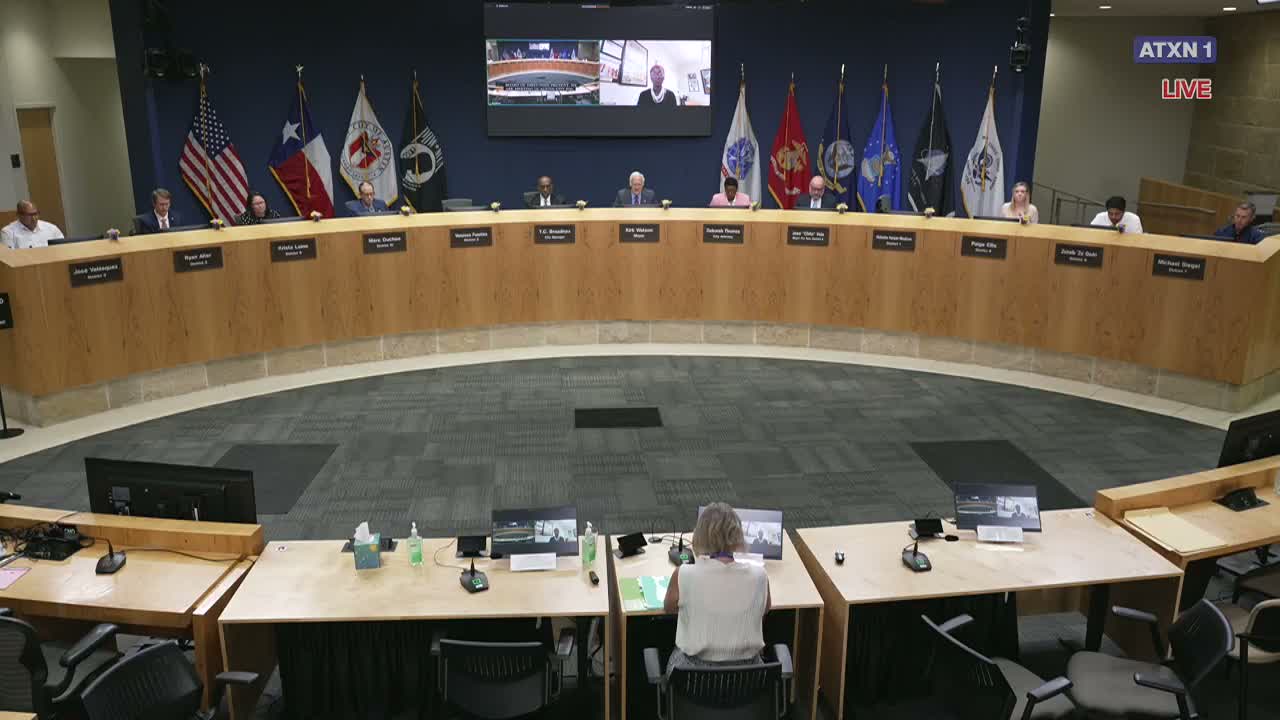
Austin City Council on May 7 advanced a mayor-sponsored economic development framework after an extensive public comment period that laid bare competing views about what industries the city should attract.
Mayor Kirk Watson told the council the resolution is intended to create “a framework or a process” for future economic-development decisions and not to grant incentives immediately. He said the policy is designed to ensure companies receiving city support “share the values that make Austin special” and to provide staff and the public with consistent standards for evaluating potential projects.
The proposal drew dozens of speakers during the public-comment period. Opponents urged the council to add explicit prohibitions against using city incentives to support data centers, artificial-intelligence infrastructure, mass-surveillance technology and defense contractors, citing concerns about heavy water and electricity use, air and noise pollution, limited long-term employment and ethical objections. “Without clear and explicit protections in this resolution, we risk turning Austin into a center for militarization, surveillance, and war profiteering,” one speaker said, urging the council to “reject this resolution unless strong and enforceable guardrails are added.”
Supporters — including chambers of commerce, tourism and hospitality groups and labor organizations — described the resolution as a necessary step to create jobs, attract investment and broaden the city’s tax base. “This policy is essential for encouraging responsible growth that benefits all of Austin,” said Carly Barnett of the Real Estate Council of Austin.
Several speakers, including consumer advocates and utility analysts, urged the city to require stronger community benefits, fund emergency bill-assistance programs for low-income customers and require regular, independent audits of large utility or infrastructure projects when incentives are involved.
Council members and staff stressed that the resolution sets policy direction but does not itself award incentives. The manager was directed to engage with stakeholders and return with recommended ordinance language and criteria for any future incentive packages.
The council adopted the consent agenda that included the framework after the public comment block concluded. The resolution’s passage directs staff to prepare implementing ordinances during the next drafting phase; those ordinances will return to council for review and formal action.
Mayor Kirk Watson told the council the resolution is intended to create “a framework or a process” for future economic-development decisions and not to grant incentives immediately. He said the policy is designed to ensure companies receiving city support “share the values that make Austin special” and to provide staff and the public with consistent standards for evaluating potential projects.
The proposal drew dozens of speakers during the public-comment period. Opponents urged the council to add explicit prohibitions against using city incentives to support data centers, artificial-intelligence infrastructure, mass-surveillance technology and defense contractors, citing concerns about heavy water and electricity use, air and noise pollution, limited long-term employment and ethical objections. “Without clear and explicit protections in this resolution, we risk turning Austin into a center for militarization, surveillance, and war profiteering,” one speaker said, urging the council to “reject this resolution unless strong and enforceable guardrails are added.”
Supporters — including chambers of commerce, tourism and hospitality groups and labor organizations — described the resolution as a necessary step to create jobs, attract investment and broaden the city’s tax base. “This policy is essential for encouraging responsible growth that benefits all of Austin,” said Carly Barnett of the Real Estate Council of Austin.
Several speakers, including consumer advocates and utility analysts, urged the city to require stronger community benefits, fund emergency bill-assistance programs for low-income customers and require regular, independent audits of large utility or infrastructure projects when incentives are involved.
Council members and staff stressed that the resolution sets policy direction but does not itself award incentives. The manager was directed to engage with stakeholders and return with recommended ordinance language and criteria for any future incentive packages.
The council adopted the consent agenda that included the framework after the public comment block concluded. The resolution’s passage directs staff to prepare implementing ordinances during the next drafting phase; those ordinances will return to council for review and formal action.
View the Full Meeting & All Its Details
This article offers just a summary. Unlock complete video, transcripts, and insights as a Founder Member.
✓
Watch full, unedited meeting videos
✓
Search every word spoken in unlimited transcripts
✓
AI summaries & real-time alerts (all government levels)
✓
Permanent access to expanding government content
30-day money-back guarantee
