NFP board approves Westgate Sports Complex Phase 2 with conditions after bat-habitat debate
May 07, 2026 | Kalamazoo City, Kalamazoo County, Michigan
This article was created by AI summarizing key points discussed. AI makes mistakes, so for full details and context, please refer to the video of the full meeting. Please report any errors so we can fix them. Report an error »
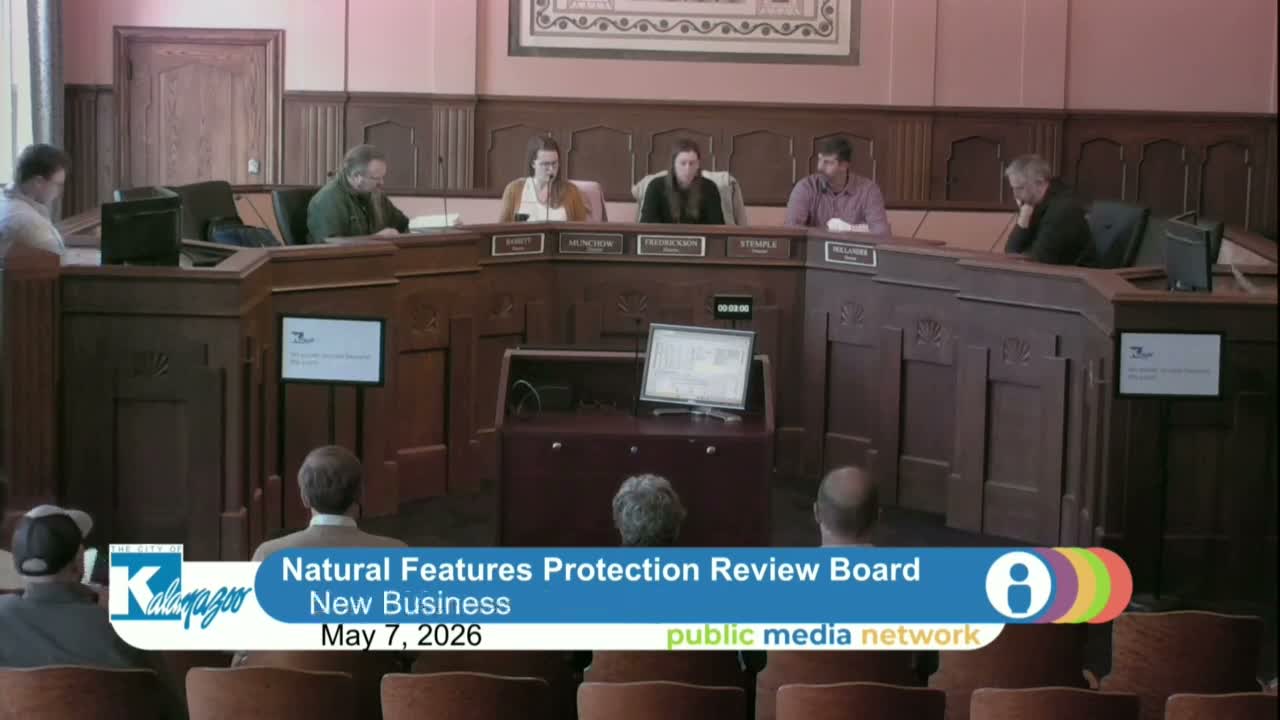
The Natural Features Protection (NFP) Board on May 7 approved the Phase 2 site plan for the Westgate Sports Complex at 1617 North Drake Road, imposing three conditions: no work may begin until full site plan review approval; copies of any required state or federal permits must be submitted to the city; and tree-protection fencing must be in place before work starts.
Staff member Nolan explained that Phase 1, previously approved, addressed woodland clearing and that Phase 2 covers the remaining site work — the building, parking lot, stormwater retention, regrading and landscaping. Nolan said staff reviewed the applicant’s rare-species documentation, including an ASTI assessment and an MSU Extension letter, and recommended approval with conditions. “Those 9 specifically, it was basically counted as maintenance by a property owner that they can do by right,” Nolan said, describing the record kept on the removed trees and noting ASTI documentation and photos are on file.
Board discussion focused on wildlife and planting choices after an MSU Extension letter flagged potential habitat for federally endangered Indiana bats and northern long-eared bats. A board member asked why nine trees that were removed as dead or dying were not replaced in a way that would support the bats. The board member proposed adding a condition to plant a minimum of nine trees (elm, maple, ash) to replace the removed habitat trees. Nolan and other technical commenters said the nine removed trees had been documented as dead or dying and that newly planted saplings would not immediately replace the unique ecological value of standing dead trees for bats; staff noted preserving woodland area and using bat boxes were alternative mitigation actions.
Board members also raised practical planting concerns: one member cautioned that white pines placed near curblines could be harmed by road salt and urged planting set back from the curb to improve survival. The applicant and staff described the landscape plan handoff and confirmed consultation through IPaC (the U.S. Fish and Wildlife Service online tool) and ASTI’s role in the rare-species review.
After brief debate, Board member [name recorded in the motion] moved to approve the site plan with the stated conditions. The board conducted a roll-call vote; the minutes record votes in favor from Hollander, Munchow, Bassett and Stempel. The motion carried.
The board did not adopt an explicit replacement-tree amendment on the record; members asked staff to ensure mitigation and documentation remain part of the project file and suggested follow-up with technical staff (arborist, stormwater engineers) if additional conditions are warranted. Staff said they will keep the ASTI documentation and any required permit copies on file and follow up if further information is needed.
The approval allows the applicant to proceed toward full site plan review with the understanding that on-the-ground work cannot begin until the remaining administrative approvals and conditions are satisfied.
Staff member Nolan explained that Phase 1, previously approved, addressed woodland clearing and that Phase 2 covers the remaining site work — the building, parking lot, stormwater retention, regrading and landscaping. Nolan said staff reviewed the applicant’s rare-species documentation, including an ASTI assessment and an MSU Extension letter, and recommended approval with conditions. “Those 9 specifically, it was basically counted as maintenance by a property owner that they can do by right,” Nolan said, describing the record kept on the removed trees and noting ASTI documentation and photos are on file.
Board discussion focused on wildlife and planting choices after an MSU Extension letter flagged potential habitat for federally endangered Indiana bats and northern long-eared bats. A board member asked why nine trees that were removed as dead or dying were not replaced in a way that would support the bats. The board member proposed adding a condition to plant a minimum of nine trees (elm, maple, ash) to replace the removed habitat trees. Nolan and other technical commenters said the nine removed trees had been documented as dead or dying and that newly planted saplings would not immediately replace the unique ecological value of standing dead trees for bats; staff noted preserving woodland area and using bat boxes were alternative mitigation actions.
Board members also raised practical planting concerns: one member cautioned that white pines placed near curblines could be harmed by road salt and urged planting set back from the curb to improve survival. The applicant and staff described the landscape plan handoff and confirmed consultation through IPaC (the U.S. Fish and Wildlife Service online tool) and ASTI’s role in the rare-species review.
After brief debate, Board member [name recorded in the motion] moved to approve the site plan with the stated conditions. The board conducted a roll-call vote; the minutes record votes in favor from Hollander, Munchow, Bassett and Stempel. The motion carried.
The board did not adopt an explicit replacement-tree amendment on the record; members asked staff to ensure mitigation and documentation remain part of the project file and suggested follow-up with technical staff (arborist, stormwater engineers) if additional conditions are warranted. Staff said they will keep the ASTI documentation and any required permit copies on file and follow up if further information is needed.
The approval allows the applicant to proceed toward full site plan review with the understanding that on-the-ground work cannot begin until the remaining administrative approvals and conditions are satisfied.
Don't Miss a Word: See the Full Meeting!
Go beyond summaries. Unlock every video, transcript, and key insight with a Founder Membership.
✓
Get instant access to full meeting videos
✓
Search and clip any phrase from complete transcripts
✓
Receive AI-powered summaries & custom alerts
✓
Enjoy lifetime, unrestricted access to government data
30-day money-back guarantee
