Star council approves limited nighttime hauling for Trailmark Station with strict conditions and quick-revoke authority
May 07, 2026 | Star, Ada County, Idaho
This article was created by AI summarizing key points discussed. AI makes mistakes, so for full details and context, please refer to the video of the full meeting. Please report any errors so we can fix them. Report an error »
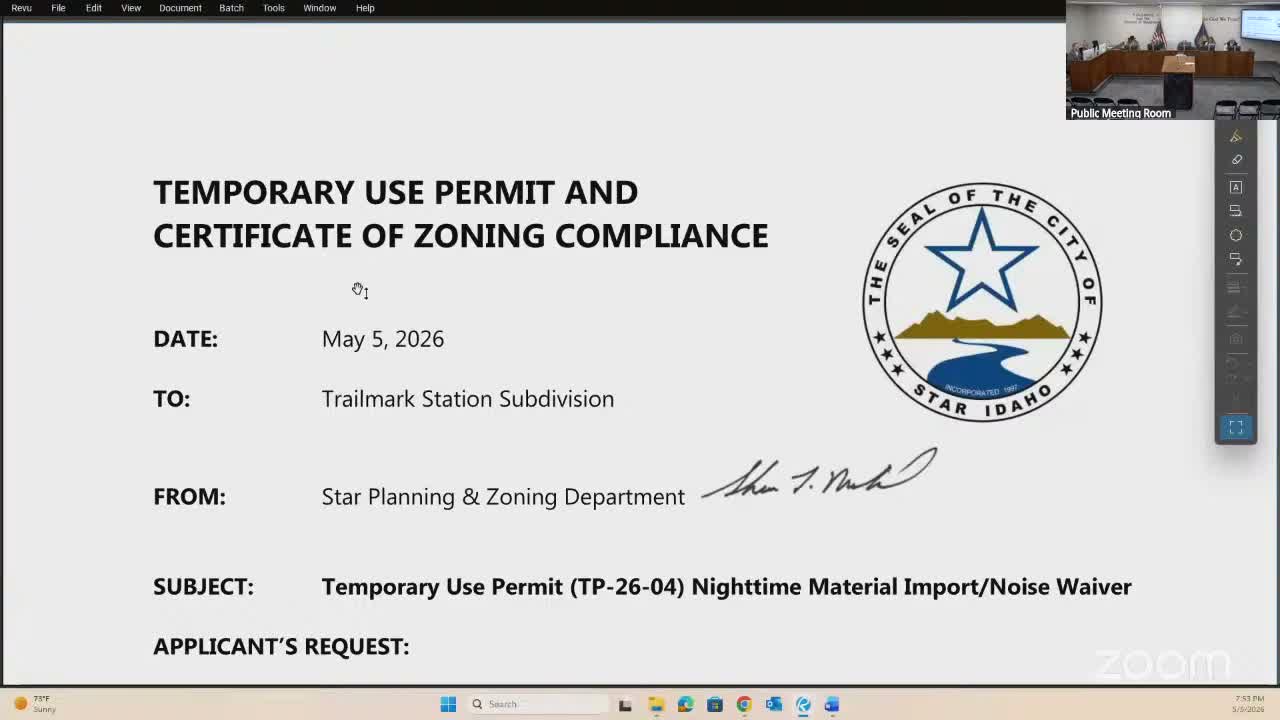
The Star City Council on May 5 approved a time-limited temporary-use permit and noise-waiver allowing Nampa Paving to deliver fill material to the first phase of the Trailmark Station subdivision at night, subject to a set of conditions and the city’s ability to revoke the permit quickly if necessary.
Tyson Byrd, representing Nampa Paving, told the council the company needs to deliver approximately 4,000 cubic yards per day at peak production (roughly 185 truckloads per day) to meet project schedules and to avoid creating daytime traffic jams through Star. Staff estimated the phase would require about 6,100 truck trips from the applicant’s closer pit if daytime routing were used, taking 75–85 days; nighttime routing from a closer pit would reduce the window to roughly 30–45 nights, staff said. Byrd framed the request as a safety measure: “People hate trucks. They’re big. They’re loud. They’re scary. ... That's where the email was, and I appreciate you guys responding to me... It’s a safety thing,” he said.
Nearby residents said they supported safer roads but worried about nighttime sleep disruption, bright work lights and backup beepers. Craig Shoemaker, who lives on Happy Day Drive, said the flashing lights and beepers “penetrate” homes and that some neighbors sleep with windows open this time of year. His wife, Dina Shoemaker, suggested a trial period and quick reassessment if the operation proved intolerable and asked for safeguards for horses and for children taking riding lessons nearby.
Police Chief Haynes told council that enforcement of transient noise violations requires either observation by officers or evidence (for example, photos or truck numbers) supplied by residents; the department will respond to complaints and coordinate with the city and company when possible.
Council members balanced two competing public-safety frames: some members argued nighttime hauling would reduce daytime truck traffic and collision risk on busy routes, while others emphasized the right of nearby residents to use their homes without unreasonable nighttime disturbance. To address both, the council conditioned approval on measures including strict truck spacing to avoid stacking on public roads, driver briefings, strict prohibition on compression/engine braking within the route, reasonable muffling of backup alarms consistent with safety rules (applicant agreed to methods that maintain worker safety), a posted on-site monitor who will log truck identification for enforcement, and active communication with nearby residents. Council authorized city staff — in consultation with the mayor and the city attorney — to suspend or revoke the permit immediately if operations created an unreasonable nuisance.
Councilman Casper Nielsen moved to approve the temporary permit with those conditions and the motion passed on roll call. Staff set a 45-day not-to-exceed limit for the permit (the applicant’s letter requested 30 days with a possible 15-day extension; council’s condition capped the total at 45 days), and emphasized the permit applies to this phase only; any future phases would require separate review.
The city asked the Shoemakers and other residents to provide contact information to staff so the city can respond promptly to complaints and, if necessary, revoke the permit under the new authority.
Tyson Byrd, representing Nampa Paving, told the council the company needs to deliver approximately 4,000 cubic yards per day at peak production (roughly 185 truckloads per day) to meet project schedules and to avoid creating daytime traffic jams through Star. Staff estimated the phase would require about 6,100 truck trips from the applicant’s closer pit if daytime routing were used, taking 75–85 days; nighttime routing from a closer pit would reduce the window to roughly 30–45 nights, staff said. Byrd framed the request as a safety measure: “People hate trucks. They’re big. They’re loud. They’re scary. ... That's where the email was, and I appreciate you guys responding to me... It’s a safety thing,” he said.
Nearby residents said they supported safer roads but worried about nighttime sleep disruption, bright work lights and backup beepers. Craig Shoemaker, who lives on Happy Day Drive, said the flashing lights and beepers “penetrate” homes and that some neighbors sleep with windows open this time of year. His wife, Dina Shoemaker, suggested a trial period and quick reassessment if the operation proved intolerable and asked for safeguards for horses and for children taking riding lessons nearby.
Police Chief Haynes told council that enforcement of transient noise violations requires either observation by officers or evidence (for example, photos or truck numbers) supplied by residents; the department will respond to complaints and coordinate with the city and company when possible.
Council members balanced two competing public-safety frames: some members argued nighttime hauling would reduce daytime truck traffic and collision risk on busy routes, while others emphasized the right of nearby residents to use their homes without unreasonable nighttime disturbance. To address both, the council conditioned approval on measures including strict truck spacing to avoid stacking on public roads, driver briefings, strict prohibition on compression/engine braking within the route, reasonable muffling of backup alarms consistent with safety rules (applicant agreed to methods that maintain worker safety), a posted on-site monitor who will log truck identification for enforcement, and active communication with nearby residents. Council authorized city staff — in consultation with the mayor and the city attorney — to suspend or revoke the permit immediately if operations created an unreasonable nuisance.
Councilman Casper Nielsen moved to approve the temporary permit with those conditions and the motion passed on roll call. Staff set a 45-day not-to-exceed limit for the permit (the applicant’s letter requested 30 days with a possible 15-day extension; council’s condition capped the total at 45 days), and emphasized the permit applies to this phase only; any future phases would require separate review.
The city asked the Shoemakers and other residents to provide contact information to staff so the city can respond promptly to complaints and, if necessary, revoke the permit under the new authority.
View the Full Meeting & All Its Details
This article offers just a summary. Unlock complete video, transcripts, and insights as a Founder Member.
✓
Watch full, unedited meeting videos
✓
Search every word spoken in unlimited transcripts
✓
AI summaries & real-time alerts (all government levels)
✓
Permanent access to expanding government content
30-day money-back guarantee
