San Bernardino opens public hearing on FY 2026–27 CDBG/ESG plan; council directs staff to return with project proposals
May 07, 2026 | San Bernardino, San Bernardino County, California
This article was created by AI summarizing key points discussed. AI makes mistakes, so for full details and context, please refer to the video of the full meeting. Please report any errors so we can fix them. Report an error »
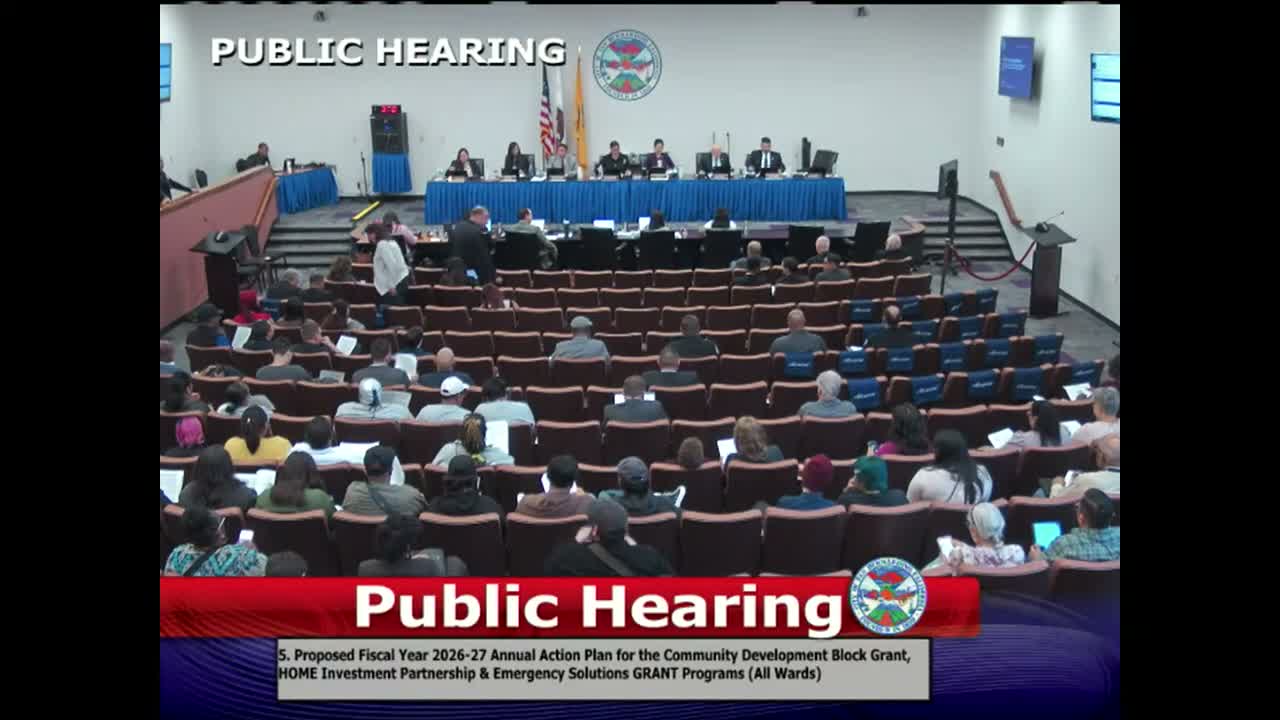
City of San Bernardino staff presented the first public hearing on the draft FY 2026–27 annual action plan for Community Development Block Grant (CDBG) and Emergency Solutions Grant (ESG) funds, outlining eligible uses, proposed allocations and reporting requirements.
The staff presentation explained federal limits — public services using CDBG are capped at 15 percent of the allocation and CDBG administrative costs are typically capped at 20 percent — and noted timing and spending rules for ESG funds. Staff said the city anticipates approximately $1.1 million in CDBG-eligible uses for the coming fiscal year and described sample allocations, including housing-mediation support (~$70,000), a police quality‑of‑life/coordination allocation (~$195,000), neighborhood housing counseling (~$43,000), senior nutrition (~$41,000) and funds earmarked for housing rehabilitation and public‑facility improvements.
Public commenters urged the council to protect funding for residents and improve subrecipient transparency. “These funds must be tied to measurable outcomes and reach west and central neighborhoods,” said Maron Alvarado, a resident and local fraud‑investigator who spoke during the hearing. Representatives of homeless‑services organizations pressed the council to prioritize shelter and prevention programs.
Councilmembers discussed eligible uses and documentation required for federal reporting. Several members said they wanted clearer project lists and accountability metrics before final allocations are adopted. Councilmember [unnamed in transcript] asked staff to develop a category that would allow funding of smaller, feasible park and amenity projects (for example, restroom facilities, playgrounds and minor repairs) and return with specific proposals.
Council action: the council approved a pediment to create a broad funding category for such projects and directed staff to return with a set of recommended projects and performance reporting that complies with HUD and program‑reporting requirements. The pediment passed unanimously.
What happens next: staff will accept written public comments and return to the council with a final recommended plan and funding amounts at the second required public hearing, scheduled for June 17, 2026, before the council considers plan adoption.
The staff presentation explained federal limits — public services using CDBG are capped at 15 percent of the allocation and CDBG administrative costs are typically capped at 20 percent — and noted timing and spending rules for ESG funds. Staff said the city anticipates approximately $1.1 million in CDBG-eligible uses for the coming fiscal year and described sample allocations, including housing-mediation support (~$70,000), a police quality‑of‑life/coordination allocation (~$195,000), neighborhood housing counseling (~$43,000), senior nutrition (~$41,000) and funds earmarked for housing rehabilitation and public‑facility improvements.
Public commenters urged the council to protect funding for residents and improve subrecipient transparency. “These funds must be tied to measurable outcomes and reach west and central neighborhoods,” said Maron Alvarado, a resident and local fraud‑investigator who spoke during the hearing. Representatives of homeless‑services organizations pressed the council to prioritize shelter and prevention programs.
Councilmembers discussed eligible uses and documentation required for federal reporting. Several members said they wanted clearer project lists and accountability metrics before final allocations are adopted. Councilmember [unnamed in transcript] asked staff to develop a category that would allow funding of smaller, feasible park and amenity projects (for example, restroom facilities, playgrounds and minor repairs) and return with specific proposals.
Council action: the council approved a pediment to create a broad funding category for such projects and directed staff to return with a set of recommended projects and performance reporting that complies with HUD and program‑reporting requirements. The pediment passed unanimously.
What happens next: staff will accept written public comments and return to the council with a final recommended plan and funding amounts at the second required public hearing, scheduled for June 17, 2026, before the council considers plan adoption.
View the Full Meeting & All Its Details
This article offers just a summary. Unlock complete video, transcripts, and insights as a Founder Member.
✓
Watch full, unedited meeting videos
✓
Search every word spoken in unlimited transcripts
✓
AI summaries & real-time alerts (all government levels)
✓
Permanent access to expanding government content
30-day money-back guarantee
