Minnesota Housing outlines loan and down-payment options, flags lower county uptake
May 07, 2026 | Sherburne County, Minnesota
This article was created by AI summarizing key points discussed. AI makes mistakes, so for full details and context, please refer to the video of the full meeting. Please report any errors so we can fix them. Report an error »
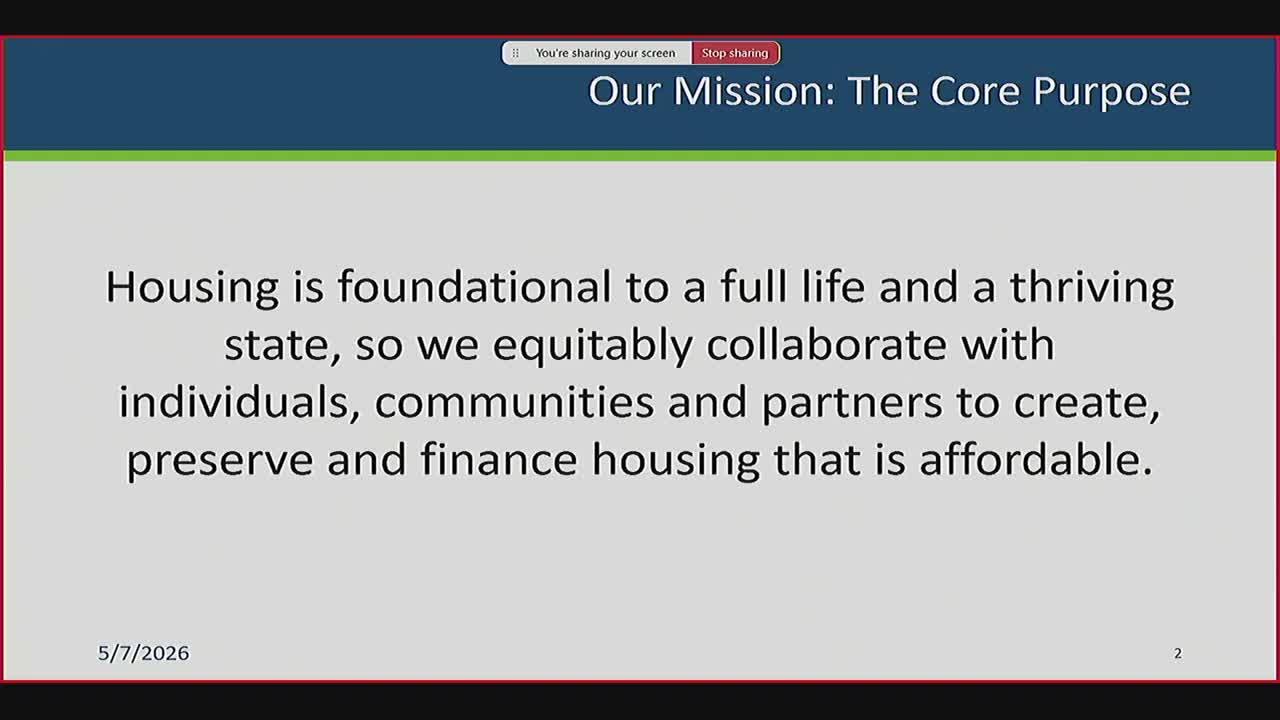
Greg Krentz, a representative of Minnesota Housing, told the Sherburne County Economic Development Authority on May 7 that the agency’s Minnesota City Participation Program and related products remain a major source of homebuyer financing across the state. "We get about $80,000,000 this year," Krentz said, describing bond-derived allocations that are prorated to participating communities.
Krentz gave a quick summary of statewide scale and local results: Minnesota Housing serviced roughly 3,600 loans in the referenced calendar year and has recorded hundreds of millions in first-mortgage production in strong years. He said Sherburne County has participated in the city participation program for more than 20 years and that last year the program served 58 households in the county, representing about $14 million in first-mortgage production.
Why it matters: Minnesota Housing pairs its mortgage products with down-payment and closing-cost assistance; Krentz said more than 98% of program borrowers also receive down-payment help statewide. "Almost everybody that comes through us for our programs gets down payment assistance," he said. He flagged that Sherburne County’s rate of using down-payment assistance is noticeably lower than the statewide average and that the county "stood out" in his review of closed loans.
Krentz outlined program mechanics and eligibility: loans are for owner-occupied single-family homes and duplexes (not three- or four-unit properties), manufactured housing taxed as real property can qualify, and borrowers must be credit- and income-qualified; Minnesota Housing requires counseling for first-time buyers. He described product specifics: startup loans targeted to first-time buyers (deferred 0% loans up to $18,000 in some cases), step-up and monthly-payment mortgages (10-year term, amortizing, up to $14,000 in many cases), and fix-up loans (secured up to $75,000; unsecured options to $25,000).
Board members pressed on possible explanations for lower local uptake: Krentz suggested lender participation, local income levels, and awareness may all play roles. He noted that large national lenders sometimes opt out of Housing Finance Agency (HFA) programs because of extra documentation and tax-recapture provisions. The EDA did not take formal action as a result of the presentation, but board members said they would follow up to explore lender outreach and local awareness campaigns.
What’s next: Krentz invited questions and follow-up, and Minnesota Housing contact information was offered for further technical assistance to expand lender partnerships and clarify program fit.
Krentz gave a quick summary of statewide scale and local results: Minnesota Housing serviced roughly 3,600 loans in the referenced calendar year and has recorded hundreds of millions in first-mortgage production in strong years. He said Sherburne County has participated in the city participation program for more than 20 years and that last year the program served 58 households in the county, representing about $14 million in first-mortgage production.
Why it matters: Minnesota Housing pairs its mortgage products with down-payment and closing-cost assistance; Krentz said more than 98% of program borrowers also receive down-payment help statewide. "Almost everybody that comes through us for our programs gets down payment assistance," he said. He flagged that Sherburne County’s rate of using down-payment assistance is noticeably lower than the statewide average and that the county "stood out" in his review of closed loans.
Krentz outlined program mechanics and eligibility: loans are for owner-occupied single-family homes and duplexes (not three- or four-unit properties), manufactured housing taxed as real property can qualify, and borrowers must be credit- and income-qualified; Minnesota Housing requires counseling for first-time buyers. He described product specifics: startup loans targeted to first-time buyers (deferred 0% loans up to $18,000 in some cases), step-up and monthly-payment mortgages (10-year term, amortizing, up to $14,000 in many cases), and fix-up loans (secured up to $75,000; unsecured options to $25,000).
Board members pressed on possible explanations for lower local uptake: Krentz suggested lender participation, local income levels, and awareness may all play roles. He noted that large national lenders sometimes opt out of Housing Finance Agency (HFA) programs because of extra documentation and tax-recapture provisions. The EDA did not take formal action as a result of the presentation, but board members said they would follow up to explore lender outreach and local awareness campaigns.
What’s next: Krentz invited questions and follow-up, and Minnesota Housing contact information was offered for further technical assistance to expand lender partnerships and clarify program fit.
View the Full Meeting & All Its Details
This article offers just a summary. Unlock complete video, transcripts, and insights as a Founder Member.
✓
Watch full, unedited meeting videos
✓
Search every word spoken in unlimited transcripts
✓
AI summaries & real-time alerts (all government levels)
✓
Permanent access to expanding government content
30-day money-back guarantee
