High‑Speed Rail Authority Defends 2026 Business Plan as Lawmakers Press for Financing Details
May 07, 2026 | California State Senate, Senate, Legislative, California
This article was created by AI summarizing key points discussed. AI makes mistakes, so for full details and context, please refer to the video of the full meeting. Please report any errors so we can fix them. Report an error »
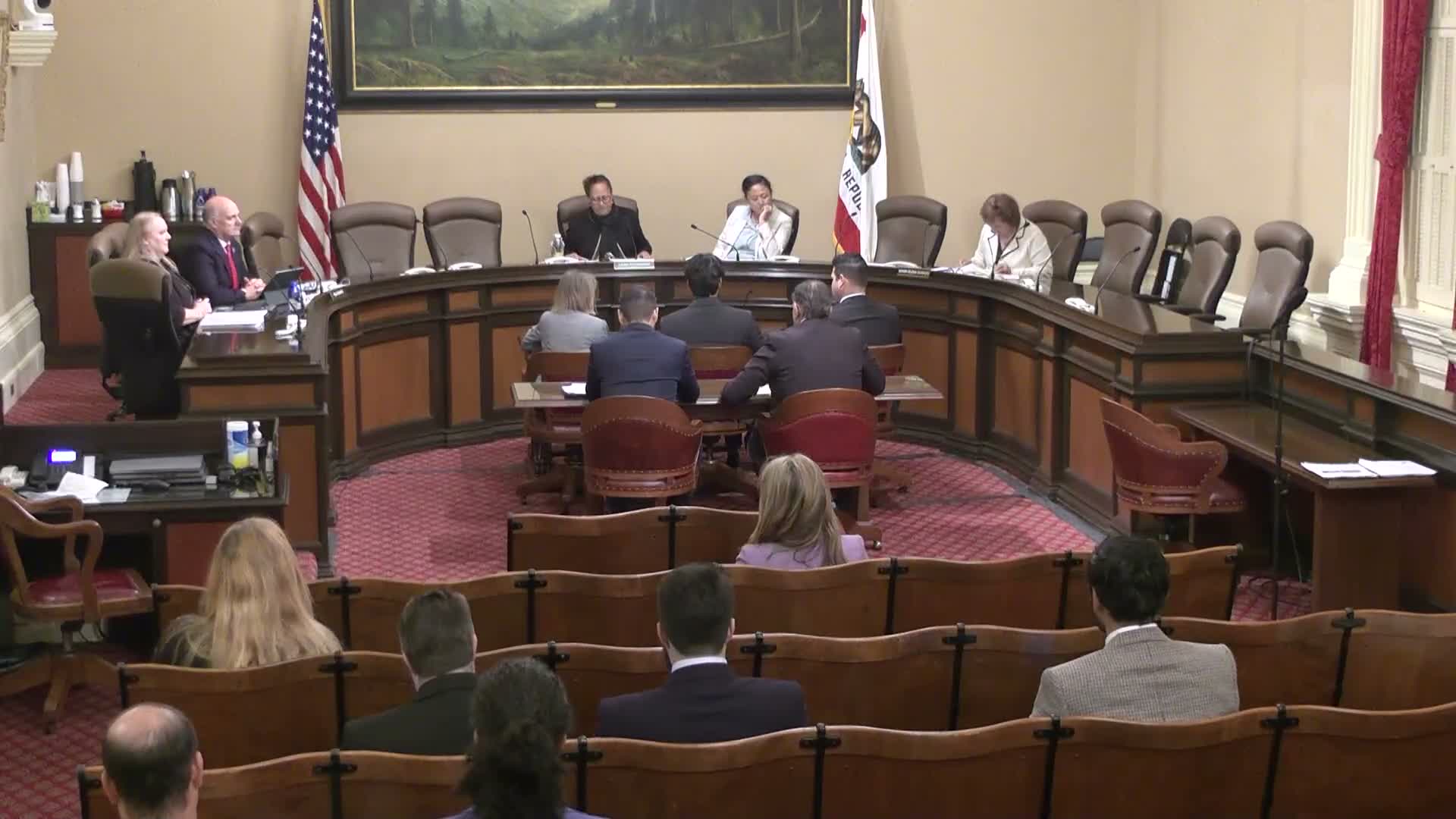
SACRAMENTO — The California High‑Speed Rail Authority on Monday told a Senate budget subcommittee that construction in the Central Valley is progressing and that a revised business plan contains tens of billions in cost‑saving measures, but lawmakers and the Legislative Analyst’s Office pressed the authority for clearer financing details and oversight provisions.
Ian Choudhury, chief executive officer of the California High‑Speed Rail Authority, told the Senate Budget Subcommittee No. 5 that crews have completed 59 of 92 major structures and about 80 of 119 miles in the Central Valley, that utility relocations are 93% finished and that track laying and electrification are slated to begin by the end of the year to support an early operating segment from Merced to Bakersfield in 2032–33. "We have completed 59 of 92 major structures and 80 of the 119 miles," Choudhury said, noting design optimizations that the authority says have produced more than $14 billion in Central Valley savings and reduced capital costs for the Merced–Bakersfield early operating segment to $35.6 billion.
Why it matters: The hearing focused on whether the authority’s funding assumptions and statutory proposals are sufficient to meet the authority’s schedule and avoid leaving the state on the hook for additional borrowing. The Legislative Analyst’s Office cautioned that some authority estimates exclude borrowing costs and that the Greenhouse Gas Reduction Fund (GGRF) — a pledged revenue source — could shrink under an active California Air Resources Board rulemaking.
The authority asked the committee to reappropriate $423 million in Proposition 1A funds for the Link US/LA Union Station project and $246 million in federal trust funds tied to CRISI and RAISE grants to prevent those dollars from expiring. Choudhury also said the authority is soliciting private partners and expects to have investors engaged by June 1; he described options that include availability‑payment or revenue‑risk models and said private partners could both finance against the state's $20 billion nominal commitment and contribute additional capital.
The Legislative Analyst’s Office, represented by Helen Kirsten, said it found no specific problems with the narrow budget change proposals but raised broader concerns about the draft business plan. Kirsten said the plan does not clearly identify the funding gap for the Merced–Bakersfield segment as required under prior legislation and that the authority’s cost‑and‑revenue assumptions may be optimistic. "There’s significant risk that funding will be insufficient to complete the initial operating segment," Kirsten said, and she warned that ongoing CARB rulemaking could reduce GGRF revenues and make borrowing against that stream more difficult.
Lawmakers pressed for concrete guardrails and clearer authority over any P3 deals. Chair Senator Richardson said the committee needs to understand "what the state is committing ourselves to do" before allowing deals that could obligate the state beyond the $1 billion‑per‑year GGRF baseline that currently funds the Central Valley work through 2045. Choudhury said the authority will publicly report proposed P3 agreements to its board and on its website and that any request for state backstopping beyond the authorized funds would be brought to the Legislature.
Members also queried how much of the $1 billion annual GGRF allocation will be available for operations or bookend projects such as LA's Link US/Union Station. Choudhury said the GGRF appropriation is earmarked for the Central Valley under SB 198 but that the authority has outlined options that could expand funding through value capture — including tax‑increment or enhanced financing districts — or through ancillary revenues such as real estate, energy or express cargo.
Several members and public commenters urged stronger labor and local hiring provisions. Senator Durazo asked how bidders would be required to disclose job counts, wages and benefits and urged more explicit manufacturing and training commitments; the authority said contractors must provide that information and the authority is working with local colleges on training programs.
Public testimony largely split along organizational lines. Labor representatives, including the State Building Construction Trades Council and the California State Council of Laborers, voiced strong support for the authority’s budget request and construction progress. Local‑government associations — the California Special Districts Association, the State Association of Counties and the League of California Cities — urged that any tax‑increment or land‑value capture mechanisms proceed only with meaningful consent from affected taxing agencies. "We believe tax‑increment financing should not advance without meaningful and freely given consent of all affected taxing agencies," said Marcus Detwiler of the California Special Districts Association.
What’s next: Choudhury said the authority expects to finalize the business plan by the end of the month and to provide the committee with updated materials that incorporate LAO comments; he also expects private partners to be identified by June 1, with financial feasibility work to follow over several months. The committee requested that the authority and LAO return with clarifications on the authority’s statutory scope to enter P3 agreements and more detailed cost and financing terms before the Legislature acts on reappropriations or other statutory changes.
The subcommittee took no vote and adjourned after public comment.
Ian Choudhury, chief executive officer of the California High‑Speed Rail Authority, told the Senate Budget Subcommittee No. 5 that crews have completed 59 of 92 major structures and about 80 of 119 miles in the Central Valley, that utility relocations are 93% finished and that track laying and electrification are slated to begin by the end of the year to support an early operating segment from Merced to Bakersfield in 2032–33. "We have completed 59 of 92 major structures and 80 of the 119 miles," Choudhury said, noting design optimizations that the authority says have produced more than $14 billion in Central Valley savings and reduced capital costs for the Merced–Bakersfield early operating segment to $35.6 billion.
Why it matters: The hearing focused on whether the authority’s funding assumptions and statutory proposals are sufficient to meet the authority’s schedule and avoid leaving the state on the hook for additional borrowing. The Legislative Analyst’s Office cautioned that some authority estimates exclude borrowing costs and that the Greenhouse Gas Reduction Fund (GGRF) — a pledged revenue source — could shrink under an active California Air Resources Board rulemaking.
The authority asked the committee to reappropriate $423 million in Proposition 1A funds for the Link US/LA Union Station project and $246 million in federal trust funds tied to CRISI and RAISE grants to prevent those dollars from expiring. Choudhury also said the authority is soliciting private partners and expects to have investors engaged by June 1; he described options that include availability‑payment or revenue‑risk models and said private partners could both finance against the state's $20 billion nominal commitment and contribute additional capital.
The Legislative Analyst’s Office, represented by Helen Kirsten, said it found no specific problems with the narrow budget change proposals but raised broader concerns about the draft business plan. Kirsten said the plan does not clearly identify the funding gap for the Merced–Bakersfield segment as required under prior legislation and that the authority’s cost‑and‑revenue assumptions may be optimistic. "There’s significant risk that funding will be insufficient to complete the initial operating segment," Kirsten said, and she warned that ongoing CARB rulemaking could reduce GGRF revenues and make borrowing against that stream more difficult.
Lawmakers pressed for concrete guardrails and clearer authority over any P3 deals. Chair Senator Richardson said the committee needs to understand "what the state is committing ourselves to do" before allowing deals that could obligate the state beyond the $1 billion‑per‑year GGRF baseline that currently funds the Central Valley work through 2045. Choudhury said the authority will publicly report proposed P3 agreements to its board and on its website and that any request for state backstopping beyond the authorized funds would be brought to the Legislature.
Members also queried how much of the $1 billion annual GGRF allocation will be available for operations or bookend projects such as LA's Link US/Union Station. Choudhury said the GGRF appropriation is earmarked for the Central Valley under SB 198 but that the authority has outlined options that could expand funding through value capture — including tax‑increment or enhanced financing districts — or through ancillary revenues such as real estate, energy or express cargo.
Several members and public commenters urged stronger labor and local hiring provisions. Senator Durazo asked how bidders would be required to disclose job counts, wages and benefits and urged more explicit manufacturing and training commitments; the authority said contractors must provide that information and the authority is working with local colleges on training programs.
Public testimony largely split along organizational lines. Labor representatives, including the State Building Construction Trades Council and the California State Council of Laborers, voiced strong support for the authority’s budget request and construction progress. Local‑government associations — the California Special Districts Association, the State Association of Counties and the League of California Cities — urged that any tax‑increment or land‑value capture mechanisms proceed only with meaningful consent from affected taxing agencies. "We believe tax‑increment financing should not advance without meaningful and freely given consent of all affected taxing agencies," said Marcus Detwiler of the California Special Districts Association.
What’s next: Choudhury said the authority expects to finalize the business plan by the end of the month and to provide the committee with updated materials that incorporate LAO comments; he also expects private partners to be identified by June 1, with financial feasibility work to follow over several months. The committee requested that the authority and LAO return with clarifications on the authority’s statutory scope to enter P3 agreements and more detailed cost and financing terms before the Legislature acts on reappropriations or other statutory changes.
The subcommittee took no vote and adjourned after public comment.
View the Full Meeting & All Its Details
This article offers just a summary. Unlock complete video, transcripts, and insights as a Founder Member.
✓
Watch full, unedited meeting videos
✓
Search every word spoken in unlimited transcripts
✓
AI summaries & real-time alerts (all government levels)
✓
Permanent access to expanding government content
30-day money-back guarantee
