Lawmakers press agencies for cost details as officials urge loosening of budget language tied to Green Mountain youth facility
May 07, 2026 | Human Services, HOUSE OF REPRESENTATIVES, Committees, Legislative , Vermont
This article was created by AI summarizing key points discussed. AI makes mistakes, so for full details and context, please refer to the video of the full meeting. Please report any errors so we can fix them. Report an error »
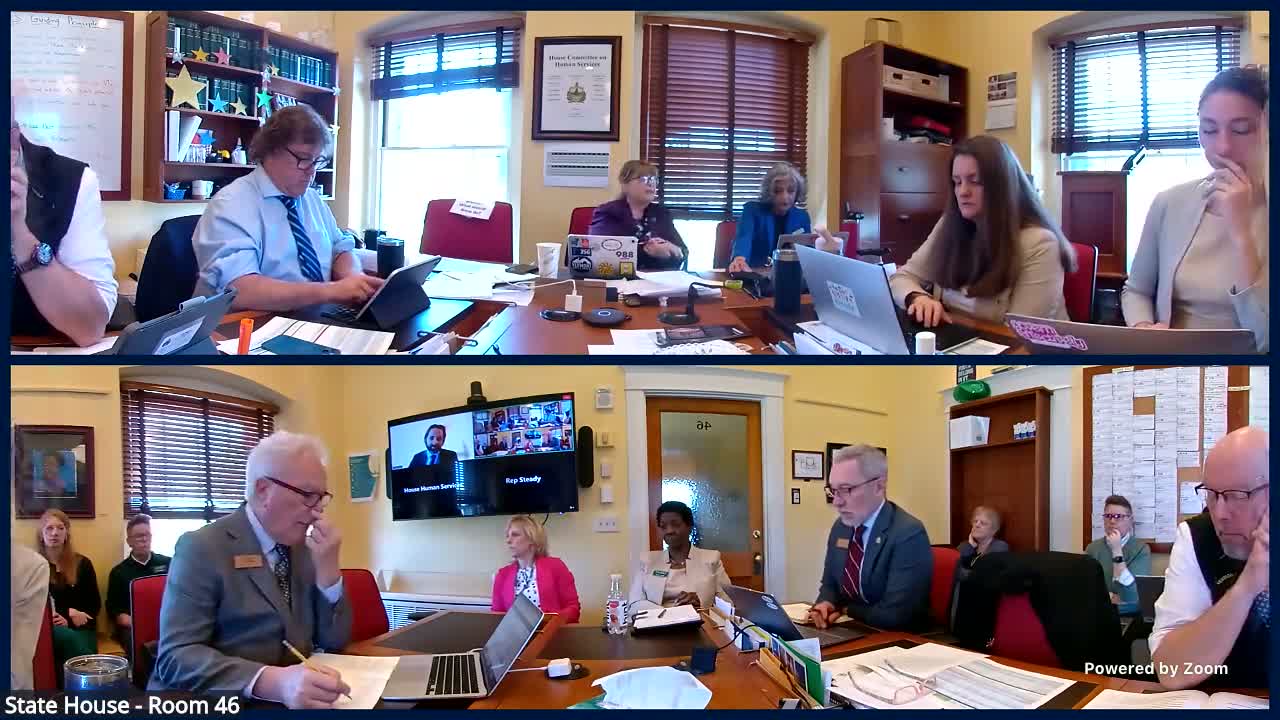
A legislative committee heard detailed testimony on a proposed in-state facility for high-acuity youth and the budget language that could block further project steps.
The committee’s chair said lawmakers requested the briefing because recent House and Senate budget language requires additional information before the state can proceed on the project and noted that a deputy secretary’s memo had not fully answered the committee’s questions. “I was hesitant in the deputy secretary’s memo, to really buy into that there’d be $21,000,000, of, quote, unquote, savings,” the chair said, pressing witnesses to explain how savings were calculated and how any identified savings would be preserved in future budget cycles.
Why it matters: The agencies are seeking to develop a 41-bed high-end system of care that includes a small secure facility and other programs intended to reduce out-of-state placements. Lawmakers want clearer, line-by-line estimates of the facility’s operating cost and the assumptions behind projected savings before allowing commitments that could create long-term operating obligations.
Buildings and General Services Commissioner London Manoli said the department has run an RFP process, signed a letter of intent with a developer and is prepared to enter a build-to-lease contract, but procurement confidentiality prevents public disclosure of the site at this time. “We are ready to move forward, but that contract is an obligation,” Manoli said, adding that the state can step out of an agreement prior to construction if permitting, design or cost issues arise.
Deputy Commissioner Erica Ratke of the Family Services Division described the proposed facility as part of a continuum of care for youths with the most acute behavioral and mental-health needs and emphasized Vermont’s gap in permanent, in-state high-end placements. “Vermont is the only state in the union that does not have a permanent facility for high end youth that are justice involved,” Ratke said, arguing that in-state services are important both for clinical continuity and for reducing costly out-of-state placements.
Tyler Allen, director of the high-end system of care, told the committee the department will provide a spreadsheet showing pre-pandemic and current residential capacity. Allen said the state’s current actual residential capacity is 115 beds, down from 196 pre-pandemic (a net loss of 81 beds), and that of roughly 92 youth currently in residential care, 53 are placed out of state. Allen said the $9,000,000 annual operating estimate for the proposed secure facility is a preliminary, ballpark figure that combines anticipated operator costs, facility lease rates and other facility-related expenses; he described the figure as subject to refinement once an operator and final design are contracted.
Allen also explained that the $21 million cited in earlier budget material is an aggregate projection that combines expected savings across multiple initiatives (including a proposed 15-bed Psychiatric Residential Treatment Facility, or PRTF, and expansions such as West River programs). “All those projections are based on averages of costs to out-of-state programs currently,” Allen said, calling the $21 million a modeled, not guaranteed, savings figure.
Emily Hobbs, commissioner for the Department of Mental Health, said a planned PRTF at the Brattleboro Retreat is expected to be operational within the year and would be separate from the secure facility under discussion. That PRTF is designed as a different program and population than the secure beds being discussed for Green Mountain, Hobbs said.
Lawmakers pressed on budgeting mechanics: if near-term savings materialize in fiscal years before the facility opens, how will those savings be retained to cover later operating costs instead of reverting to agencies’ base budgets? Witnesses said savings could appear across multiple departments and that agencies would need to account for intended reallocation in their budget proposals.
Committee members also sought clarity on procurement competition and costs observed in similar programs: BGS clarified that some recent RFP rounds produced only one bidder for this specialized build-to-lease project, which raises price and capacity concerns seen in earlier high-cost programs such as West River Haven.
What’s next: The committee did not take a vote. Tyler Allen committed to sending the committee a detailed capacity spreadsheet and DCF/BGS staff offered to answer additional data questions as members deliberate whether to soften the restrictive budget language to allow design and contracting activity to proceed with legislative oversight.
The hearing closed with lawmakers indicating further internal discussion on whether to modify the capital/budget language that currently blocks expenditure and site control until committee approvals are satisfied.
The committee’s chair said lawmakers requested the briefing because recent House and Senate budget language requires additional information before the state can proceed on the project and noted that a deputy secretary’s memo had not fully answered the committee’s questions. “I was hesitant in the deputy secretary’s memo, to really buy into that there’d be $21,000,000, of, quote, unquote, savings,” the chair said, pressing witnesses to explain how savings were calculated and how any identified savings would be preserved in future budget cycles.
Why it matters: The agencies are seeking to develop a 41-bed high-end system of care that includes a small secure facility and other programs intended to reduce out-of-state placements. Lawmakers want clearer, line-by-line estimates of the facility’s operating cost and the assumptions behind projected savings before allowing commitments that could create long-term operating obligations.
Buildings and General Services Commissioner London Manoli said the department has run an RFP process, signed a letter of intent with a developer and is prepared to enter a build-to-lease contract, but procurement confidentiality prevents public disclosure of the site at this time. “We are ready to move forward, but that contract is an obligation,” Manoli said, adding that the state can step out of an agreement prior to construction if permitting, design or cost issues arise.
Deputy Commissioner Erica Ratke of the Family Services Division described the proposed facility as part of a continuum of care for youths with the most acute behavioral and mental-health needs and emphasized Vermont’s gap in permanent, in-state high-end placements. “Vermont is the only state in the union that does not have a permanent facility for high end youth that are justice involved,” Ratke said, arguing that in-state services are important both for clinical continuity and for reducing costly out-of-state placements.
Tyler Allen, director of the high-end system of care, told the committee the department will provide a spreadsheet showing pre-pandemic and current residential capacity. Allen said the state’s current actual residential capacity is 115 beds, down from 196 pre-pandemic (a net loss of 81 beds), and that of roughly 92 youth currently in residential care, 53 are placed out of state. Allen said the $9,000,000 annual operating estimate for the proposed secure facility is a preliminary, ballpark figure that combines anticipated operator costs, facility lease rates and other facility-related expenses; he described the figure as subject to refinement once an operator and final design are contracted.
Allen also explained that the $21 million cited in earlier budget material is an aggregate projection that combines expected savings across multiple initiatives (including a proposed 15-bed Psychiatric Residential Treatment Facility, or PRTF, and expansions such as West River programs). “All those projections are based on averages of costs to out-of-state programs currently,” Allen said, calling the $21 million a modeled, not guaranteed, savings figure.
Emily Hobbs, commissioner for the Department of Mental Health, said a planned PRTF at the Brattleboro Retreat is expected to be operational within the year and would be separate from the secure facility under discussion. That PRTF is designed as a different program and population than the secure beds being discussed for Green Mountain, Hobbs said.
Lawmakers pressed on budgeting mechanics: if near-term savings materialize in fiscal years before the facility opens, how will those savings be retained to cover later operating costs instead of reverting to agencies’ base budgets? Witnesses said savings could appear across multiple departments and that agencies would need to account for intended reallocation in their budget proposals.
Committee members also sought clarity on procurement competition and costs observed in similar programs: BGS clarified that some recent RFP rounds produced only one bidder for this specialized build-to-lease project, which raises price and capacity concerns seen in earlier high-cost programs such as West River Haven.
What’s next: The committee did not take a vote. Tyler Allen committed to sending the committee a detailed capacity spreadsheet and DCF/BGS staff offered to answer additional data questions as members deliberate whether to soften the restrictive budget language to allow design and contracting activity to proceed with legislative oversight.
The hearing closed with lawmakers indicating further internal discussion on whether to modify the capital/budget language that currently blocks expenditure and site control until committee approvals are satisfied.
View the Full Meeting & All Its Details
This article offers just a summary. Unlock complete video, transcripts, and insights as a Founder Member.
✓
Watch full, unedited meeting videos
✓
Search every word spoken in unlimited transcripts
✓
AI summaries & real-time alerts (all government levels)
✓
Permanent access to expanding government content
30-day money-back guarantee
