Council adopts registration process, postpones vote on commercial bicycle-tour ban
May 07, 2026 | Hawaii County, Hawaii
This article was created by AI summarizing key points discussed. AI makes mistakes, so for full details and context, please refer to the video of the full meeting. Please report any errors so we can fix them. Report an error »
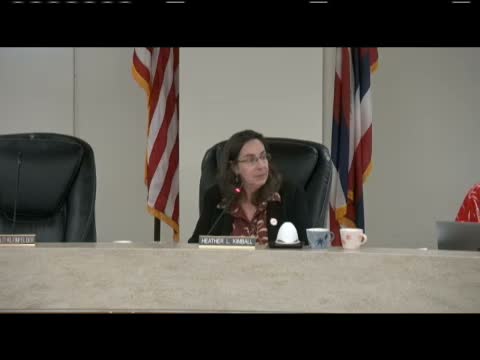
The Hawaii County Council on May 1 adopted an amendment to Bill 125 that creates an annual registration process for commercial bicycle tour operators and establishes a procedure for the council to restrict specific road segments, then postponed final action on the bill until May 15 to allow departments time to refine implementation details.
Public testimony focused on safety along Kohala Mountain Road and the Akoni Pule Highway. Michael Lancaster, a remote testifier, told the council that he takes dialysis three times a week and has been delayed when bicyclists gather on narrow roads: "I've been late several times for my dialysis...it is dangerous," he said. Other residents urged protections for keiki and kupuna and warned of possible county liability if a serious injury or fatality occurred during a commercial tour.
Councilmember Kirkowitz’s amendment (communication 679.6), which the council adopted before postponing the bill, requires annual electronic registration through the Department of Finance, disclosure of routes and maximum participants, and documentation such as property-owner permission when a route crosses private property. The amendment also establishes a written review process: the chief of police and the director of public works would provide written recommendations about whether a road presents an "unsafe road condition," and for state highways the bill seeks a concurrence letter from DOT. Corporation Counsel Elizabeth Strantz cautioned the council that state law limits county authority over state roads and that the council should be careful when asking state agencies for determinations; she recommended building an administrative enforcement and appeal process if the county adopts citations or penalties.
Chief Ben Moskowitz of the Hawaii Police Department told the council the department could provide site evaluations and written testimony on road safety and said enforcement could scale with group size. He also suggested practical enforcement tools, such as requiring tour operators to provide identifying reflective devices for riders to help officers distinguish commercial groups from locals.
Councilmembers debated possible fees and enforcement tools. Kirkowitz proposed a $250 annual fee as a placeholder; other members proposed a sliding scale keyed to the number of support vehicles or vans an operator uses. Councilmember Leila and others supported the registration concept as a data-gathering tool that could also fund signage, education and enforcement. Councilmember Evans, who introduced the bill, had earlier offered a different amendment (679.59) but withdrew it after discussion and embraced collaboration with Kirkowitz on edits.
The council voted to adopt Kirkowitz’s amendment (Clerk recorded 8 ayes; one member excused) and subsequently voted to postpone Bill 125, as amended, to the May 15 council meeting to allow for further drafting and departmental input. The postponement gives staff time to produce clear definitions, a response timeframe for department reviews, administrative rules for enforcement and a penalty structure for unregistered operators.
What happens next: Councilmembers and staff will refine language on fees, the departmental review process and enforcement mechanics; the council will reconsider the amended Bill 125 on May 15.
Public testimony focused on safety along Kohala Mountain Road and the Akoni Pule Highway. Michael Lancaster, a remote testifier, told the council that he takes dialysis three times a week and has been delayed when bicyclists gather on narrow roads: "I've been late several times for my dialysis...it is dangerous," he said. Other residents urged protections for keiki and kupuna and warned of possible county liability if a serious injury or fatality occurred during a commercial tour.
Councilmember Kirkowitz’s amendment (communication 679.6), which the council adopted before postponing the bill, requires annual electronic registration through the Department of Finance, disclosure of routes and maximum participants, and documentation such as property-owner permission when a route crosses private property. The amendment also establishes a written review process: the chief of police and the director of public works would provide written recommendations about whether a road presents an "unsafe road condition," and for state highways the bill seeks a concurrence letter from DOT. Corporation Counsel Elizabeth Strantz cautioned the council that state law limits county authority over state roads and that the council should be careful when asking state agencies for determinations; she recommended building an administrative enforcement and appeal process if the county adopts citations or penalties.
Chief Ben Moskowitz of the Hawaii Police Department told the council the department could provide site evaluations and written testimony on road safety and said enforcement could scale with group size. He also suggested practical enforcement tools, such as requiring tour operators to provide identifying reflective devices for riders to help officers distinguish commercial groups from locals.
Councilmembers debated possible fees and enforcement tools. Kirkowitz proposed a $250 annual fee as a placeholder; other members proposed a sliding scale keyed to the number of support vehicles or vans an operator uses. Councilmember Leila and others supported the registration concept as a data-gathering tool that could also fund signage, education and enforcement. Councilmember Evans, who introduced the bill, had earlier offered a different amendment (679.59) but withdrew it after discussion and embraced collaboration with Kirkowitz on edits.
The council voted to adopt Kirkowitz’s amendment (Clerk recorded 8 ayes; one member excused) and subsequently voted to postpone Bill 125, as amended, to the May 15 council meeting to allow for further drafting and departmental input. The postponement gives staff time to produce clear definitions, a response timeframe for department reviews, administrative rules for enforcement and a penalty structure for unregistered operators.
What happens next: Councilmembers and staff will refine language on fees, the departmental review process and enforcement mechanics; the council will reconsider the amended Bill 125 on May 15.
View the Full Meeting & All Its Details
This article offers just a summary. Unlock complete video, transcripts, and insights as a Founder Member.
✓
Watch full, unedited meeting videos
✓
Search every word spoken in unlimited transcripts
✓
AI summaries & real-time alerts (all government levels)
✓
Permanent access to expanding government content
30-day money-back guarantee
