Vermont labor officials say UI trust fund holds about $307M but growth is slowing
May 07, 2026 | Commerce & Economic Development, HOUSE OF REPRESENTATIVES, Committees, Legislative , Vermont
This article was created by AI summarizing key points discussed. AI makes mistakes, so for full details and context, please refer to the video of the full meeting. Please report any errors so we can fix them. Report an error »
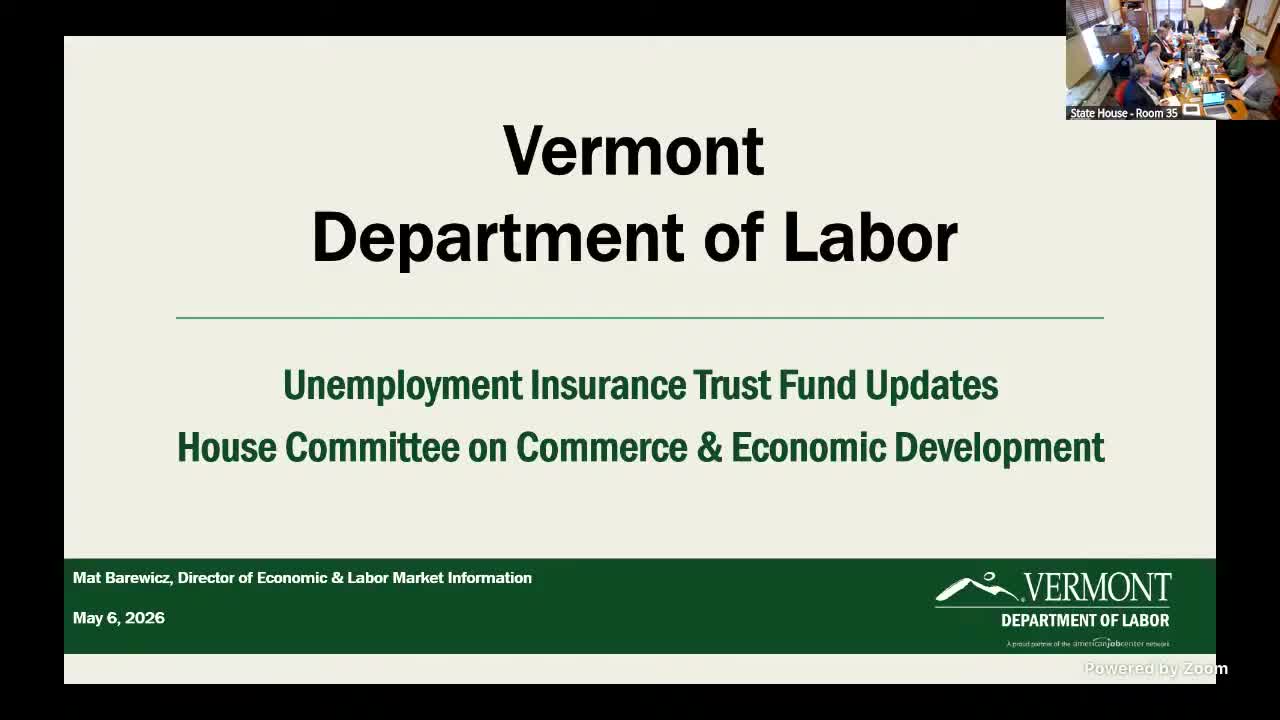
The Commerce & Economic Development committee heard an annual briefing on the state unemployment insurance trust fund Wednesday, where Department of Labor officials said the fund remains solvent but is growing more slowly as claims and benefits tick up.
Matthew Bierwitz, director of the Economic and Labor Market Information Division at the Vermont Department of Labor, told the committee that “as of week ending, April 18, we have $307,000,000,” and that subsequent weekly reporting pushed the balance nearer $309,000,000. He said the department calculates it needs about $290,000,000 to remain on tax‑rate schedule 1, the lowest employer rate class.
Bierwitz outlined how the trust is funded by quarterly employer contributions, interest earnings and benefit outlays. He reported about $71,000,000 in employer contributions in 2025 and roughly $67,700,000 in benefits paid last year — a year‑over‑year benefits increase of about 14.9 percent — and stressed that interest income on the trust (approximately $10,000,000 last year) has played an important role in recent fund growth.
“Our current unemployment insurance duration is 12.9 weeks,” Bierwitz said, noting duration has risen roughly a week‑and‑a‑half from earlier readings and that claims levels have been “slightly elevated” in recent months. He told members that even modest increases in claims or a recession could draw down the fund and ultimately push the state onto a higher tax schedule that raises employer contributions.
Committee members questioned how the tax‑rate schedule and employer experience ratings work. Bierwitz explained that employer taxes are set by three elements: a yearly tax‑rate schedule, an indexed taxable wage base and each employer’s experience rating, which ranks employers into 21 rate classes. He said the state’s three‑year experience window and certain indexing changes enacted after the 2010–2011 policy reforms were designed to build resilience in the fund.
Bierwitz also described a policy decision to exclude 2020 from the tax‑rate calculation after the COVID recession. He said that legislative change prevented an immediate jump from schedule 1 to schedule 5, which would have produced substantially higher employer tax rates for an extended period.
Rowan Hawthorne, director of policy and legislative affairs at the Department of Labor, gave an update on the department’s modernization of the UI system. Hawthorne said testing is on track and the department is aiming for a summer rollout. He said the department worked with the National Association of State Workforce Agencies (NASWA), Vermont Legal Aid and municipal partners for usability testing and town halls and that the claimant portal will include improved online filing, Spanish language access and tighter security.
On recent benefit changes, Bierwitz said a temporary $60 increase to the maximum weekly benefit was funded with an $8,000,000 appropriation; once the new system goes live, the department plans to convert that arrangement to a $25 across‑the‑board increase for all beneficiaries. He estimated the net annual cost of that change to the UI trust fund at roughly $4,000,000.
Committee members asked for follow‑up on several details, including how many claimants receive the maximum benefit and comparative taxable wage bases in other states; Bierwitz offered to provide more precise calculations and annual publication comparisons at a later session. He also confirmed federal employees and railroad workers do not pay into Vermont’s state UI system and have separate arrangements.
The committee chair thanked the department for the briefing and said members may request a deeper dive into the mechanics of the trust fund and S.71 at a future meeting. There were no formal votes taken at the hearing.
Matthew Bierwitz, director of the Economic and Labor Market Information Division at the Vermont Department of Labor, told the committee that “as of week ending, April 18, we have $307,000,000,” and that subsequent weekly reporting pushed the balance nearer $309,000,000. He said the department calculates it needs about $290,000,000 to remain on tax‑rate schedule 1, the lowest employer rate class.
Bierwitz outlined how the trust is funded by quarterly employer contributions, interest earnings and benefit outlays. He reported about $71,000,000 in employer contributions in 2025 and roughly $67,700,000 in benefits paid last year — a year‑over‑year benefits increase of about 14.9 percent — and stressed that interest income on the trust (approximately $10,000,000 last year) has played an important role in recent fund growth.
“Our current unemployment insurance duration is 12.9 weeks,” Bierwitz said, noting duration has risen roughly a week‑and‑a‑half from earlier readings and that claims levels have been “slightly elevated” in recent months. He told members that even modest increases in claims or a recession could draw down the fund and ultimately push the state onto a higher tax schedule that raises employer contributions.
Committee members questioned how the tax‑rate schedule and employer experience ratings work. Bierwitz explained that employer taxes are set by three elements: a yearly tax‑rate schedule, an indexed taxable wage base and each employer’s experience rating, which ranks employers into 21 rate classes. He said the state’s three‑year experience window and certain indexing changes enacted after the 2010–2011 policy reforms were designed to build resilience in the fund.
Bierwitz also described a policy decision to exclude 2020 from the tax‑rate calculation after the COVID recession. He said that legislative change prevented an immediate jump from schedule 1 to schedule 5, which would have produced substantially higher employer tax rates for an extended period.
Rowan Hawthorne, director of policy and legislative affairs at the Department of Labor, gave an update on the department’s modernization of the UI system. Hawthorne said testing is on track and the department is aiming for a summer rollout. He said the department worked with the National Association of State Workforce Agencies (NASWA), Vermont Legal Aid and municipal partners for usability testing and town halls and that the claimant portal will include improved online filing, Spanish language access and tighter security.
On recent benefit changes, Bierwitz said a temporary $60 increase to the maximum weekly benefit was funded with an $8,000,000 appropriation; once the new system goes live, the department plans to convert that arrangement to a $25 across‑the‑board increase for all beneficiaries. He estimated the net annual cost of that change to the UI trust fund at roughly $4,000,000.
Committee members asked for follow‑up on several details, including how many claimants receive the maximum benefit and comparative taxable wage bases in other states; Bierwitz offered to provide more precise calculations and annual publication comparisons at a later session. He also confirmed federal employees and railroad workers do not pay into Vermont’s state UI system and have separate arrangements.
The committee chair thanked the department for the briefing and said members may request a deeper dive into the mechanics of the trust fund and S.71 at a future meeting. There were no formal votes taken at the hearing.
View the Full Meeting & All Its Details
This article offers just a summary. Unlock complete video, transcripts, and insights as a Founder Member.
✓
Watch full, unedited meeting videos
✓
Search every word spoken in unlimited transcripts
✓
AI summaries & real-time alerts (all government levels)
✓
Permanent access to expanding government content
30-day money-back guarantee
