Glendale planning commission denies appeal, upholds variance allowing Hotel Indigo to add floor area
May 07, 2026 | Glendale, Los Angeles County, California
This article was created by AI summarizing key points discussed. AI makes mistakes, so for full details and context, please refer to the video of the full meeting. Please report any errors so we can fix them. Report an error »
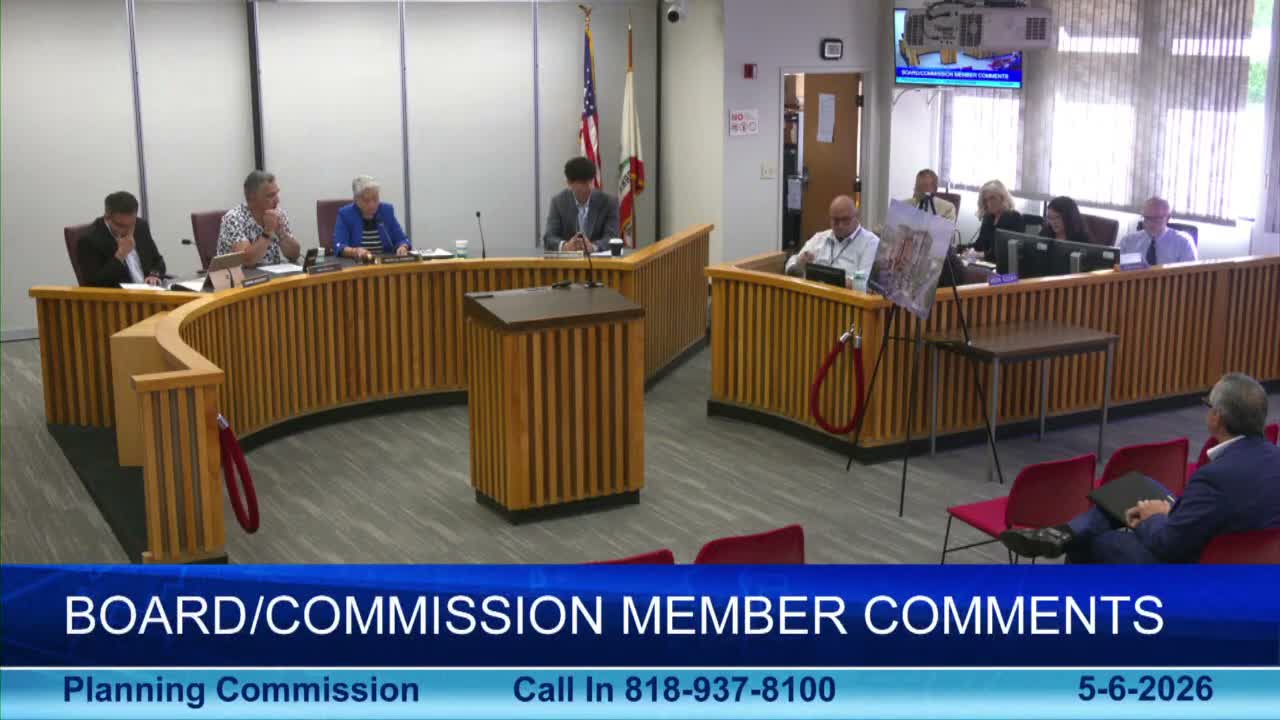
The Glendale Planning Commission on May 6 denied an appeal from Unite Here Local 11 and upheld a planning hearing officer's decision to grant a variance allowing the Hotel Indigo at 515 623 North Central Avenue to increase its floor-area ratio (FAR) to 3.25.
Staff had recommended approval, saying the proposed 3,201-square-foot addition on the mezzanine and seventh floor would fit within the already approved building envelope and cause only a minimal increase in mass and bulk. "Given the location of the proposed additional floor area, the mass and bulk of the project would only slightly increase," staff told the commission and recommended the variance as conditioned in the staff report.
Why it matters: The appeal centered on three legal and procedural claims from the union-backed appellant: that the required variance findings were unsupported by substantial evidence, that the project was ineligible for a Class 32 CEQA infill exemption because the deviations were not legally permitted, and that multiple incremental approvals since 2020 amounted to improper piecemealing under CEQA. Appellant counsel Jamie Hall asked the commission to reverse the January 6 letter of determination and to find the project not eligible for the categorical exemption.
The appellant: Jamie Hall, a land-use and environmental attorney representing Unite Here Local 11, told the commission the hardships cited by the applicant were self-induced and that the 2018 Kaiser Marston analysis the hearing officer relied on was outdated or improperly used. "That's textbook self-induced harm and the law does not allow it," Hall said, arguing that the record lacked the specific, substantial evidence required to make the variance findings.
The applicant's case: Owner representatives and counsel said the changes were operationally necessary, did not expand the building footprint or height, and left public-facing amenities at the ground floor and mezzanine intact. Project counsel said the question before the commission was legal: whether the four findings were supported by substantial evidence. "Are the required findings supported by substantial evidence in the record? The answer is clearly yes," counsel said, urging the commission to deny the appeal.
Public testimony: More than a dozen speakers called in or attended, with a mix of support and opposition. Union representatives and several callers argued the variance would trade a publicly accessible rooftop restaurant for private guest rooms and that a 2020 covenant with the city required any such change to have city council approval. Supporters including the project's general contractor, architect and nearby residents said the changes are minor, the building is already under construction, and the revisions help keep the project economically viable.
Commission discussion and vote: Commissioners pressed staff and project representatives on CEQA eligibility, the administrative record and whether the project truly required the variance to operate. After deliberation a motion to deny the appeal was made and seconded; a roll-call vote recorded three yes votes and the motion carried. The commission's denial of the appeal leaves the planning hearing officer's January variance approval in place. Staff noted an appeal to the City Council remains possible; appeals must be filed within 15 days using the city's online permit portal.
What happens next: With the variance upheld, the applicant may proceed to amend or obtain building permits reflecting the approved changes; staff said the project's current construction schedule targets roughly June 2027 for completion. The commission also announced upcoming items including introduction of an objective design standards ordinance to the City Council and previewed items for its May 20 meeting.
The commission adjourned following community development updates.
Staff had recommended approval, saying the proposed 3,201-square-foot addition on the mezzanine and seventh floor would fit within the already approved building envelope and cause only a minimal increase in mass and bulk. "Given the location of the proposed additional floor area, the mass and bulk of the project would only slightly increase," staff told the commission and recommended the variance as conditioned in the staff report.
Why it matters: The appeal centered on three legal and procedural claims from the union-backed appellant: that the required variance findings were unsupported by substantial evidence, that the project was ineligible for a Class 32 CEQA infill exemption because the deviations were not legally permitted, and that multiple incremental approvals since 2020 amounted to improper piecemealing under CEQA. Appellant counsel Jamie Hall asked the commission to reverse the January 6 letter of determination and to find the project not eligible for the categorical exemption.
The appellant: Jamie Hall, a land-use and environmental attorney representing Unite Here Local 11, told the commission the hardships cited by the applicant were self-induced and that the 2018 Kaiser Marston analysis the hearing officer relied on was outdated or improperly used. "That's textbook self-induced harm and the law does not allow it," Hall said, arguing that the record lacked the specific, substantial evidence required to make the variance findings.
The applicant's case: Owner representatives and counsel said the changes were operationally necessary, did not expand the building footprint or height, and left public-facing amenities at the ground floor and mezzanine intact. Project counsel said the question before the commission was legal: whether the four findings were supported by substantial evidence. "Are the required findings supported by substantial evidence in the record? The answer is clearly yes," counsel said, urging the commission to deny the appeal.
Public testimony: More than a dozen speakers called in or attended, with a mix of support and opposition. Union representatives and several callers argued the variance would trade a publicly accessible rooftop restaurant for private guest rooms and that a 2020 covenant with the city required any such change to have city council approval. Supporters including the project's general contractor, architect and nearby residents said the changes are minor, the building is already under construction, and the revisions help keep the project economically viable.
Commission discussion and vote: Commissioners pressed staff and project representatives on CEQA eligibility, the administrative record and whether the project truly required the variance to operate. After deliberation a motion to deny the appeal was made and seconded; a roll-call vote recorded three yes votes and the motion carried. The commission's denial of the appeal leaves the planning hearing officer's January variance approval in place. Staff noted an appeal to the City Council remains possible; appeals must be filed within 15 days using the city's online permit portal.
What happens next: With the variance upheld, the applicant may proceed to amend or obtain building permits reflecting the approved changes; staff said the project's current construction schedule targets roughly June 2027 for completion. The commission also announced upcoming items including introduction of an objective design standards ordinance to the City Council and previewed items for its May 20 meeting.
The commission adjourned following community development updates.
View the Full Meeting & All Its Details
This article offers just a summary. Unlock complete video, transcripts, and insights as a Founder Member.
✓
Watch full, unedited meeting videos
✓
Search every word spoken in unlimited transcripts
✓
AI summaries & real-time alerts (all government levels)
✓
Permanent access to expanding government content
30-day money-back guarantee
