Witnesses tell committee Senate Bill 64 would expand optometrist authority to ease access, with training safeguards
May 07, 2026 | Government Operations & Military Affairs, HOUSE OF REPRESENTATIVES, Committees, Legislative , Vermont
This article was created by AI summarizing key points discussed. AI makes mistakes, so for full details and context, please refer to the video of the full meeting. Please report any errors so we can fix them. Report an error »
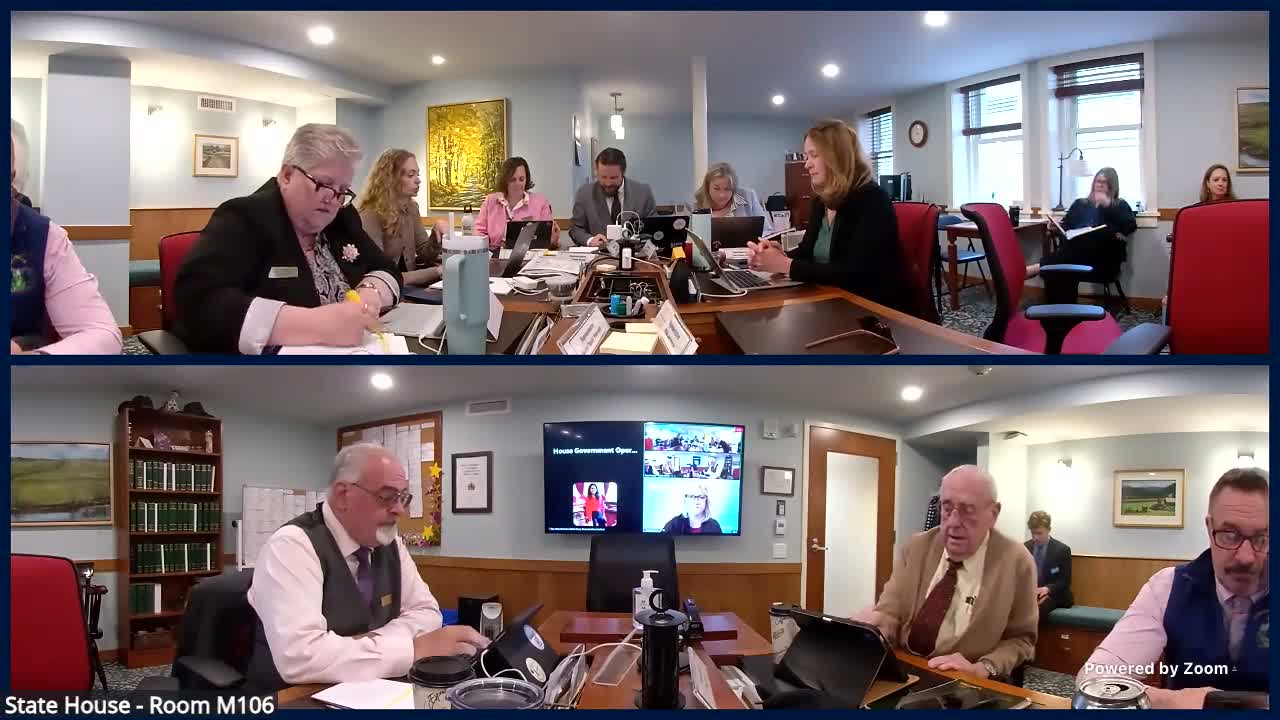
MONTPELIER — Supporters of Senate Bill 64 told the Government Operations & Military Affairs committee on May 7 that the proposal to expand optometrists’ scope of practice would improve access to care in Vermont while including strict training and oversight requirements.
Kelsey George, a senior policy specialist with the National Conference of State Legislatures, briefed the committee on how states regulate optometrists and the variation in licensure and scope-of-practice rules. George said many states require the National Board of Examiners in Optometry exams and that continuing-education and supervised clinical-hour requirements vary widely; she cited examples ranging from about 10 to 1,000 supervised hours identified in statutes or administrative rules. “NCSL staff like myself are nonpartisan, and we do not take position for or against any state policy,” George told the committee as she reviewed maps showing which states allow laser privileges, injections and expanded prescriptive authority.
George said Senate Bill 64 would allow optometrists to prescribe or administer certain hydrocodone-combination medications for up to 72 hours with no refills, a limit similar to rules in some other states. She also described variations across states in injection authority — some states limit optometrists to epinephrine for anaphylaxis while others authorize broader injections — and noted existing Vermont statute already authorizes optometrists to administer epinephrine.
Tina Keshava, an optometrist from Rutland and president of the Vermont Optometric Association, urged lawmakers to pass the bill to reduce wait times and travel for patients who now must see ophthalmologists for some laser procedures. Keshava described cases in which patients traveled 45 minutes or more for referral appointments and said workforce studies project a growing shortfall of ophthalmologists: “If optometrists are able to work to their full training, it will save the ophthalmologist chair time for more complex needs,” she said. Keshava added the advanced license in SB 64 would include additional training, board exams, proctored procedures, preceptorships and adverse-event reporting, and would require more continuing education than standard licensure.
Supporters cited research they said shows low complication and malpractice rates after scope expansions in other states. Keshava referenced studies (including a 2024 study she summarized) that she said found very low negative outcomes after optometrists performed laser procedures and that malpractice rates did not increase in recent analyses.
Committee members pressed witnesses on several implementation concerns. One member asked whether optometry schools uniformly provide hands-on training in laser and surgical procedures; George said NCSL’s review covered state laws and rules rather than school curricula and recommended the Association of Schools and Colleges of Optometry for program-level details. Another member raised malpractice and accountability questions; George said NCSL staff could provide additional, state-by-state malpractice information.
Members also asked how the bill’s eyelid-laceration language would work in practice. The bill as discussed limits optometrists to treating lacerations that are no larger than 2.5 centimeters, not deeper than the orbicularis muscle, and not involving the eyelid margin or lacrimal drainage structures; committee members and gallery speakers noted patients will not be measuring wounds in the moment and urged careful drafting and triage guidance.
Several gallery speakers and witnesses emphasized that trained optometrists already handle many routine emergency eye presentations and that clinicians who feel a case is beyond their competency should refer to ophthalmology. “If an optometrist doesn’t feel comfortable with the length or depth, they’re not going to do it,” a gallery speaker told the committee, adding that avoiding emergency-room visits can reduce costs.
The committee paused to take a break and moved next to a planned discussion on a Williston charter change.
What’s next: The committee did not take a formal vote during the hearing. Witnesses offered to provide additional materials and research to the committee, and members asked staff to review bill language and practical triage questions before further consideration.
Kelsey George, a senior policy specialist with the National Conference of State Legislatures, briefed the committee on how states regulate optometrists and the variation in licensure and scope-of-practice rules. George said many states require the National Board of Examiners in Optometry exams and that continuing-education and supervised clinical-hour requirements vary widely; she cited examples ranging from about 10 to 1,000 supervised hours identified in statutes or administrative rules. “NCSL staff like myself are nonpartisan, and we do not take position for or against any state policy,” George told the committee as she reviewed maps showing which states allow laser privileges, injections and expanded prescriptive authority.
George said Senate Bill 64 would allow optometrists to prescribe or administer certain hydrocodone-combination medications for up to 72 hours with no refills, a limit similar to rules in some other states. She also described variations across states in injection authority — some states limit optometrists to epinephrine for anaphylaxis while others authorize broader injections — and noted existing Vermont statute already authorizes optometrists to administer epinephrine.
Tina Keshava, an optometrist from Rutland and president of the Vermont Optometric Association, urged lawmakers to pass the bill to reduce wait times and travel for patients who now must see ophthalmologists for some laser procedures. Keshava described cases in which patients traveled 45 minutes or more for referral appointments and said workforce studies project a growing shortfall of ophthalmologists: “If optometrists are able to work to their full training, it will save the ophthalmologist chair time for more complex needs,” she said. Keshava added the advanced license in SB 64 would include additional training, board exams, proctored procedures, preceptorships and adverse-event reporting, and would require more continuing education than standard licensure.
Supporters cited research they said shows low complication and malpractice rates after scope expansions in other states. Keshava referenced studies (including a 2024 study she summarized) that she said found very low negative outcomes after optometrists performed laser procedures and that malpractice rates did not increase in recent analyses.
Committee members pressed witnesses on several implementation concerns. One member asked whether optometry schools uniformly provide hands-on training in laser and surgical procedures; George said NCSL’s review covered state laws and rules rather than school curricula and recommended the Association of Schools and Colleges of Optometry for program-level details. Another member raised malpractice and accountability questions; George said NCSL staff could provide additional, state-by-state malpractice information.
Members also asked how the bill’s eyelid-laceration language would work in practice. The bill as discussed limits optometrists to treating lacerations that are no larger than 2.5 centimeters, not deeper than the orbicularis muscle, and not involving the eyelid margin or lacrimal drainage structures; committee members and gallery speakers noted patients will not be measuring wounds in the moment and urged careful drafting and triage guidance.
Several gallery speakers and witnesses emphasized that trained optometrists already handle many routine emergency eye presentations and that clinicians who feel a case is beyond their competency should refer to ophthalmology. “If an optometrist doesn’t feel comfortable with the length or depth, they’re not going to do it,” a gallery speaker told the committee, adding that avoiding emergency-room visits can reduce costs.
The committee paused to take a break and moved next to a planned discussion on a Williston charter change.
What’s next: The committee did not take a formal vote during the hearing. Witnesses offered to provide additional materials and research to the committee, and members asked staff to review bill language and practical triage questions before further consideration.
View the Full Meeting & All Its Details
This article offers just a summary. Unlock complete video, transcripts, and insights as a Founder Member.
✓
Watch full, unedited meeting videos
✓
Search every word spoken in unlimited transcripts
✓
AI summaries & real-time alerts (all government levels)
✓
Permanent access to expanding government content
30-day money-back guarantee
