Chair Lalonde moves to find Greer amendment limiting 287(g) agreements not germane
May 07, 2026 | Judiciary, HOUSE OF REPRESENTATIVES, Committees, Legislative , Vermont
This article was created by AI summarizing key points discussed. AI makes mistakes, so for full details and context, please refer to the video of the full meeting. Please report any errors so we can fix them. Report an error »
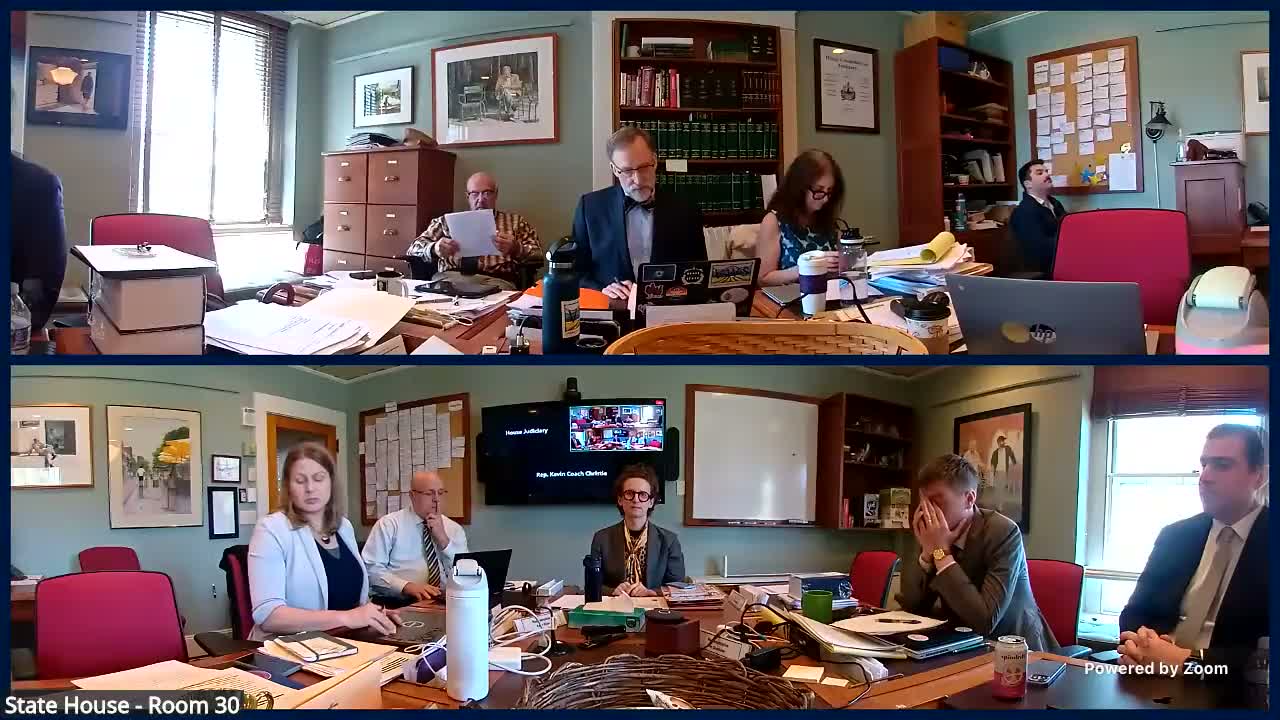
On May 7, during a meeting of the House Judiciary Committee, Representative Greer introduced an amendment to bar public agencies and their officers from entering into 287(g) agreements with the Department of Homeland Security, and Chair Lalonde moved to find the amendment not germane to the underlying bill.
Greer described the amendment as largely language cleanup on the first two pages and said that ‘‘on page 3, subsection b, we strike out language’’ that allowed the governor to authorize a law-enforcement agency ‘‘to enter into a 287(g) agreement.’’ Greer repeated the statutory reference, saying the draft retains language that agencies ‘‘shall enter into an agreement pursuant to section 287(g) of the Immigration and Nationality Act.’’ Greer also cited materials from DHS and an ACLU report, saying those sources informed the sponsor’s conclusion that 287(g) agreements ‘‘are not good for our communities and not good for best law enforcement practices.’’
A committee member objected on procedural grounds, saying, ‘‘this is not germane to the bill that we're working on,’’ and said they could not support a non-germane amendment in committee. Greer disputed that assessment and argued the amendment was connected to discussion of ‘‘sensitive locations’’ and to the potential for DHS access to state law-enforcement data, which Greer said could put Vermonters at risk.
Greer explained how 287(g) arrangements typically work in practice: ‘‘what they're doing is entering into a contract with DHS. And part of that contractual agreement is that they can access databases that these law enforcement agencies have, and that data is pretty much given to them to do that.’’ Greer cited the example of Los Angeles County, which Greer said had participated in a 287(g) program and later opted out amid controversy over the use of information in local databases.
Other members raised related concerns about data reciprocity across states and the practical implications of withdrawing from multi-jurisdictional data-sharing arrangements. Chair Lalonde warned that removing the governor’s authority would raise separation-of-powers and implementation questions and said the floor might not be the appropriate place for such an amendment at this stage of the session.
Chair Lalonde then called for a motion to find the amendment (draft 1.3) unfavorable on germaneness grounds and asked members to raise their hands for a straw poll. The transcript records the chair counting raised hands and announcing a straw poll but does not record a formal roll-call or an official tally for a binding committee vote.
The committee adjourned after the discussion; the chair said members would be notified if further testimony or a meeting on related bills (including S.193) was required.
Sources: committee transcript, May 7.
Greer described the amendment as largely language cleanup on the first two pages and said that ‘‘on page 3, subsection b, we strike out language’’ that allowed the governor to authorize a law-enforcement agency ‘‘to enter into a 287(g) agreement.’’ Greer repeated the statutory reference, saying the draft retains language that agencies ‘‘shall enter into an agreement pursuant to section 287(g) of the Immigration and Nationality Act.’’ Greer also cited materials from DHS and an ACLU report, saying those sources informed the sponsor’s conclusion that 287(g) agreements ‘‘are not good for our communities and not good for best law enforcement practices.’’
A committee member objected on procedural grounds, saying, ‘‘this is not germane to the bill that we're working on,’’ and said they could not support a non-germane amendment in committee. Greer disputed that assessment and argued the amendment was connected to discussion of ‘‘sensitive locations’’ and to the potential for DHS access to state law-enforcement data, which Greer said could put Vermonters at risk.
Greer explained how 287(g) arrangements typically work in practice: ‘‘what they're doing is entering into a contract with DHS. And part of that contractual agreement is that they can access databases that these law enforcement agencies have, and that data is pretty much given to them to do that.’’ Greer cited the example of Los Angeles County, which Greer said had participated in a 287(g) program and later opted out amid controversy over the use of information in local databases.
Other members raised related concerns about data reciprocity across states and the practical implications of withdrawing from multi-jurisdictional data-sharing arrangements. Chair Lalonde warned that removing the governor’s authority would raise separation-of-powers and implementation questions and said the floor might not be the appropriate place for such an amendment at this stage of the session.
Chair Lalonde then called for a motion to find the amendment (draft 1.3) unfavorable on germaneness grounds and asked members to raise their hands for a straw poll. The transcript records the chair counting raised hands and announcing a straw poll but does not record a formal roll-call or an official tally for a binding committee vote.
The committee adjourned after the discussion; the chair said members would be notified if further testimony or a meeting on related bills (including S.193) was required.
Sources: committee transcript, May 7.
Don't Miss a Word: See the Full Meeting!
Go beyond summaries. Unlock every video, transcript, and key insight with a Founder Membership.
✓
Get instant access to full meeting videos
✓
Search and clip any phrase from complete transcripts
✓
Receive AI-powered summaries & custom alerts
✓
Enjoy lifetime, unrestricted access to government data
30-day money-back guarantee
