Senate Finance advances H.657, an omnibus health and welfare bill including unaccompanied‑youth certificate and SSI handling changes
May 07, 2026 | Finance, SENATE, Committees, Legislative , Vermont
This article was created by AI summarizing key points discussed. AI makes mistakes, so for full details and context, please refer to the video of the full meeting. Please report any errors so we can fix them. Report an error »
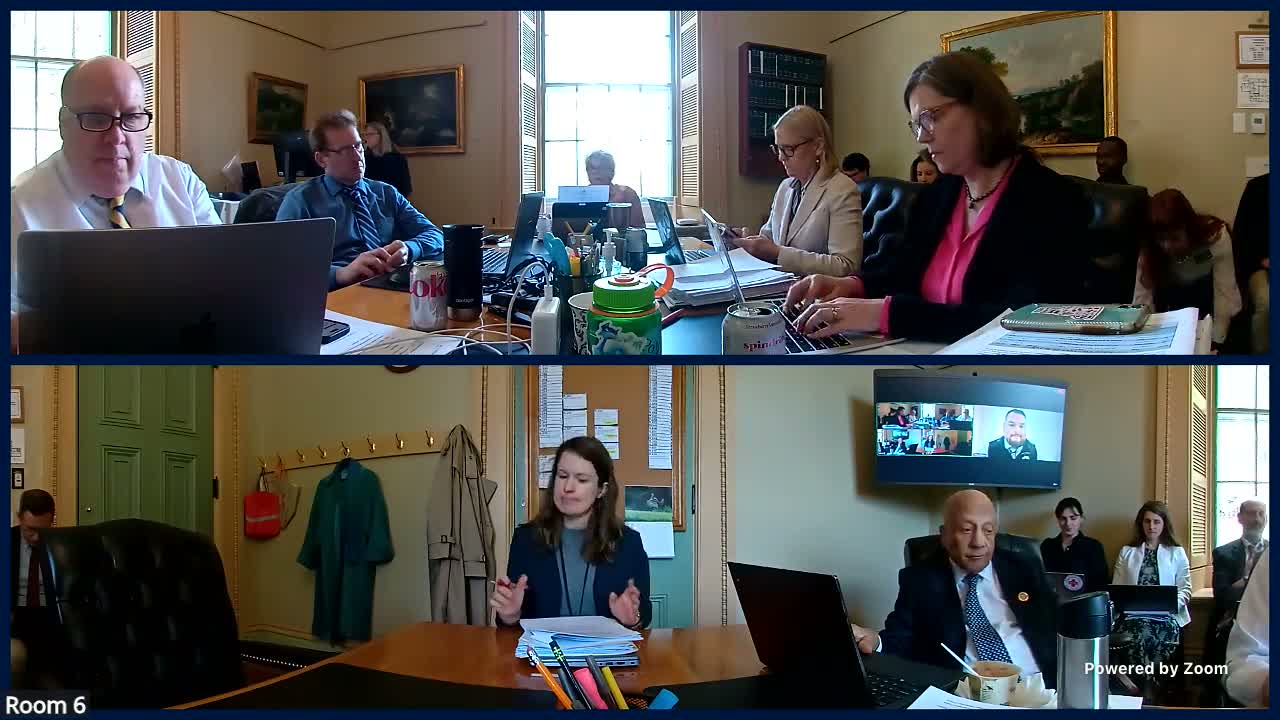
The Senate Finance Committee on May 7 voted to pass the Health & Welfare committee report for H.657 and send the bill favorably to the full Senate after hearing a summary of its provisions and fiscal flags.
Katie (presenter) told the committee that H.657 is an omnibus health and welfare bill that removes an asset limit for the Reach Up program, creates an unaccompanied‑youth certificate intended to let certain 16–17‑year‑old youth obtain identification and services without parental consent, and includes provisions addressing seclusion, restraint, and related reporting and a working group to study implementation.
The unaccompanied‑youth certificate, as presented, would allow certified youth to obtain certain documents or services at no charge — including certified vital records, a non‑driver identification card or an operator privilege card, learner’s permit exam waivers in some cases, and other fee exemptions described in the bill text. The presenter listed the categories of entities that may certify a youth (school district homeless liaisons, emergency‑shelter directors, court‑designee personnel, and other designees), and noted multiple conforming statutory sections that would be amended to effect the waivers.
Committee members raised a separate but related concern about how H.657 would change the treatment of Social Security (SSI) benefits for children in Department for Children and Families (DCF) custody. One member summarized the change as directing SSI benefits into a trust for the child rather than having the state retain part of those funds to offset foster‑care costs. Several senators warned that if the state stops retaining those funds, the department charged with those costs would need a backfill appropriation; fiscal staff and committee members called that an appropriations issue that could create a budgetary hole for the affected department.
Matthew Bernstein, Child, Youth and Family Advocate for the State of Vermont, joined by Zoom and addressed a Department of Mental Health memo on contracting. Bernstein clarified that the restraint and seclusion sections in H.657 apply to facilities where children in DCF custody are placed and to facilities licensed and regulated by DCF; he distinguished psychiatric residential treatment facilities that are not licensed by DCF and therefore outside some of the bill’s direct regulatory scope. Bernstein said the bill’s safeguards are intended as essential protections for children placed in in‑state DCF facilities.
Fiscal staff reiterated that possible contract changes flagged by the Department of Mental Health could change how the state procures some placements and thereby influence contract terms and costs; staff included that as a fiscal‑note flag that warrants appropriations review. The committee recorded a motion to pass the Senate Health and Welfare committee report on H.657 and conducted a roll call; the transcript records affirmative responses and moves to recess afterward.
Next steps: the committee reported H.657 favorably to the full Senate; members signaled follow‑up on budgetary implications for SSI and contracting practices as the bill moves forward.
Katie (presenter) told the committee that H.657 is an omnibus health and welfare bill that removes an asset limit for the Reach Up program, creates an unaccompanied‑youth certificate intended to let certain 16–17‑year‑old youth obtain identification and services without parental consent, and includes provisions addressing seclusion, restraint, and related reporting and a working group to study implementation.
The unaccompanied‑youth certificate, as presented, would allow certified youth to obtain certain documents or services at no charge — including certified vital records, a non‑driver identification card or an operator privilege card, learner’s permit exam waivers in some cases, and other fee exemptions described in the bill text. The presenter listed the categories of entities that may certify a youth (school district homeless liaisons, emergency‑shelter directors, court‑designee personnel, and other designees), and noted multiple conforming statutory sections that would be amended to effect the waivers.
Committee members raised a separate but related concern about how H.657 would change the treatment of Social Security (SSI) benefits for children in Department for Children and Families (DCF) custody. One member summarized the change as directing SSI benefits into a trust for the child rather than having the state retain part of those funds to offset foster‑care costs. Several senators warned that if the state stops retaining those funds, the department charged with those costs would need a backfill appropriation; fiscal staff and committee members called that an appropriations issue that could create a budgetary hole for the affected department.
Matthew Bernstein, Child, Youth and Family Advocate for the State of Vermont, joined by Zoom and addressed a Department of Mental Health memo on contracting. Bernstein clarified that the restraint and seclusion sections in H.657 apply to facilities where children in DCF custody are placed and to facilities licensed and regulated by DCF; he distinguished psychiatric residential treatment facilities that are not licensed by DCF and therefore outside some of the bill’s direct regulatory scope. Bernstein said the bill’s safeguards are intended as essential protections for children placed in in‑state DCF facilities.
Fiscal staff reiterated that possible contract changes flagged by the Department of Mental Health could change how the state procures some placements and thereby influence contract terms and costs; staff included that as a fiscal‑note flag that warrants appropriations review. The committee recorded a motion to pass the Senate Health and Welfare committee report on H.657 and conducted a roll call; the transcript records affirmative responses and moves to recess afterward.
Next steps: the committee reported H.657 favorably to the full Senate; members signaled follow‑up on budgetary implications for SSI and contracting practices as the bill moves forward.
Don't Miss a Word: See the Full Meeting!
Go beyond summaries. Unlock every video, transcript, and key insight with a Founder Membership.
✓
Get instant access to full meeting videos
✓
Search and clip any phrase from complete transcripts
✓
Receive AI-powered summaries & custom alerts
✓
Enjoy lifetime, unrestricted access to government data
30-day money-back guarantee
