Council approves Twin Hollow rezoning, clearing way for 63‑lot PRC plan and permanent trail dedication
May 07, 2026 | Mapleton City Planning Commission, Mapleton, Utah County, Utah
This article was created by AI summarizing key points discussed. AI makes mistakes, so for full details and context, please refer to the video of the full meeting. Please report any errors so we can fix them. Report an error »
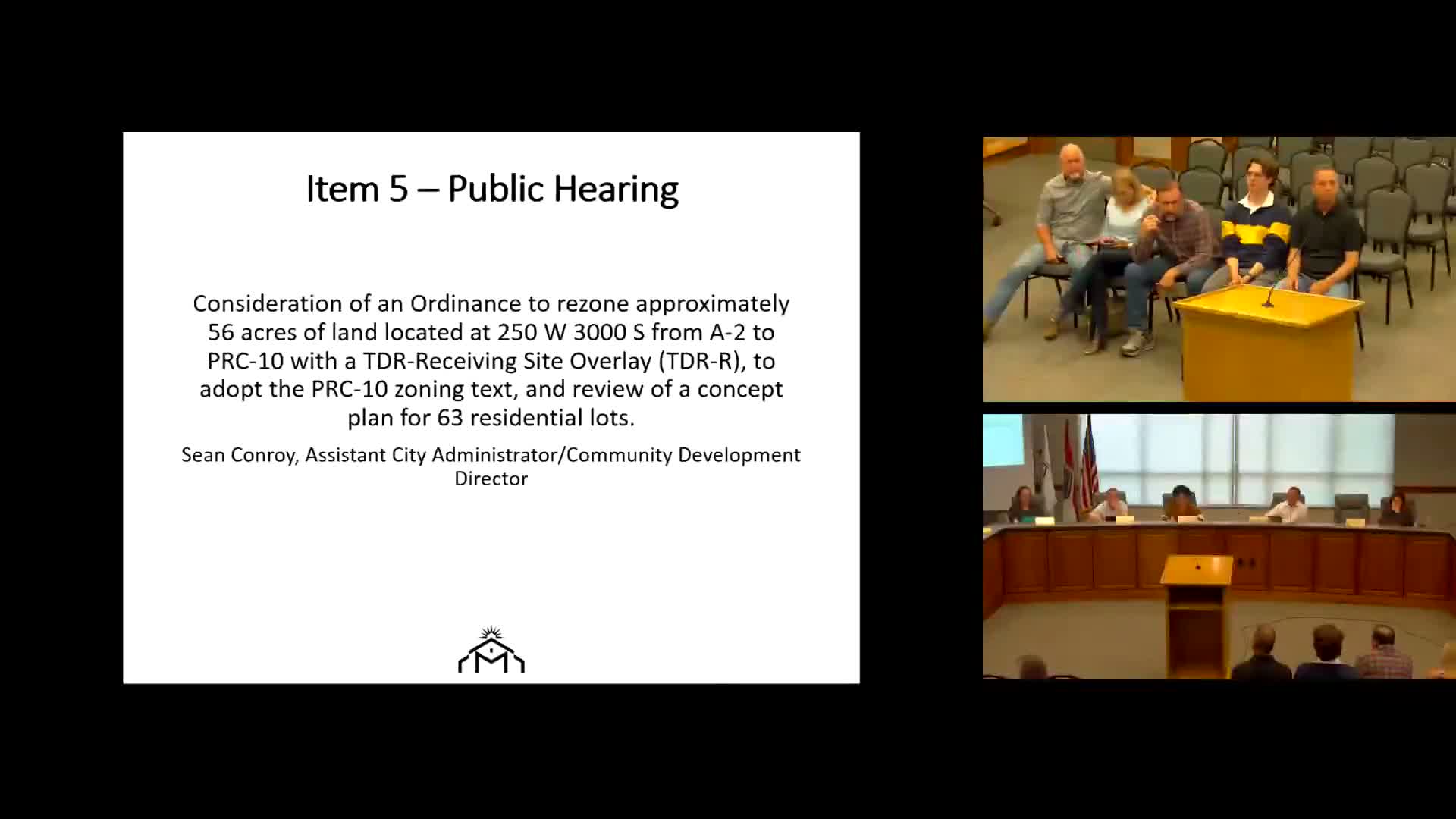
Mapleton's council voted to rezone about 56 acres of land north of Mapleton Village to a PRC‑10 zone and approve a concept plan for 63 residential lots, accepting a developer offer to dedicate roughly 4.8 acres that contains the Parkway Trail to the city.
The rezoning, proposed by developer Mike Clowk and property owners including the Allen family and Twin Hollow LLC, uses about 20 transferable development rights (TDRs) to increase density on the site. County‑style findings staff described to the council included consistency with portions of the general plan, conformance with the TDR ordinance and mitigation through open‑space clustering. Staff noted the base buildable yield under the current general plan would be about 43 lots and the applicant is asking to be approved for 63 lots by using the TDR bonus.
Why it mattered: The applicant pledged permanent public access to the city’s Parkway Trail corridor and maintenance of key open‑space buffers, which staff and several council members cited as a public benefit. Opponents countered that the rezoning departs from prior plan expectations, would increase traffic on narrow neighborhood roads and raised questions about geotechnical issues in nearby lots.
What speakers said: Developer Mike Clowk described the plan as a ‘‘logical extension’’ of existing receiving sites and framed the 4.8‑acre trail dedication and oak‑stand protections as public benefits. Resident Julie Whitaker told council members the process felt ‘‘predetermined’’ and accused the developer of exercising undue influence, saying the plan was ‘‘greed and negligence’’ if approved without more accountability. Council members referenced the general‑plan goals, the required multiple‑access rule for subdivisions above 30 lots, and state housing mandates that constrain local discretion.
Vote and next steps: Council member Lake moved to approve the rezone to PRC‑10 with a TDR receiving‑site overlay, to adopt the PRC‑10 zoning text, and to accept the concept plan for 63 lots. The motion passed on a council voice vote and was announced as approved. Staff and the developer will return with subdivision and engineering details, traffic analysis follow‑up and any required development agreements before building permits are issued.
Context and constraints: Staff reminded the council that the zoning change is legislative and that final lot construction is subject to subdivision review, multiple access requirements, applicable engineering standards, and the city’s TDR and subdivision ordinances. Several council members noted state legislative actions on housing and roadway standards that affect how cities can manage density.
The council moved on to the next agenda item after approving the rezoning; no building permits will be issued until subsequent subdivision approvals and infrastructure conditions are satisfied.
The rezoning, proposed by developer Mike Clowk and property owners including the Allen family and Twin Hollow LLC, uses about 20 transferable development rights (TDRs) to increase density on the site. County‑style findings staff described to the council included consistency with portions of the general plan, conformance with the TDR ordinance and mitigation through open‑space clustering. Staff noted the base buildable yield under the current general plan would be about 43 lots and the applicant is asking to be approved for 63 lots by using the TDR bonus.
Why it mattered: The applicant pledged permanent public access to the city’s Parkway Trail corridor and maintenance of key open‑space buffers, which staff and several council members cited as a public benefit. Opponents countered that the rezoning departs from prior plan expectations, would increase traffic on narrow neighborhood roads and raised questions about geotechnical issues in nearby lots.
What speakers said: Developer Mike Clowk described the plan as a ‘‘logical extension’’ of existing receiving sites and framed the 4.8‑acre trail dedication and oak‑stand protections as public benefits. Resident Julie Whitaker told council members the process felt ‘‘predetermined’’ and accused the developer of exercising undue influence, saying the plan was ‘‘greed and negligence’’ if approved without more accountability. Council members referenced the general‑plan goals, the required multiple‑access rule for subdivisions above 30 lots, and state housing mandates that constrain local discretion.
Vote and next steps: Council member Lake moved to approve the rezone to PRC‑10 with a TDR receiving‑site overlay, to adopt the PRC‑10 zoning text, and to accept the concept plan for 63 lots. The motion passed on a council voice vote and was announced as approved. Staff and the developer will return with subdivision and engineering details, traffic analysis follow‑up and any required development agreements before building permits are issued.
Context and constraints: Staff reminded the council that the zoning change is legislative and that final lot construction is subject to subdivision review, multiple access requirements, applicable engineering standards, and the city’s TDR and subdivision ordinances. Several council members noted state legislative actions on housing and roadway standards that affect how cities can manage density.
The council moved on to the next agenda item after approving the rezoning; no building permits will be issued until subsequent subdivision approvals and infrastructure conditions are satisfied.
Don't Miss a Word: See the Full Meeting!
Go beyond summaries. Unlock every video, transcript, and key insight with a Founder Membership.
✓
Get instant access to full meeting videos
✓
Search and clip any phrase from complete transcripts
✓
Receive AI-powered summaries & custom alerts
✓
Enjoy lifetime, unrestricted access to government data
30-day money-back guarantee
