Planning board reviews package of zoning edits to clean up ordinance, adjust parking and require sidewalks
May 07, 2026 | Franklin Park, Somerset County, New Jersey
This article was created by AI summarizing key points discussed. AI makes mistakes, so for full details and context, please refer to the video of the full meeting. Please report any errors so we can fix them. Report an error »
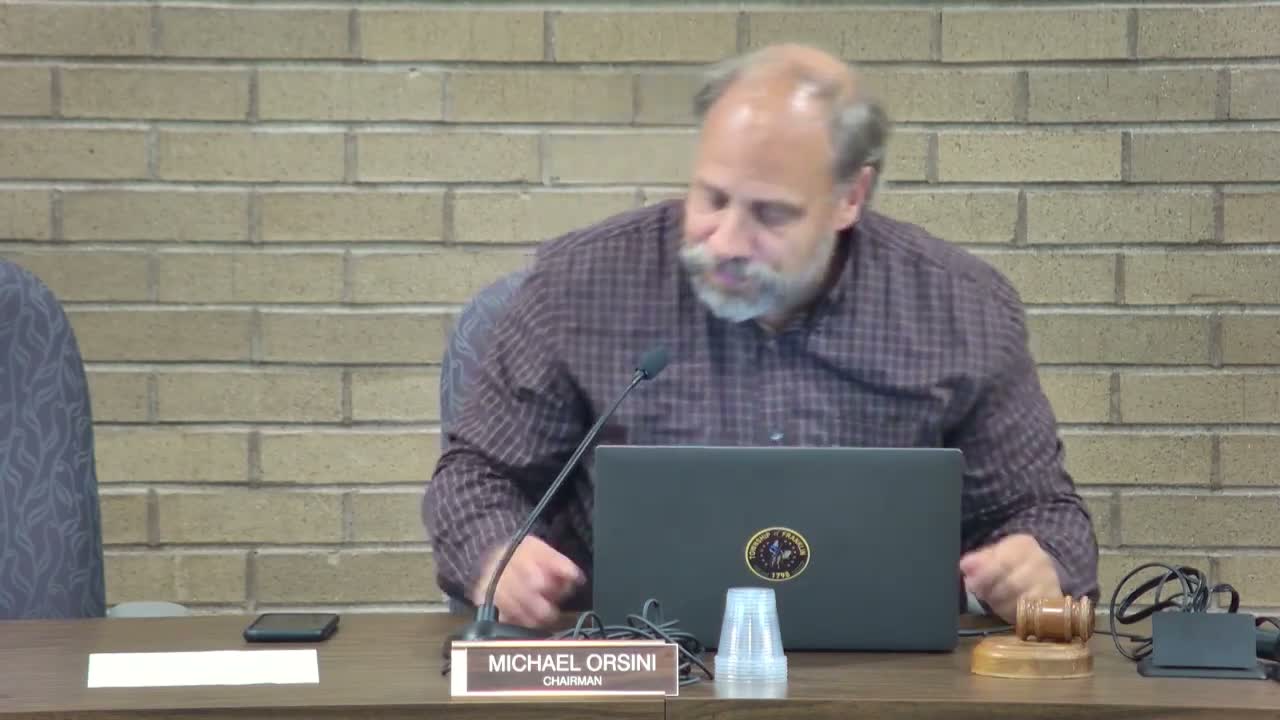
Franklin Township planning staff presented a package of ordinance amendments the board described as mostly editorial and targeted at higher‑priority, lower‑controversy changes.
Staff member Mark said the edits remove certain intensive uses (examples cited: golf courses, hospitals) from single‑family residential permitting where such uses no longer make sense, while preserving existing, location‑specific uses so they do not become nonconforming. He also proposed moving certain design standards out of the conditional‑use section and into supplemental zoning requirements to reduce confusion.
On group homes and community residences, staff reminded the board that the municipal land use law requires towns to permit specified categories of group homes and that local provisions (such as five‑acre minima) must be removed or adjusted to align the ordinance with state law. “We have to permit them… just as we permit single family homes,” Mark said.
Among substantive changes discussed: revising parking for houses of worship and other assembly uses that lack fixed seating. The draft would replace a square‑foot‑based parking standard (1 space per 15 sq ft) with a people‑based standard (1 space per 3 persons of permissible occupancy under the building code), which staff said brings the ordinance in line with typical practice and avoids excessively high parking requirements.
Staff also proposed consolidating duplicate definitions for indoor recreation and allowing indoor recreation in larger shopping centers (over 25,000 square feet) to support uses such as roller rinks, climbing facilities and pools. Mark said the change aims to keep retail centers active and make efficient use of existing parking.
Sidewalks were a major topic: the draft would require plans for site‑plan or subdivision approval to propose sidewalks along all road frontages, public or private, while giving the board discretion to grant relief for unique safety or site constraints. Where relief is granted, applicants would be required to make an in‑lieu contribution to a township capital fund dedicated to constructing sidewalks along public roadways. Board members discussed clarifying language to ensure private roads are not designated the responsibility of township construction and emphasized that exceptions for public safety and impervious‑coverage trade‑offs would remain available.
Board members repeatedly characterized the package as an opportunity to adopt straightforward corrections and to return later with more substantive items. No formal ordinance vote was taken; staff will return with draft ordinance language in a future meeting.
Staff member Mark said the edits remove certain intensive uses (examples cited: golf courses, hospitals) from single‑family residential permitting where such uses no longer make sense, while preserving existing, location‑specific uses so they do not become nonconforming. He also proposed moving certain design standards out of the conditional‑use section and into supplemental zoning requirements to reduce confusion.
On group homes and community residences, staff reminded the board that the municipal land use law requires towns to permit specified categories of group homes and that local provisions (such as five‑acre minima) must be removed or adjusted to align the ordinance with state law. “We have to permit them… just as we permit single family homes,” Mark said.
Among substantive changes discussed: revising parking for houses of worship and other assembly uses that lack fixed seating. The draft would replace a square‑foot‑based parking standard (1 space per 15 sq ft) with a people‑based standard (1 space per 3 persons of permissible occupancy under the building code), which staff said brings the ordinance in line with typical practice and avoids excessively high parking requirements.
Staff also proposed consolidating duplicate definitions for indoor recreation and allowing indoor recreation in larger shopping centers (over 25,000 square feet) to support uses such as roller rinks, climbing facilities and pools. Mark said the change aims to keep retail centers active and make efficient use of existing parking.
Sidewalks were a major topic: the draft would require plans for site‑plan or subdivision approval to propose sidewalks along all road frontages, public or private, while giving the board discretion to grant relief for unique safety or site constraints. Where relief is granted, applicants would be required to make an in‑lieu contribution to a township capital fund dedicated to constructing sidewalks along public roadways. Board members discussed clarifying language to ensure private roads are not designated the responsibility of township construction and emphasized that exceptions for public safety and impervious‑coverage trade‑offs would remain available.
Board members repeatedly characterized the package as an opportunity to adopt straightforward corrections and to return later with more substantive items. No formal ordinance vote was taken; staff will return with draft ordinance language in a future meeting.
View the Full Meeting & All Its Details
This article offers just a summary. Unlock complete video, transcripts, and insights as a Founder Member.
✓
Watch full, unedited meeting videos
✓
Search every word spoken in unlimited transcripts
✓
AI summaries & real-time alerts (all government levels)
✓
Permanent access to expanding government content
30-day money-back guarantee
