Experts tell committee Legislature can set guardrails on school employee health bargaining
May 07, 2026 | Health Care, HOUSE OF REPRESENTATIVES, Committees, Legislative , Vermont
This article was created by AI summarizing key points discussed. AI makes mistakes, so for full details and context, please refer to the video of the full meeting. Please report any errors so we can fix them. Report an error »
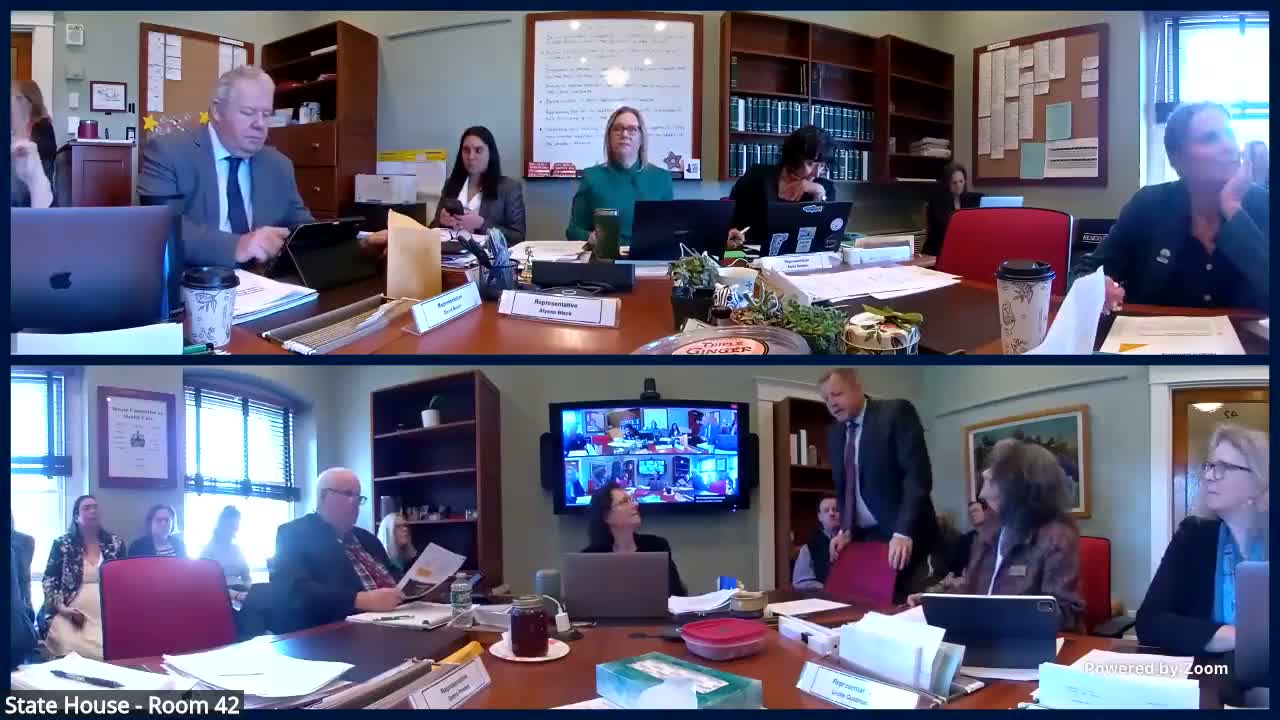
Witnesses before a legislative committee said the Legislature has the authority to impose statutory guardrails on statewide school‑employee health bargaining and that doing so would change how future negotiations proceed.
Sophie Sedatny of the Office of Legislative Council outlined the commission created by Act 11 (2018), explaining that the law removed certain health‑benefit subjects from local bargaining and established a statewide process that sets cost‑sharing, eligibility and contract terms. "The commission is made up of 10 members..." Sedatny said, describing the commission’s composition and its fact‑finding and arbitration timeline.
The panel discussed how the statutory language would guide negotiators. Committee members asked whether references to "health care benefits" include plan design as well as cost. Sedatny answered that statutory parameters are accounted for in impact bargaining and that procedures — including fact‑finding and last‑best‑offer arbitration — are designed to push parties toward agreement. "Last best offer is a mechanism that's used to get the parties to figure out what is most important to them," she said.
Guy Samson, Commissioner at DFR, placed an actuarial figure on induced utilization: when plans are normalized for age and other factors, "there is a difference of about $70 per member per month," or roughly an 8 percent difference in claims per member per month, he said. That estimate was discussed as a measurable factor for comparing plan generosity across groups.
Attorney Joe McNeal told the committee the bill before it "is both, legal, very clearly legal," arguing that the Legislature routinely establishes statutory standards that affect collective bargaining. "This particular measure expanded the opportunity for both paid and unpaid leave... This decision would be made in order to limit the extraordinary growth of the dollars that Vermont school districts and Vermont taxpayers are paying for health insurance," McNeal said, describing how prior statutes altered bargaining practice.
Not all testimony endorsed every provision. Sue Cyglowski of the Vermont School Boards Association said VSBA "supports draft 1.1," praising the bill’s new section on cost containment and its requirement that participating employees "shall bear first dollar responsibility." She argued the change would help address health benefits as a driver of property taxes.
Adam Norton of the Vermont State Employees Association urged inclusion of state employee plans in pilots or expansions and warned of cost‑shifting: "Our premiums have increased 63% in the last 5 years," he said, and higher employee contributions can prompt wage adjustments that offset savings.
The committee did not vote on the measure. Members asked witnesses to submit written memos and to meet offline with counsel and the Green Mountain Care Board to resolve technical and compliance questions. The hearing resumed the following day for further markup and additional witnesses.
Sophie Sedatny of the Office of Legislative Council outlined the commission created by Act 11 (2018), explaining that the law removed certain health‑benefit subjects from local bargaining and established a statewide process that sets cost‑sharing, eligibility and contract terms. "The commission is made up of 10 members..." Sedatny said, describing the commission’s composition and its fact‑finding and arbitration timeline.
The panel discussed how the statutory language would guide negotiators. Committee members asked whether references to "health care benefits" include plan design as well as cost. Sedatny answered that statutory parameters are accounted for in impact bargaining and that procedures — including fact‑finding and last‑best‑offer arbitration — are designed to push parties toward agreement. "Last best offer is a mechanism that's used to get the parties to figure out what is most important to them," she said.
Guy Samson, Commissioner at DFR, placed an actuarial figure on induced utilization: when plans are normalized for age and other factors, "there is a difference of about $70 per member per month," or roughly an 8 percent difference in claims per member per month, he said. That estimate was discussed as a measurable factor for comparing plan generosity across groups.
Attorney Joe McNeal told the committee the bill before it "is both, legal, very clearly legal," arguing that the Legislature routinely establishes statutory standards that affect collective bargaining. "This particular measure expanded the opportunity for both paid and unpaid leave... This decision would be made in order to limit the extraordinary growth of the dollars that Vermont school districts and Vermont taxpayers are paying for health insurance," McNeal said, describing how prior statutes altered bargaining practice.
Not all testimony endorsed every provision. Sue Cyglowski of the Vermont School Boards Association said VSBA "supports draft 1.1," praising the bill’s new section on cost containment and its requirement that participating employees "shall bear first dollar responsibility." She argued the change would help address health benefits as a driver of property taxes.
Adam Norton of the Vermont State Employees Association urged inclusion of state employee plans in pilots or expansions and warned of cost‑shifting: "Our premiums have increased 63% in the last 5 years," he said, and higher employee contributions can prompt wage adjustments that offset savings.
The committee did not vote on the measure. Members asked witnesses to submit written memos and to meet offline with counsel and the Green Mountain Care Board to resolve technical and compliance questions. The hearing resumed the following day for further markup and additional witnesses.
View the Full Meeting & All Its Details
This article offers just a summary. Unlock complete video, transcripts, and insights as a Founder Member.
✓
Watch full, unedited meeting videos
✓
Search every word spoken in unlimited transcripts
✓
AI summaries & real-time alerts (all government levels)
✓
Permanent access to expanding government content
30-day money-back guarantee
