Santa Rosa studies FY26–27 budget as staff warn of $13.8M structural shortfall
May 07, 2026 | Santa Rosa City, Sonoma County, California
This article was created by AI summarizing key points discussed. AI makes mistakes, so for full details and context, please refer to the video of the full meeting. Please report any errors so we can fix them. Report an error »
City staff presented the Santa Rosa City Council with a proposed FY 2026–27 budget and a set of difficult choices on Tuesday, saying long-term increases in payroll and benefits have produced a structural shortfall staff estimated at about $13.8 million that will require either new revenue or service reductions.
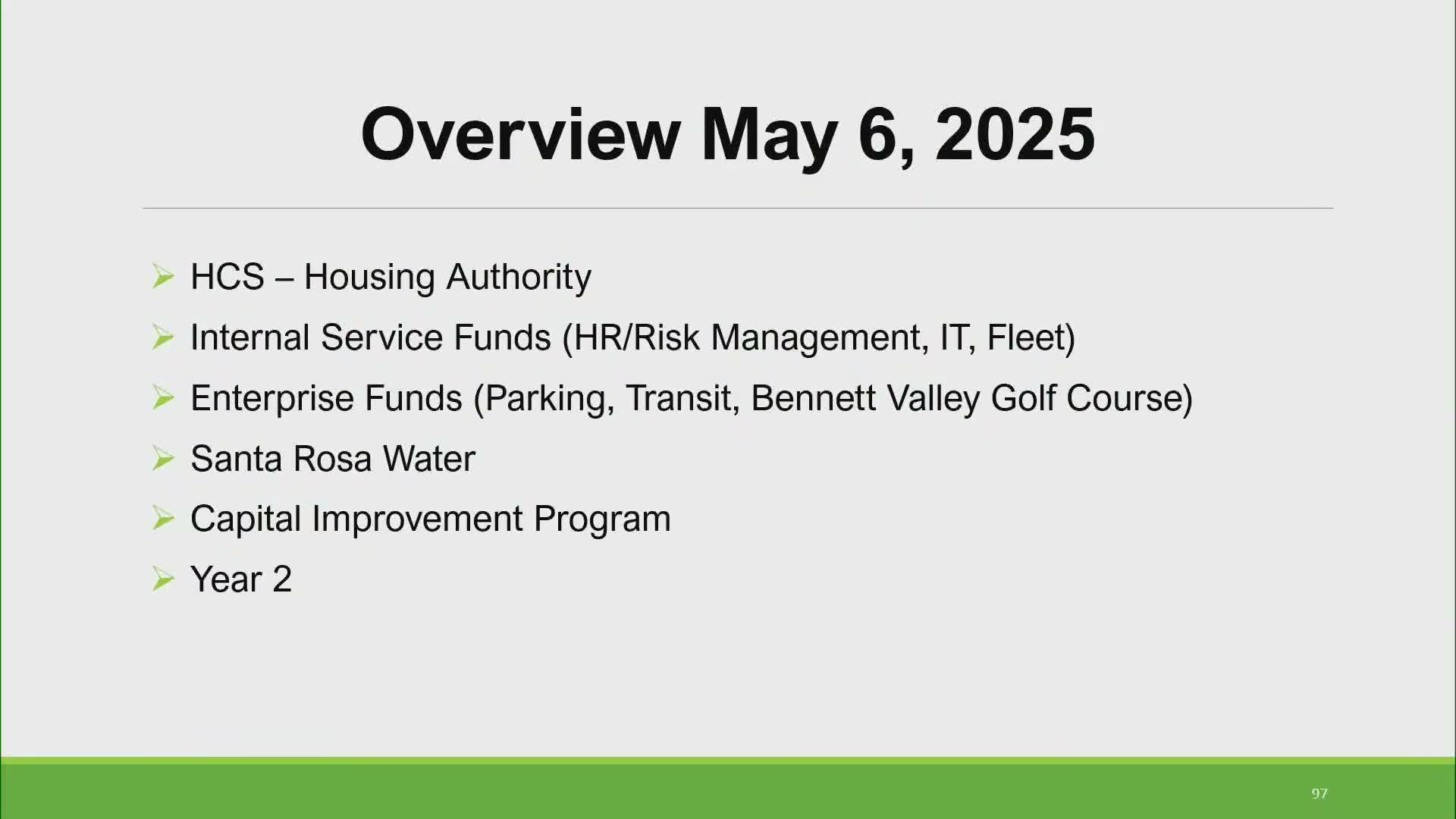
The presentation ranged across departments: the water utility reported higher costs tied to Sonoma Water and modest CIP increases, transit staff described short-term reserve needs and a push to replace aging buses with federal low- or zero-emission grants, and the capital improvement program (CIP) team laid out a slate of parks and street projects and options for reallocating quadrant funds.
Why it matters: The council must decide whether to pursue revenue measures, reallocate one-time funds or accept reductions in city programs. Staff warned that personnel and benefit costs comprise roughly 77% of the budget, and without revenue growth those fixed costs will force cuts affecting maintenance, recreation programs and some public-safety support functions.
Staff presentation and numbers
Jennifer (director, City of Santa Rosa utilities) summarized the utilities budget, saying water revenues are rising—largely from higher Sonoma Water costs—to about $3.7 million for the coming year and that the utilities plan includes a $156,000 allocation for stormwater repair and a $600,000 increase in CIP for wastewater projects. “Hemos oído el mensaje… la ciudad tendrá que tener la mejora de los ingresos,” staff said, noting the city projects some rate and cost pressures next year.
Transit and fleet
Transit staff said reserves for transit were expected to be about $8 million at fiscal year end if current assumptions hold, but they also estimated a near-term draw of about $1.3 million to operate through service and hiring gaps. The city has 58 bus operator positions with persistent vacancies; staff said federal grants could fund up to two-thirds of a fleet replacement if awarded, helping the city move to low- or zero-emission buses.
Streets, CIP and parks
Staff presented condition data showing about one-third of city streets in poor condition and an estimated $42 million needed to repave roughly 44 miles. The CIP overview showed roughly $23–33 million in currently funded projects and an approach to prioritize construction-ready projects while leaving some designated funds in place for projects that will not be ready this year. Staff proposed short-term borrowing across quadrant-designated funds to finish southeast projects now and repay the money later.
Council reaction and next steps
Councilmembers pressed staff for details on reserve levels, staffing plans and the timetable for major projects and asked how the city might balance investments in maintenance versus reconstruction. Several councilmembers urged tracking benefits to each district from quadrant funds and requested clearer breakdowns before any borrowing or reallocation decisions. Staff said the budget adoption timeline remains June for adoption of a recommended budget with additional sessions and a final adoption expected in July.
What did not happen
No formal vote or final action was taken in the study session; staff asked the council for direction and scheduled follow-up meetings and community engagement on several items, including a return visit on transit service proposals and a parks- and streets-prioritization discussion.
The council will consider staff recommendations and potential revenue measures at upcoming budget hearings, with adoption of the FY 2026–27 budget expected in June and additional work sessions in July to address revenue, CIP timing and service trade-offs.
The presentation ranged across departments: the water utility reported higher costs tied to Sonoma Water and modest CIP increases, transit staff described short-term reserve needs and a push to replace aging buses with federal low- or zero-emission grants, and the capital improvement program (CIP) team laid out a slate of parks and street projects and options for reallocating quadrant funds.
Why it matters: The council must decide whether to pursue revenue measures, reallocate one-time funds or accept reductions in city programs. Staff warned that personnel and benefit costs comprise roughly 77% of the budget, and without revenue growth those fixed costs will force cuts affecting maintenance, recreation programs and some public-safety support functions.
Staff presentation and numbers
Jennifer (director, City of Santa Rosa utilities) summarized the utilities budget, saying water revenues are rising—largely from higher Sonoma Water costs—to about $3.7 million for the coming year and that the utilities plan includes a $156,000 allocation for stormwater repair and a $600,000 increase in CIP for wastewater projects. “Hemos oído el mensaje… la ciudad tendrá que tener la mejora de los ingresos,” staff said, noting the city projects some rate and cost pressures next year.
Transit and fleet
Transit staff said reserves for transit were expected to be about $8 million at fiscal year end if current assumptions hold, but they also estimated a near-term draw of about $1.3 million to operate through service and hiring gaps. The city has 58 bus operator positions with persistent vacancies; staff said federal grants could fund up to two-thirds of a fleet replacement if awarded, helping the city move to low- or zero-emission buses.
Streets, CIP and parks
Staff presented condition data showing about one-third of city streets in poor condition and an estimated $42 million needed to repave roughly 44 miles. The CIP overview showed roughly $23–33 million in currently funded projects and an approach to prioritize construction-ready projects while leaving some designated funds in place for projects that will not be ready this year. Staff proposed short-term borrowing across quadrant-designated funds to finish southeast projects now and repay the money later.
Council reaction and next steps
Councilmembers pressed staff for details on reserve levels, staffing plans and the timetable for major projects and asked how the city might balance investments in maintenance versus reconstruction. Several councilmembers urged tracking benefits to each district from quadrant funds and requested clearer breakdowns before any borrowing or reallocation decisions. Staff said the budget adoption timeline remains June for adoption of a recommended budget with additional sessions and a final adoption expected in July.
What did not happen
No formal vote or final action was taken in the study session; staff asked the council for direction and scheduled follow-up meetings and community engagement on several items, including a return visit on transit service proposals and a parks- and streets-prioritization discussion.
The council will consider staff recommendations and potential revenue measures at upcoming budget hearings, with adoption of the FY 2026–27 budget expected in June and additional work sessions in July to address revenue, CIP timing and service trade-offs.
View the Full Meeting & All Its Details
This article offers just a summary. Unlock complete video, transcripts, and insights as a Founder Member.
✓
Watch full, unedited meeting videos
✓
Search every word spoken in unlimited transcripts
✓
AI summaries & real-time alerts (all government levels)
✓
Permanent access to expanding government content
30-day money-back guarantee
